Quick Facts
Grow in a warm, sunny sheltered location
Best in sharply drained or poor soils
Easy to grow and low maintenance
Drought resistant
Easy to make new plants from rosettes and cuttings
Some have exotic and colourful flowers
Container grown plants can be moved indoors for winter


Before you get started
Most hardy cacti and are grown in a similar way to houseplant types. So see our Growing guide below for houseplant cacti and succulents for much of the information you will need to grow a range of hardy cactic and succulent plants outdoors.
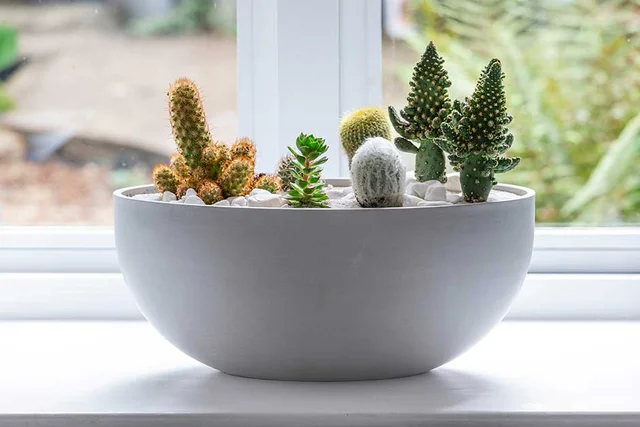
Continue reading for specific tips on overwintering hardy cacti and succulents outdoors and any problems you might encounter.
Further details on individual species growing guides can be found in RHS Find a Plant with a list of stockists.
You might try the British Cactus and Succulent Society for further advice on specific species and cultivars.
Ongoing Care
Overwintering
Getting your plants ready for the winter is vital for their survival. Here are a few notes specific to overwintering cacti and ;
- Some plants such as the Opuntia will benefit from a covering of reused or repurposed bubble wrap to keep out the winter wet as well as the cold
- Plants that are de-hydrated will be hardier. Allow pots and specimens to dry out slightly before you wrap them
- Wrap containers that cannot be brought inside, to help prevent the roots from freezing. Use hessian or reused/repurposed bubblewrap
- Plantings that are at the foot of a wall, by an airbrick or under the shelter of an eave will stand a greater chance of survival
- When using non-breathable plastic and bubble wrap, never wrap the plant too tight. Allow for some air circulation and always reuse or repurpose plastic
- Give the plant a good tidy up before wrapping; remove fallen leaves, debris and dead foliage. This helps to prevent decay
Problems
Pests
Mealybug occurs as white patches on stems and bronzed areas may indicate glasshouse red spider mite. Scale insects cause patching on stems and leaves.
Diseases
Cacti and suffer from rots such as Erwinia, fusarium and botrytis. These are caused by insufficient or excess water and cold temperature. Try to treat with a fungicide as soon as you see the infection and improve growing conditions. However, they can be difficult to control.
Poor cultivation
Overwatering will stunt growth and cause blistering due to oedema; prolonged overwatering with eventually lead to rot. Underwatering also limits growth and causes shrivelling. Affected plants will become misshapen and scarred. Lack of light produces weak and misshapen specimens and cold damage produces patches on the surface.
Cactus corky scab is a common problem where growing conditions are too humid or bright. Brown or buff patches form on the skin of the plant and gradually shrink to form a scab surrounded by unaffected areas. Gradual reduction in and light can prevent further scabs but abrupt changes can make the problem worse.