The vast majority of the fungi found in a garden are beneficial. Fungi are crucial for recycling of nutrients, can improve the uptake of water and nutrients by plants, and add greatly to garden biodiversity. A small minority can cause plant disease – these are dealt with in other RHS advice profiles some of which can be found at the bottom of this webpage. Very occasionally, however, fungi that are normally beneficial for a garden can cause a nuisance, as outlined in this profile.
By The RHS Advice Team
Quick facts
Quick Facts
1
Common name - Fungi in annoying places
2
Scientific name - Mostly basidiomycetes
3
Parts of the garden affected - Soil with excess mycelium, lawns or logs with unwanted fruit bodies, unprotected wooden features
4
Cause - Water-repellent mycelium, smelly or poisonous fruiting bodies, wood-decay
5
Timing - Mycelium present all year, fruiting bodies more frequent in autumn
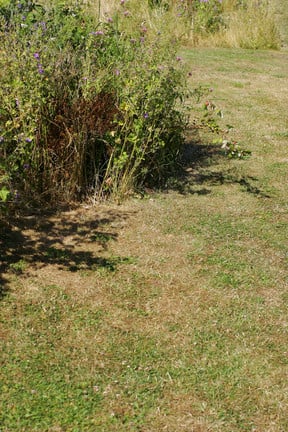
The presence of fungi in gardens becomes noticeable when their fruiting bodies pop up in lawns, on tree trunks or branches or when white mycelium starts growing andcovering hard surfaces, wooden structures, plant containers, soil or mulches. Usually harmless, mycelium can have water-repellent properties, for example if it is found in excess growing in turf, it can cause a dry patch by preventing water from reaching the roots of the grass.
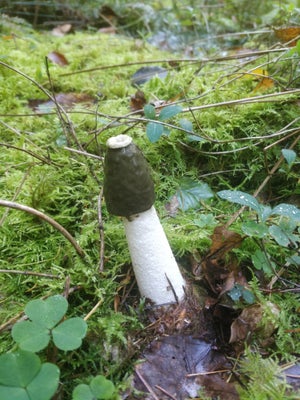
Fruiting bodies can be a nuisance too if they are smelly e.g. the stinkhorn, Phallus impudicus. Some fruiting bodies are poisonous if consumed, which can be a concern to those wishing to protect young children, vulnerable adults or pets.
Prolific production of fruiting bodies in can suppress the growth of young . A number of fungi can produce fruiting bodies that exert a great deal of pressure as they expand, some are known to push through tarmac and lift paving slabs. Wood or weakened trees may rot faster than desired once fungal rot begins, and some decay fungi can take advantage of the weakened trees and further their decline.
1
of
9
Excessive mycelium in soil. Image: Jassy Drakulic
of
Stinkhorn egg (Phallus impudicus). Image: David Harbour
of
Death cap (Amanita phalloides) showing ring on stem. Image: Jassy Drakulic
of
Funeral bell (Galerina marginata). Image: Jassy Drakulic
of
Common Earthball (Scleroderma citrina). Image: RHS/Samuel Booth
of
Rotting wood stained by mycelium of green elf cup - (Chlorociboria aeruginescens). Image: Jassy Drakulic
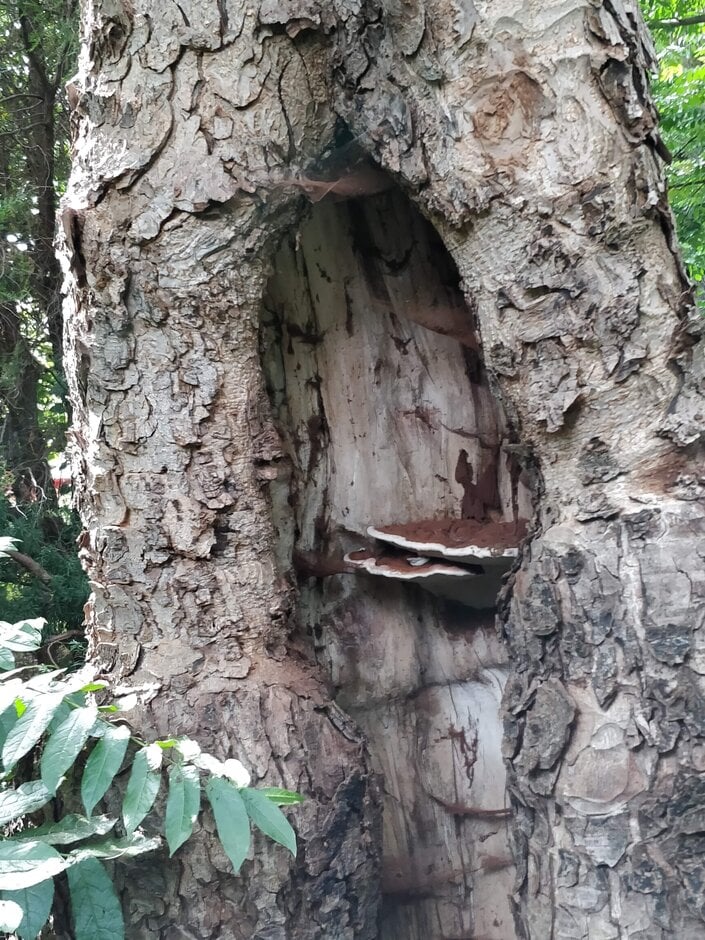
Ganoderma causing subsidence of tree, eventually felled. Image: Jassy Drakulic
of
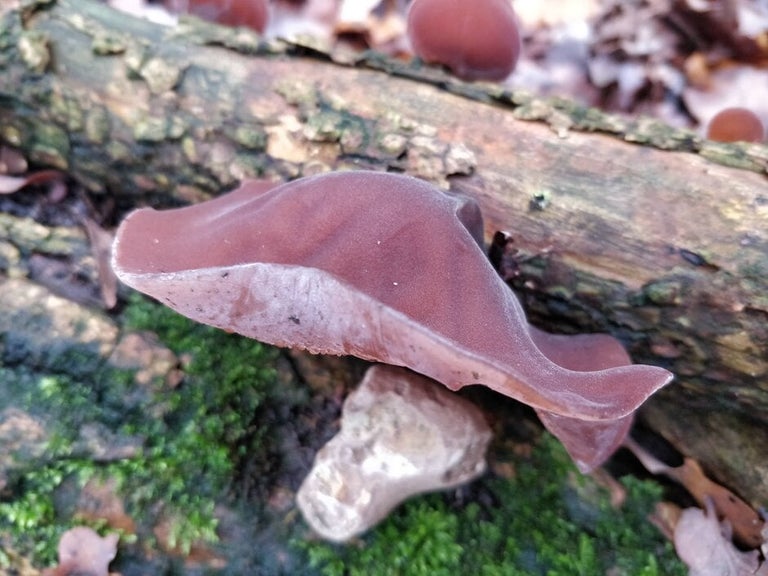
Saprotrophic fungus, likely Peziza sp.. Image: Patricia Johnson Field
Signs and Symptoms
Abundant mycelium: Mycelium is the ‘body’ of the fungus comprised of a network of threadlike cells. Usually it is too well-dispersed to view it with the naked eye, but if the environment is especially favourable, the fungus may produce a large and dense mass of white, fluffy mycelium. It is not possible to tell which species of fungus is present from visual inspection of the mycelium alone, but fungi that have this habit will be saprotrophic in nature (decay fungi).
Fruiting bodies: Fruiting bodies are the reproductive structures of fungi and come in a range of shapes, colours, textures and sizes, and are often the only way to visualise fungal activity in an area of the garden. Mushrooms are short-lived fruiting bodies that consist of a cap held up by a vertical stalk, like an umbrella, which most often appear in the autumn. Stinkhorns, e.g. Phallus impudicus, are mushroom-like structures composed of a thick vertical stalk and a small gooey cap which emerges from a white ‘egg’ but smells like rotting meat.
Each species has its own visible characteristics which need to be captured close-up to have a chance of identifying it. This includes the appearance of the top and underneath of the cap or bracket, the colour of the spores, as well as the stem (stipe) or means of attachment. A cross-section view can also show key internal features, such as the gills or pores, and whether the flesh changes colour when cut.
Poisonous mushrooms: Most people are not able to tell a poisonous mushroom from a harmless or edible one, as without training and dedicated study it is difficult to identify fungal fruiting bodies. There are no consistent traits to tell a poisonous mushroom from a harmless one.
The most poisonous mushrooms often have dramatic common names, including the deathcap (Amanita phalloides), the destroying angel (Amantia virosa) and the funeral bell (Galerina marginata). Most dapperlings are strongly poisonous, particularly the deadly dapperling (Lepiota brunneoincarnata) and the fatal dapperling (L. subincarnata). Webcaps, the Cortinarius species, are often poisonous, but are named after the webbing that forms around the cap edges.
Rotting wood: Untreated wooden structures may become food for wood-decay fungi. Wood that is rotting will become weaker and change colour, usually becoming darker. Invertebrates may make their home and these structures will become an unintended sanctuary for garden . Some wood decay fungi may add to the attractiveness of the wood by creating attractive staining, such as with the green elfcup fungus, Chlorociboria aeruginescens, that stains wood teal, and dark interaction lines, called spelting lines by woodworkers.
Bad smells: Some fungi produce unpleasant smells, but you may not notice until you are quite close-up or there are lots of mushrooms in an area. Stinkhorns are so named because they release an odour like that of rotting meat. The cabbage parachute, Gymnopus brassicolens, occurs in clusters of small mushrooms that smell like brassica crops. As mushrooms degrade they can become soft and water-soaked with a distinctive smell until they have fully disintegrated.
Effect on Wildlife, including humans
Fungi are an integral part of the ecosystem and affect the wildlife they come into contact with in many different ways.
As fungi breakdown the substrates around them they recycle essential minerals and , enabling other organisms to access them. The fruiting bodies themselves are grazed on by many animals including invertebrates, mammals, birds, and even play host to other communities of fungi and bacteria. Fungi capable of breaking down wood also carve out new habitats for wildlife, such as the hollowing out of trees by heartwood fungi. These are complex relationships of which there is still much to learn. Please see our web pages on saprotrophic fungi and heartwood fungi for further information.
There are very small number of species that are deadly poisonous to humans, more species will cause illness, some will cause illness only in some people or when ingested with other substances, such as alcohol. Most species are harmless but not enjoyable for eating, while a few are prized edibles.
Even among the most poisonous fungi, these will only cause harm if consumed in quantities of at least one whole mushroom. No fungi will harm humans or animals to touch and handle them, although it is best to wash hands after handling anything in the garden, including fungi.
The RHS does not provide advice on the edibility of individual species of fungi. For further information on poisonous fungi please read the fungi section of our poisonous plants web profile.
Control
In the majority of cases where fungal growth occurs no action is necessary. Fungi are hugely beneficial to garden ecosystems and are an important part of their .
However, where there are problems the following actions may help:
Prevent the continual appearance of fruiting bodies by removing the food source of the fungus. Digging down and removing pieces of dead wood or dead tree roots, or removing and replacing the top few inches of soil, may help.
To manage fruiting bodies appearing in inconvenient places, or within reach of children, pets or vulnerable adults, pick or sweep them up and move them to the bin or elsewhere out of reach, e.g. in or under a holly bush, so they can still release their spores and provide food for wildlife.
Break up abundant mycelial growth in soil (which is often water repellent) with a fork or hoe. This type of growth in soil or compost often disappears on its own if the food source of the fungus runs out, or if environmental conditions (e.g. temperature and moisture levels) change. Reduce moisture levels to prevent re-emergence.
Protect the base of wooden fence posts by using a ‘post protection sleeve’ which provides a barrier to moisture and decay fungi. Wooden objects placed directly onto soil will decay more quickly. Consider using plinths, treatments, varnish, paints and liners to prolong the lifespan of wooden ornaments or structures.
If a weak tree is under added stress due to an opportunistic fungus, there is not much that can be done to stop it. A qualified arborist may be able to attempt to prune out the branches showing fungal fruit bodies, but the mycelium may be spread throughout the wood e.g. of the trunk, so it would continue. Monitor the tree for safety and support its general health by adding a , reducing competition, shading or alleviating compaction. Read more about managing saprotrophic fungi on trees on the heartwood fungi page.
Fungi provide valuable habitats and resources for wildlife. By accepting and accommodating their presence on woody plants and structures in your garden you are enabling the natural processes of recycling to occur.
Biology
Saprotrophic (decay) fungi recycle dead material and create richer and more stable soils through their activity, while mycorrhizal fungi form associations with plants to support each other by giving and receiving , water and even chemical signals to do with detecting stressors. Fungi can grow in almost any habitat as long as they have access to water, oxygen and a food source; they are extremely abundant in the soil.
The bulk of a fungus occurs as thread-like cells (hyphae) that form a network called the mycelium. You might notice these threads in the soil or under . Growth takes place in the tips of these hyphae and continues whilst conditions are favourable. Unlike plants fungi cannot produce their own food. In order to feed the mycelium grows through soil or plant material and uses enzymes to breakdown complex food sources, like lignin found in wood, into simple compounds that it can absorb. This process is very helpful in most cases, as this liberates nutrition locked away in dead material that mostly returns to the soil to the benefit of plants and wildlife.
The mycelium can form other more visible structures like cords or rhizomorphs which enable the fungus spread further in search of food. Some fungi also form structures called sclerotia, a hardened mass of fungal tissue acting as a reserve of energy which can survive in challenging environments, the fungi can then regenerate from this when conditions are more favourable.
When fungi have enough resources to invest in reproduction, they make fruit bodies comprised of tightly woven hyphae to spread their spores. These are best known in the form of mushrooms, but can appear as crusts, cups, brackets, balls, jellies and other structures. The spores are tiny and can easily spread on the wind. Some fungi use animals to disperse their spores, such as stink horns, which attract flies with a pungent smelling slime imbued with spores.