The Nest: a sustainable design feature for people, plants and the planet
The vision of one passionately creative horticulturist, a new feature has been completed at RHS Wisley that upcycles garden waste to provide for wildlife, people and plants
Olivia Drake
RHS Science and Horticulture Editor
6-minute read
As they stroll through the Pinetum, visitors to RHS Garden Wisley will now stumble across something that is proving to catch the eyes of all who pass by. Hoving into view amongst a grove of magnificent oaks, The Nest is unmissable and unignorable.
As you approach, drawn towards this strange spiral-shaped structure with its inviting entrance, you notice beautiful bands of colour created by the stems of dogwood, willow and birch used in its meticulous construction. When you spot a pair of inviting wooden recliners placed at the secluded centre, surrounded by tranquil planting and a small water feature, it is hard to resist going in to investigate.
The Nest is born
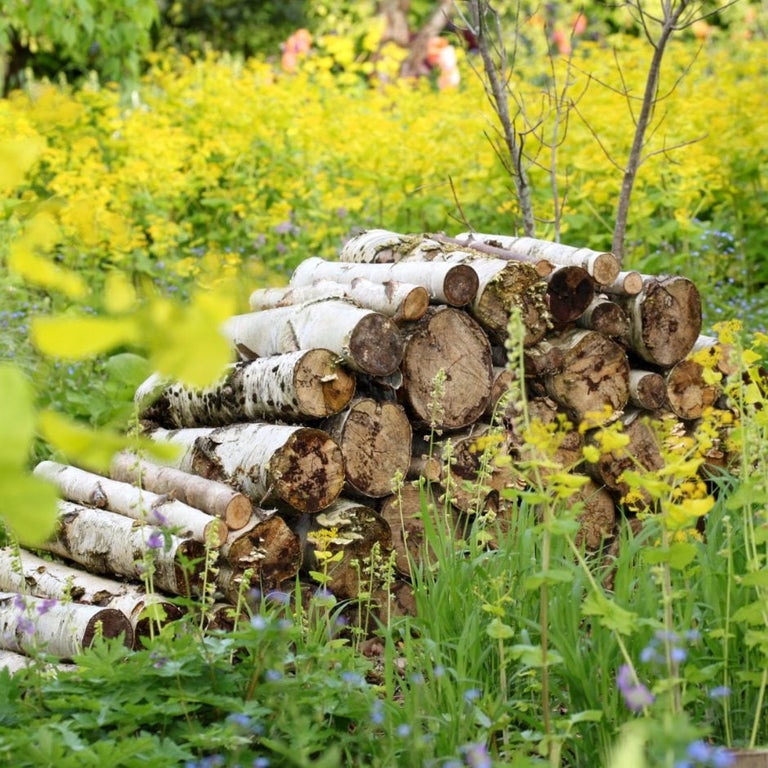
Horticulturist Sam Southgate first conceptualised what has become known as ‘The Nest’ while planning his show garden for RHS Hampton Court Palace Garden Festival 2023, combining his previous experience in building dead hedges with inspiration from Nigel Dunnett. Sam’s garden at RHS Hampton featured a smaller six-by-six-metre version of this creatively designed, multifunctional twist on the traditional ‘dead hedge’.
"It shouldn’t be called a dead hedge. It’s a life-giving hedge"
- Sam Southgate, Horticulturist and creator of The Nest
Refining this prototype to create a larger, more permanent version of the intriguing structure on his home turf at RHS Wisley, Sam started building The Nest in November 2023 and finished in April 2024. The result is a design feature that aims to unite habitat, fine horticulture and a ‘place to be’, all using upcycled ‘waste’ material.
Now, Sam is keen to inspire others to try out this idea in their gardens at home, in a way and on a scale that works for them.
Closing the circle: the concept
“The concept behind The Nest is that it is an ornamental use for what is seen as waste,” explains Sam. “I’m trying to close the circle – the idea is that material shouldn’t leave the site.”
The material forming the walls of the nest was all generated from around the garden and a nearby nature reserve, as a by-product of pruning and storm damage. Sam explains that woody ‘waste’ is often tricky to dispose of in gardens and is often burnt, which releases stored carbon into the atmosphere and bypasses the opportunity to create valuable habitat.
“If you know a local nature reserve or an arborist, it will cost them money to dispose of woody material or they will have to burn it – so this is a fantastic use for it. It’s worth getting in touch.”
Benefits of the nest
Sam explains that The Nest ticks three main boxes that are needed in gardens:
Provides shelter – important if you have a windy site or want to grow shade plants in an otherwise sunny garden
Provides screening – useful if you’re overlooked or want to screen off a compost heap or similar
Creates horticultural microclimates – enables you to grow a different range of plants that thrive in the conditions you’ve created
In addition, it also provides habitat, shelter and foraging opportunities for a range of wildlife.
Planning The Nest
The Nest is orientated to direct gaze towards the shape of the beautiful oak in front of it, as well as being sensitive to the layout of existing paths and the way people move through the garden.
Though a structure like this can also be built with soft material, Sam chose to use woody material, firstly so that the walls don’t need to be topped up over time, and secondly because of the difficulties in disposing of woody material.
With careful construction, he expects it to last for years to come: “This isn’t going anywhere, not even in any storm,” he says.
“Every single garden and its conditions are going to be different. You can use whatever you like, and it can be whatever you want it to be. It doesn’t have to be as big as this one.”
Though Sam completed The Nest in six months, he emphasises that you don’t have to finish it in one year if you don’t have enough material – simply build it up at your own pace.
"It’s so difficult to work down here without people stopping and asking. People relax on the chairs and are interested"
- Sam Southgate
How do you build a nest?
“There’s an art to building it,” explains Sam. “Start with the thicker branches, then push the next ones through like needle felting to lock in the layers. Build the walls up layer by layer in this way, carefully walking on each layer before moving onto the next to ensure the structure doesn’t sink.”
The base layer of The Nest is silver birch that was repurposed from the show garden prototype at RHS Hampton Court.
All the material that was too small to use for the walls was used to stuff tipi-shaped habitat towers standing nearby. “As soon as you make the excess material into a pyramid, it becomes a feature in its own right,” says Sam.
Sam Southgate
The twigs that were too small to use in the nest were used to stuff habitat towers
How to build your own nest
A structure like The Nest can be created in a few simple steps:
Measure out an outer and inner circle to give the desired depth of hedge
Divide the circle into quarters to allow for the differences in height as you travel around the circle, with the lowest point at the entrance
Mark out the entrance by breaking the circle to expand it on one side, and extend this section to create an overlap so that the entrance is flanked by walls. The resulting shape is the beginnings of a spiral
Drive pairs of stakes into the ground along the outer and inner circles, using a post driver or mallet with care. These will hold in the woody material
Layer up the material, compacting each layer
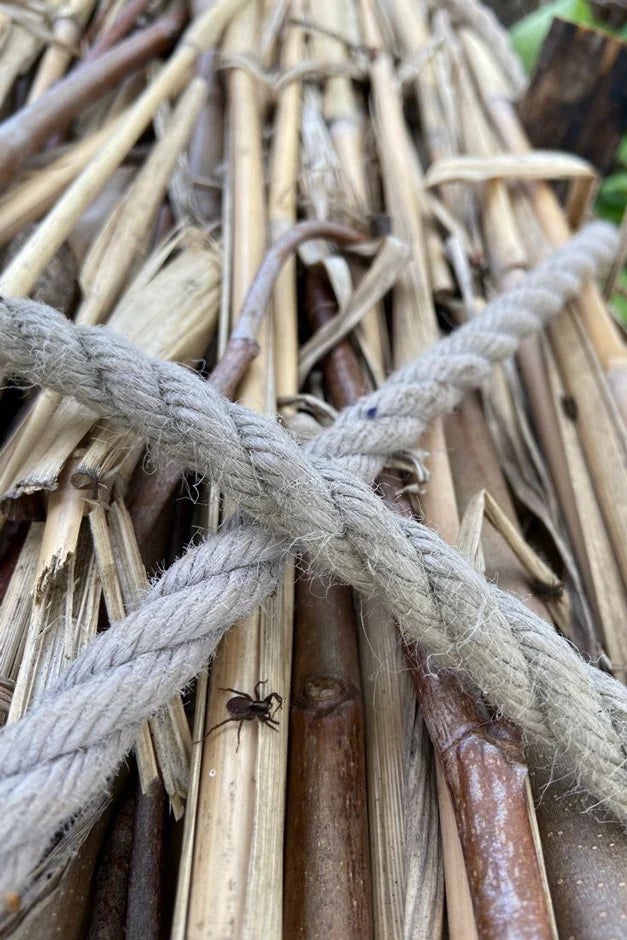
When finished, secure the material with rope criss-crossing between the stakes
"Once the stakes are in there’s no need for machinery – anyone can do it; kids can get involved"
- Sam Southgate
A unique planting opportunity
The sheltered conditions of The Nest provide an ideal opportunity for some choice planting that makes the most of the microclimate created by the dense outer walls. Sam was keen to explore shade planting beyond just ferns with some woodland edge style planting that extends the flowering season for pollinators.
Informal beds edged with old apple branches from the orchard nestle beneath the walls, brimming with perennials such as Pulmonaria, Tiarella, Aquilegia, Campanula and Thalictrum. The Thalictrum seedheads will be left through the winter, as these provide habitat and refugia for hibernating invertebrates.
Pops of colour will be created by rusty foxglove (Digitalis ferruginea), while purple hazel (Coryllus maxima ‘Purpurea’) gives shrubby structural interest.
"Who says you can’t have a woodland edge garden on an exposed sandy site. As the structure and planting matures, I can’t wait to see what else it attracts"
- Sam Southgate
The soil is enriched with a thick layer of RHS Wisley’s homemade and topped with a little woodchip. This preserves moisture and reduces weeds.
Sam plans to sow seed of more woodland plants over the top of the beds, and to monitor the site’s conditions this season to give a better idea by next year of the different microclimates present in order to further develop the planting.
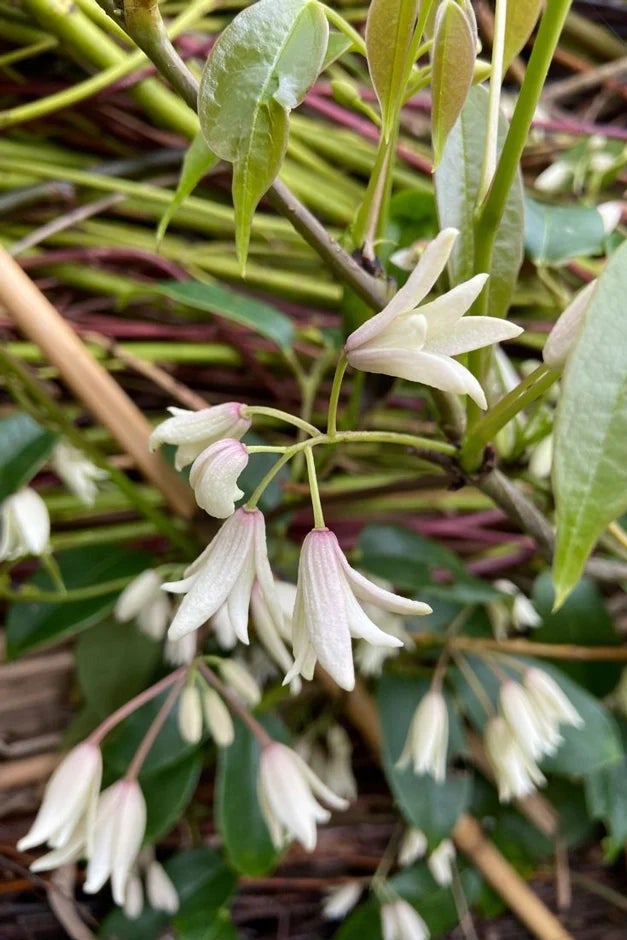
Sausage vine (Holboelliabrachyandra) enjoys the sheltered microclimate and scrambles over the twigs without needing support
One of the star features of The Nest are the choice climbers that scramble up its walls, without the need for tying in. Sam chose sweetly scented sausage vine (Holboelliabrachyandra), which is hard to grow as it needs shelter, making the enclosed inner space of The Nest an ideal opportunity to cultivate it.
Rambling happily nearby is Lonicera henryi ‘Copper Beauty’; a good, reliable long-season plant that’s great for pollinators, with Sam giving the species a discerning horticultural twist through the choice of a bronze-leafed . Sam is adamant that wildlife gardening needn’t come at the expense of fine horticulture, and The Nest demonstrates a novel union of both concepts.
"I’m particularly excited to see the sausage vine in flower – without the protection of the dead hedge it would have been unlikely to survive the winter"
- Sam Southgate
A haven for wildlife
One of the key features of The Nest is to provide habitat and resources for wildlife. The dead hedge provides shelter, foraging and hibernating opportunities for a range of mammals, birds, amphibians and invertebrates.
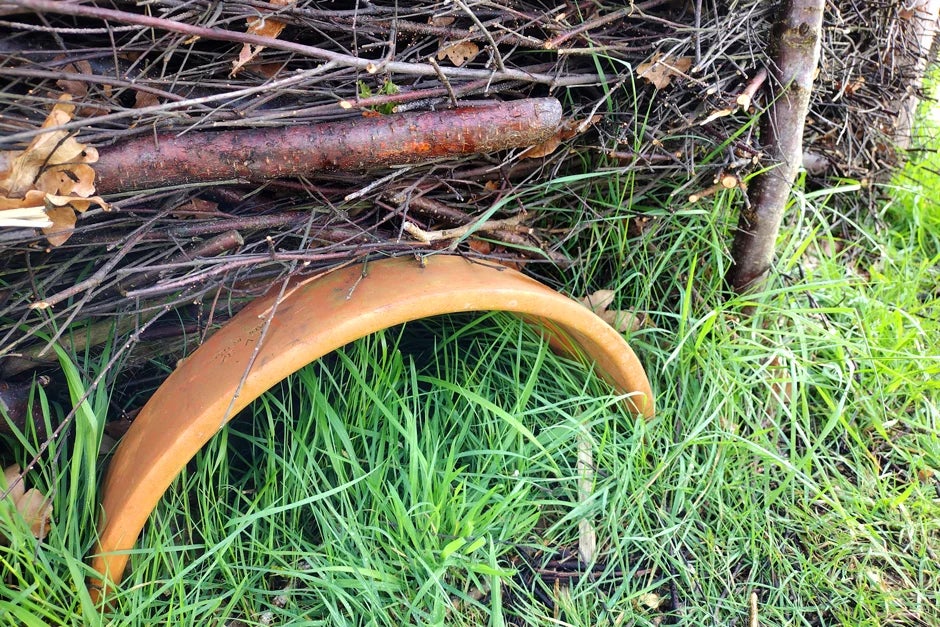
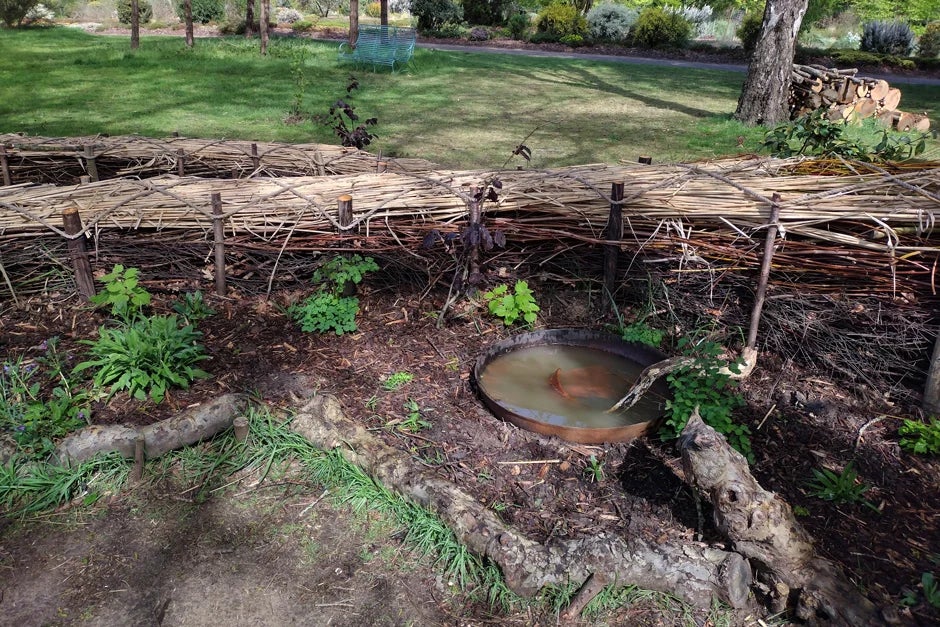
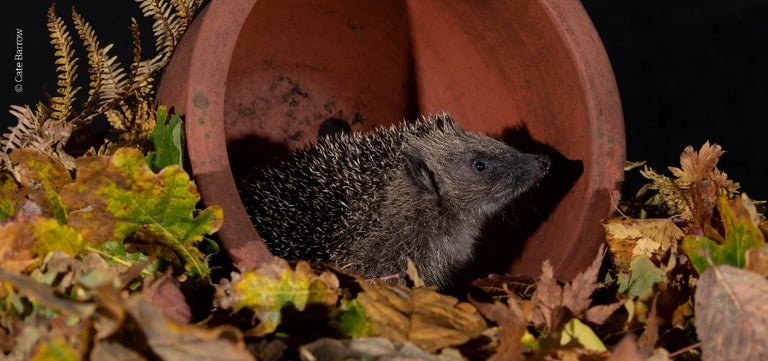
An upcycled firepit sunk into the planting becomes a wildlife pool, from which birds and mammals such as hedgehogs can drink. Two upturned half terracotta pots placed at the base of the dense hedge provide entry and exit points for wildlife.
The team will be recording the in and around The Nest this summer to shed light the range of wildlife that can be supported by a dead hedge such as this. “There’ll be interest all year round,” says Sam. “Birds will be in and out; there are already frogs in the hedge.”
Every week from late spring to midsummer, horticultural student Eli will be recording what biodiversity she can observe in The Nest over a half hour survey period, which will contribute to a report later in the summer.
Camera traps have been installed to record mammals such as mice and squirrels as well as nocturnal visitors. Overnight moth traps will allow ecologist Gemma Golding to identify and re-release smaller nocturnal visitors, while reptile mats will give an indication of any lizards, grass snakes and slow worms that may be in the area.
"A tree has fantastic habitat, which you lose when it falls, but by using the material for a dead hedge, you are mitigating that loss by creating a new habitat in a different form"
- Sam Southgate
Get inspired
Why not come and see The Nest for yourself to gather inspiration for your own garden? Turning right after entering RHS Garden Wisley, you can find it by following the Pinetum path towards the Stone Pine Café. You’ll spot The Nest on your left near the river.
In the same area and by following the path a little further, you can see a range of other creations by Sam and his team that all aim to repurpose waste materials while providing habitat and interesting design features. Sneak a peak below.
Sam’s message? Give it a go, he urges. “I would love to spread the message of the benefits these structures can provide.”
“When we showcased a similar structure at RHS Hampton Court last year I had a lot of interest from members of community gardens, allotments and schools. I think structures like this would be ideal in these environments and could provide multiple benefits for biodiversity without compromising on ornamental value.”
Anyone can create a Nest in their own garden; it doesn’t have to be as large as this one
"You can screen your garden, protect your garden, and grow things you couldn’t grow before. Anyone can do this in their garden"
- Sam Southgate
More new upcycling creations in the Pinetum at RHS Wisley
The sinuous dead hedge
Sam explains: “This contrasting example acts to create a viewing point: where previously people used to pass by without really noticing this area, it compels people to stop and look at it and notice the bluebells. A couple of small turns draw the eye along its length when viewed from the path. As well as providing habitat, it brings a ‘stop and look’ effect to a corner of the garden that was previously overlooked.”
The habitat doorway
Horticulturist Natalie Plumbridge, who created the doorway, explains: “After a storm in January 2024, all the debris was collected and turned into multiple habitat creations in the Pinetum and Heather Landscape. The habitat doorway was entirely created from a fallen Betula nigra ‘Little King’.
“Moving the fallen material less than 50m away from the original site not only made the clearance more environmentally friendly, but also allowed us to create a new feature that visitors can interact with and provides habitat for wildlife. The doorway is made to look like a log wall on the inside, attracting bugs and insects. This evolves into a dead hedge on the outside, creating habitat for birds and small mammals.
“This feature can be replicated in gardens using seasonal prunings and reclaimed wood. It can be used to create zones within your garden without the need to buy fencing. We started with a wooden frame and filled the bottom with the larger logs to create a stable base, then built up the levels with the rest of the material, creating a tall dead hedge that tapers inwards as you work up the frame. For the roof, chicken wire was stapled onto the structure and the holes stuffed with the smallest twigs to create what looks like a continuation of the dead hedge.”
The Romanian haystack
Sam explains: “Pat, who looked after the Pinetum before, came up with this concept and his inspiration came from Romanian haystacks. This is the hay harvested from this meadow when the grass was cut, with no baling and no plastic. It’s a much quicker and less labour-intensive way of storing hay.”
“The grass is spiralled around a central pole, and the layers cut in afterwards to make the structure more interesting. The thatching keeps it dry.
“Horticultural relevance is provided by the climbers – purple clematis and a golden hop, which will scramble over the structure. Both are planted on the shady side so that they don’t reach away from the structure towards the sun, which means they won’t need tying in. As the hay decomposes, are fed back into the ground to feed the climbers.”
Sam Southgate
Sam Southgate
About the author – Olivia Drake
With a background in biology, Olivia is passionate about sustainable horticulture and the role gardening can play in conservation. She is professionally trained as a botanical horticulturist and previously worked in public gardens around the UK and overseas.