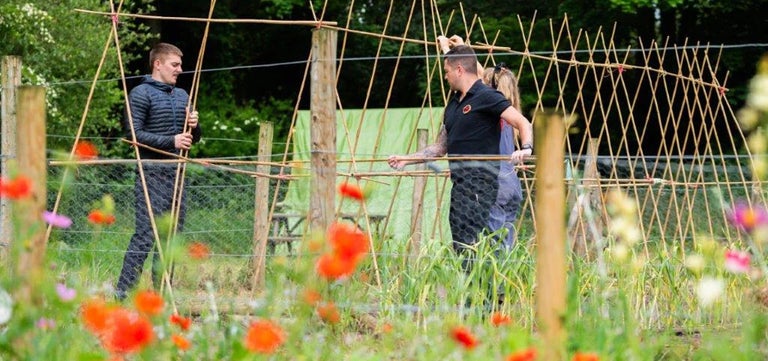
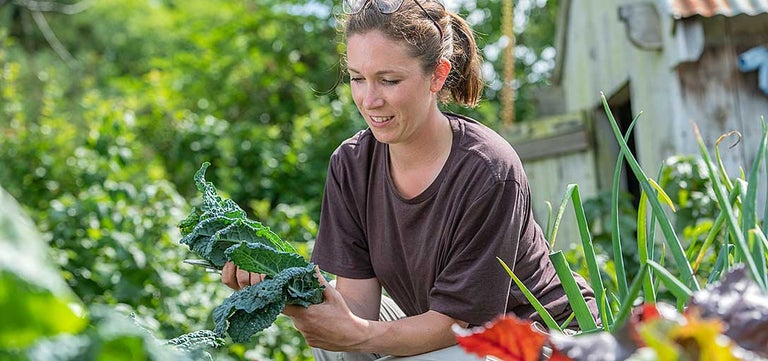
Supporting military veterans through horticultural therapy
Discover how gardening is becoming a vital anchor for vulnerable veterans

Mikael Colville-Andersen, a Canadian-Danish urban designer, has built a therapy garden in the heart of Kyiv to help combat the growing mental health crisis caused by the Russia-Ukraine war
When Russia invaded Ukraine in February 2022, urban designer Mikael Colville-Andersen had already been living in Kyiv for over a year. Witnessing the growing toll of war on mental health, he turned to his Scandinavian roots – and the wealth of research on nature-based therapy from Denmark and Sweden – to design a solution: Ukraine’s first Scandinavian-style therapy garden.
Built beside Pavlov Psychiatric Hospital, one of Europe’s largest mental health institutions, the Therapy Garden is an innovative response to the escalating mental health crisis in the country. According to the World Health Organization, an estimated 9.6 million people in Ukraine are at risk of developing or currently living with mental health conditions due to the war.
“Despite 15 years of compelling research from institutions in Denmarkand Sweden, the concept of therapy gardens as treatment spaces remains largely unknown outside of Scandinavia,” says Mikael. “But in Denmark, they’re increasingly common. Their effectiveness is well-documented.”
Mikael brought together a small team of Ukrainian architects and the landscape design firm LDesign to complete the garden in just 11 weeks. Adjacent to the forested grounds of Pavlov Psychiatric Hospital, the site was cleared with the help of more than 1,000 volunteers – many of whom were responding to an open call Mikael posted on social media.
“I was hoping for 50 people to show up that first weekend,” he recalls. “Instead, 500 came. Every weekend for nearly three months, volunteers kept returning to help. That spirit of collective action is deeply rooted in Ukrainian culture – it’s called toloka, where people show up without hesitation to help each other.”
"I was hoping for 50 people to show up that first weekend. Instead, 500 came. Every weekend for nearly three months, volunteers kept returning to help."


In a country where mental health care systems are strained and often reliant on overmedication, alternative treatments like therapy gardens offer hope. Mikael also emphasises the growing issue of domestic violence and untreated PTSD. “There’s a pressing need for other forms of support – ones that don’t involve only pharmaceutical intervention,” he says.

To ensure the design met real needs, Mikael interviewed military veterans and relied heavily on Scandinavian clinical research. The garden is structured to serve people experiencing three levels of mental trauma.
“The first level offers secluded spots for those who need to be alone,” he explains. “The second is for patients open to gentle interaction with a caregiver or loved one. The third features a communal space for group therapy and nature-based activities.”
The garden takes full advantage of its location in a forested area around Pavlov Psychiatric Hospital. Given the prevalence of drone warfare and constant aerial alerts, special attention was given to designing both open and enclosed spaces.
“There are cabins with roofs for those suffering from paranoia, and others with open skies for those who crave openness,” Mikael says. “Each cabin has three solid walls wrapped in greenery for privacy and calm. Inside, a single chair faces the trees – designed so patients don’t feel vulnerable or exposed.”
"The entire garden is designed to support recovery year-round."
Seasonal, sensory plants were chosen carefully, including evergreens and climbing plants that remain lush in winter while also buffering sound and wind. “The entire garden is designed to support recovery year-round,” he says.

The garden officially opened on 27 June, 2024. While Mikael considers his role in the project complete, he’s working with local partners to organise conferences and workshops that will train other Ukrainian professionals in the design and therapeutic use of such spaces.
“This is more than just a garden,” he says. “It’s a model for healing – a space that encourages conversation about mental health and promotes community-based care. I hope professionals from across Ukraine will come to see how it works and be inspired to replicate it.”
"Building this garden for others has been incredibly healing for me, too. It’s been the most rewarding experience of my professional life."
For Mikael, the project has also been personally meaningful. “I suffer from an anxiety disorder myself. Building this garden for others has been incredibly healing for me, too. It’s been the most rewarding experience of my professional life.”
Scandinavian research into nature-based therapy
Advances due to both research and pilot projects in Denmark and Sweden over the last 15 years have taken our understanding of the health and wellbeing benefits of nature to the next level.
In 2001, the Alnarp Rehabilitation Garden was established at the Swedish University of Agricultural Sciences, and in 2010, the Danish Healing Forest Garden Nacadia was constructed at the University of Copenhagen.
For more information or to donate to the Nordic therapy garden pilot project in Kyiv, Ukraine visit Mikael Colville-Andersen’s website.
Want to know more about gardening for health and wellbeing? The RHS and the NHS are currently developing wellbeing spaces for staff, patients and the local community. See the NHS wellbeing gardens for more details.
About the author - Charlotte Olver
Charlotte Olver is a garden writer who blends science and storytelling to highlight how nature supports wellbeing. Her work explores gardening as a path to healing, resilience and connection.