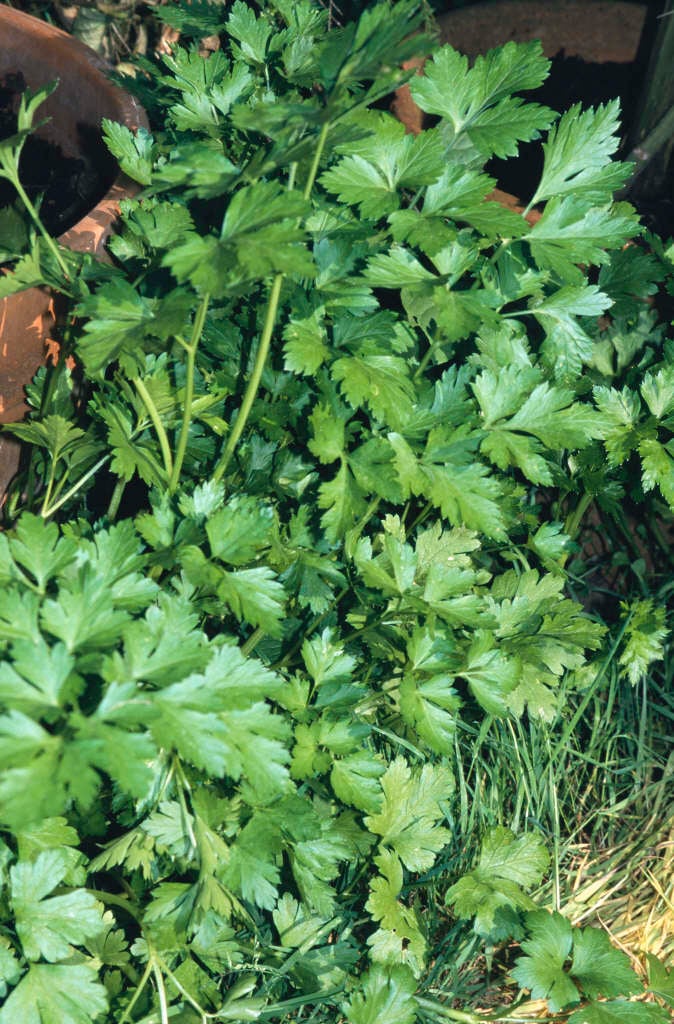
Petroselinum crispum var. neapolitanum

RHS Plant Profile
flat-leaved parsley
flat-leaved parsley RHS 2002

Other common names

Italian parsley, plain-leaved parsley, parsley 'Italian Giant'

Synonyms

Petroselinum 'Italian Giant'
Petroselinum crispum 'Italian'
Petroselinum crispum 'Italian Giant'
Petroselinum crispum 'Plain Leaved'

Annual Biennial Herbs - Culinary

A robust biennial with strongly aromatic, dark green, 1- to 3- pinnate, flat leaves, and small yellow-green flowers in umbels in summer

Position

Full sun, Partial shade

Soil Types

Chalk, Clay, Loam, Sand

Max Height

0.1-0.5 metres

Max Spread

0.1-0.5 metres

Size

Time to Maturity
1–2 years
Max Spread
0.1-0.5 metres
Max Height
0.1-0.5 metres

Growing Conditions

Chalk Clay Loam Sand
Moisture
Moist but well–drained
pH
Acid or Alkaline or Neutral

Position

Full sun Partial shade
Aspect
East–facing or South–facing or West–facing
Exposure
Exposed or Sheltered
Hardiness
H6

Colour & Scent

Fragrance Foliage
Season Stem Flower Foliage Fruit
Spring
Summer
Autumn
Winter

Botanical Details

Family
Apiaceae
Native to GB/Ireland
No
Foliage
Deciduous
Habit
Bushy
Genus
Petroselinum are aromatic biennials with broad, pinnate to 3-pinnate leaves and compound umbels of small white or pale green flowers
Name Status
Correct

How to Grow

Cultivation

Grow in fertile, moist, but well-drained soil in full sun or partial shade. Normally grown as an annual it can be overwintered although leaves become coarser in the second year

Propagation

Propagate by seed sown in situ, in succession from late spring through summer

Suggested planting locations and garden types

  • City and courtyard gardens
  • Cottage and informal garden
  • Patio and container plants

Pruning

Remove flowers unless wanted for seed

Pests

May be susceptible to carrot fly, aphids and celery leaf miner

Diseases

May be susceptible to a leaf spot and a virus
