Cymbidium Magna Charta gx 'Spring Promise'
boat orchid Magna Charta gx 'Spring Promise'
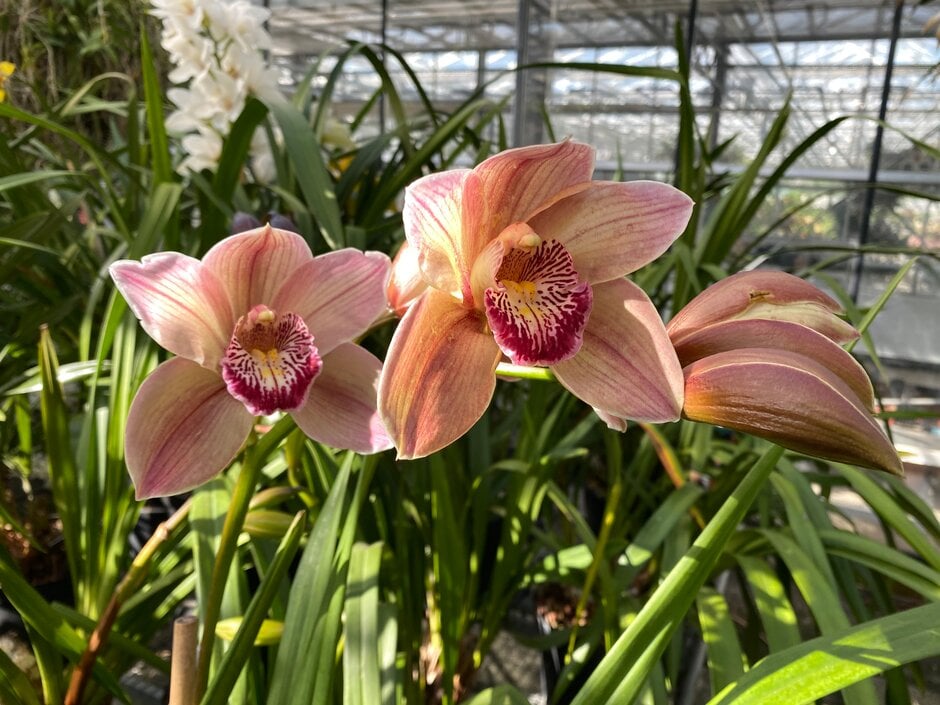
A medium to large-sized, evergreen orchid hybrid, producing a clump of egg-shaped pseudobulbs. Each pseudobulb is covered with leaf-bearing, basal sheaths. The leaves are linear, semi-rigid and leathery, up to 90cm long and 2-3cm wide. Upright or arching flowering stems emerge from the bases of new mature pseudobulbs in late winter and spring and carry 6-15 flowers. The waxy, long-lasting flowers measuring up to 10cm across are pale cream with pink linear markings and a white lip with a dark pink pattern
Size
Ultimate height
0.5–1 metresTime to ultimate height
2–5 yearsUltimate spread
0.5–1 metresGrowing conditions
Moisture
Moist but well–drained, Well–drainedpH
NeutralColour & scent
| Stem | Flower | Foliage | Fruit | |
| Spring | Cream Pink | Green | ||
|---|---|---|---|---|
| Summer | Green | |||
| Autumn | Green | |||
| Winter | Cream Pink | Green |
Position
- Full sun
- Partial shade
Aspect
East–facing or North–facing or South–facing or West–facing
Exposure
Sheltered Hardiness
H1CBotanical details
- Family
- Orchidaceae
- Native to GB / Ireland
- No
- Foliage
- Evergreen
- Habit
- Clump forming, Columnar upright
- Potentially harmful
- Skin allergen. Wear gloves and other protective equipment when handling
- Genus
Cymbidium are epiphytic, lithophytic or terrestrial orchids with prominent spherical to ovoid pseudobulbs, long linear leaves and fleshy white roots. Several long lasting showy flowers with a distinctive 3-lobed lip are borne on erect or arching flower spikes from the bases of the pseudobulbs
- Name status
Unresolved
How to grow
Cultivation
Grow in an open, free-draining orchid compost with addition of perlite, sphagnum moss or coir. Requires day temperatures around 16°C and 10°C at night. Provide good light levels, but avoid direct sunlight. Water plants thoroughly when compost is almost dry, allow to drain and use orchid fertiliser regularly during growing season. Reduce watering in winter. Place outside in dappled shade during the summer months to aid flower initiation. See cymbidium cultivation for more detailed information
Propagation
Propagation by seed is only possible in a controlled laboratory environment. Mature plants may be divided in early or mid spring, when the plant overgrows its container. Each division should have at least 3 older pseudobulbs with a sufficient amount of stored energy and water, to support new growth and reduce stress after repotting
Suggested planting locations and garden types
- Houseplants
- Conservatory and greenhouse
- Cut flowers
Pruning
No pruning required. Cut down flowered stems to base
Pests
May be susceptible to aphids, glasshouse red spider mite, scale insects and mealybugs
Diseases
Generally disease-free. Sterilising cutting tools may prevent virus diseases, such as Cymbidium Mosaic Virus (CMV)
Get involved
The Royal Horticultural Society is the UK’s leading gardening charity. We aim to enrich everyone’s life through plants, and make the UK a greener and more beautiful place.