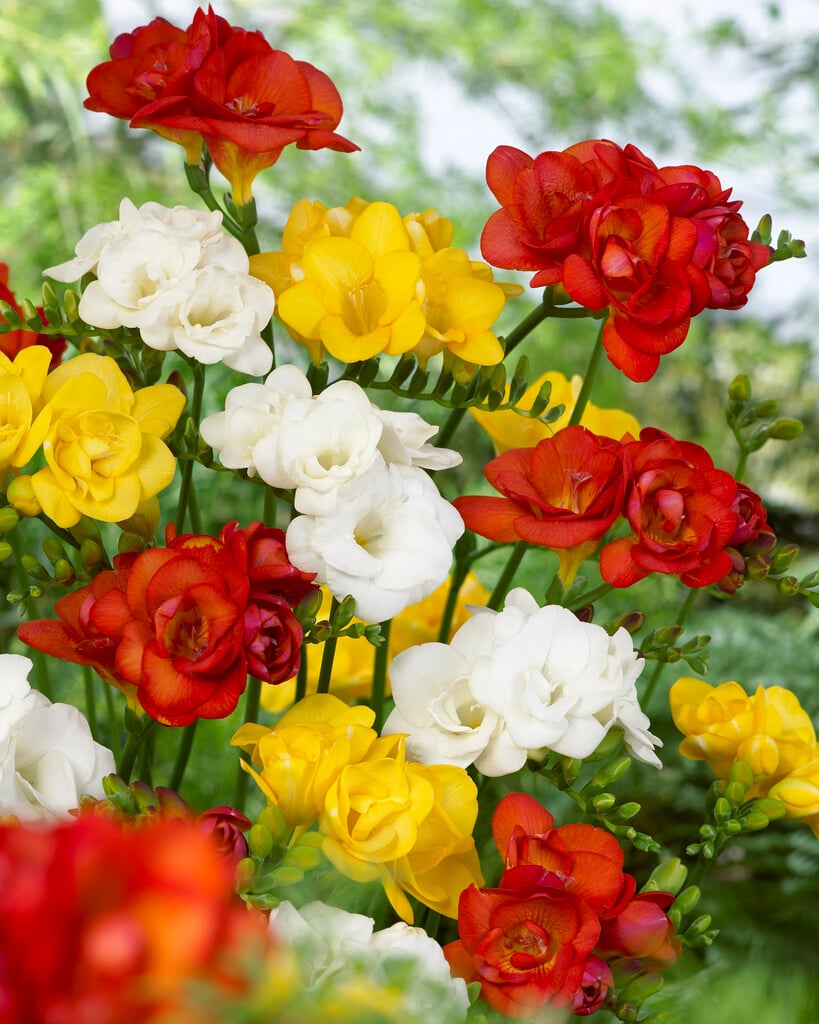
Freesia double mixed (d)

RHS Plant Profile
freesia double mixed
Bulbs

A colour mix of tender flowering perennials which grow from bulb-like structures known as corms. In late winter, spring or summer (depending on time of planting), funnel-shaped, double, scented flowers in mauve, orange, white, yellow and cerise bloom sequentially on thin arching stems above sword-shaped, mid-green leaves. Height around 45cm (18in).

Position

Full sun

Soil Types

Chalk, Clay, Loam, Sand

Max Height

0.1-0.5 metres

Max Spread

0.1-0.5 metres

Size

Time to Maturity
1 year
Max Spread
0.1-0.5 metres
Max Height
0.1-0.5 metres

Growing Conditions

Chalk Clay Loam Sand
Moisture
Moist but well–drained
pH
Acid or Alkaline or Neutral

Position

Full sun
Aspect
South–facing or West–facing
Exposure
Sheltered
Hardiness
H2

Colour & Scent

Fragrance Flower
Season Stem Flower Foliage Fruit
Spring
Summer
Autumn
Winter

Botanical Details

Family
Iridaceae
Native to GB/Ireland
No
Foliage
Deciduous
Habit
Clump forming
Genus
Freesia are cormous deciduous perennials with erect, linear to narrowly lance-shaped leaves and upright stems bearing terminal racemes of slender-tubed, salver-shaped or trumpet-shaped flowers that are usually scented
Name Status
Correct

How to Grow

Cultivation

Freesias naturally flower in early spring, but need frost-free conditions. Plant corms in autumn, outdoors in very mild areas, or in containers in a frost-free greenhouse. Specially prepared corms can be planted outdoors in mid-spring to flower in late summer, but will only do this for the first year. See freesia cultivation

Propagation

Propagate by separating corm offsets, or by seed. Young plants take a few seasons to reach flowering size. See freesia cultivation

Suggested planting locations and garden types

  • City and courtyard gardens
  • Cottage and informal garden
  • Cut flowers
  • Conservatory and greenhouse
  • Flower borders and beds
  • Wall side borders

Pruning

No pruning required

Pests

May be susceptible to glasshouse red spider mite and aphids

Diseases

May be susceptible to dry rot and Fusarium wilt