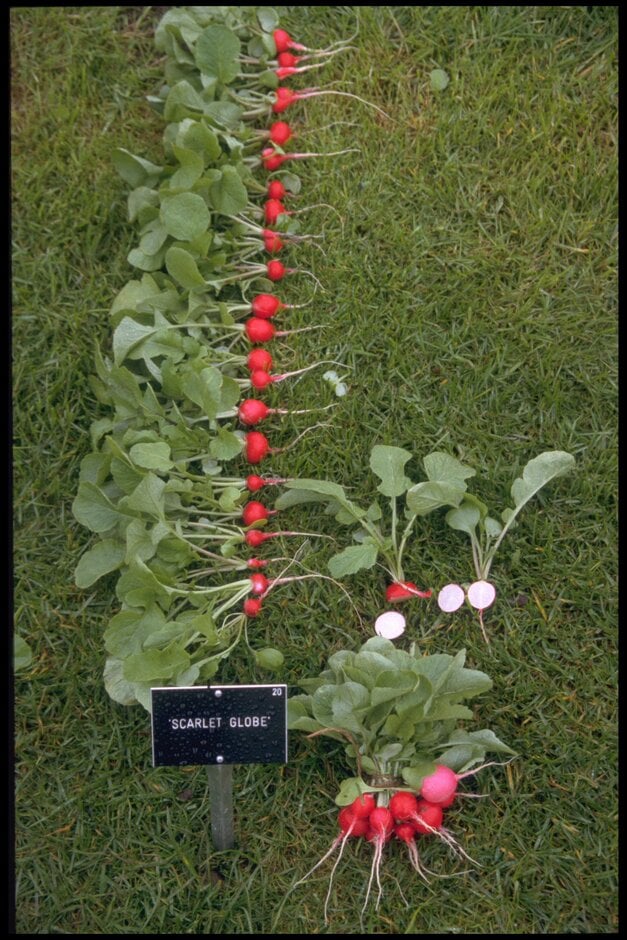
Raphanus sativus 'Scarlet Globe'

RHS Plant Profile
radish 'Scarlet Globe'
radish 'Scarlet Globe' RHS
Award of Garden Merit
Annual Biennial

Has leaves about 15cm high and round roots with red skin and crisp white flesh with a mild flavour. Radishes, Raphanus sativus, are annuals or biennials which germinate fast and grow fast, with lobed, dark green leaves to about 15-20cm high, and succulent, sharp-tasting edible enlarged taproots which can be harvested about four weeks after sowing, and can be round, tapering, or cylindrical, and have red, white, green, yellow, purple, or black skin, while the flesh is usually white but may be red or purple; if plants are left long enough, for example when grown as a cover crop or green manure, to grow to about 90cm then they can produce white or pale lilac flowers which provide both nectar and pollen for bees.

Position

Full sun, Partial shade

Soil Types

Chalk, Clay, Loam, Sand

Max Height

0.1-0.5 metres

Max Spread

0.1-0.5 metres

Size

Time to Maturity
1–2 years
Max Spread
0.1-0.5 metres
Max Height
0.1-0.5 metres

Growing Conditions

Chalk Clay Loam Sand
Moisture
Moist but well–drained
pH
Acid or Alkaline or Neutral

Position

Full sun Partial shade
Aspect
South–facing or West–facing or East–facing
Exposure
Exposed or Sheltered
Hardiness
H2

Colour & Scent

Season Stem Flower Foliage Fruit
Spring
Summer
Autumn
Winter

Botanical Details

Family
Brassicaceae
Native to GB/Ireland
No
Foliage
Deciduous
Habit
Bushy
Genus
Raphanus can be annual, biennial or perennial herbaceous plants, often with lyrate, glaucous leaves, small, four-petalled flowers and indehiscent fruits. Edible species are cultivated as annual vegetables (radish)
Name Status
Accepted

How to Grow

Cultivation

Grow in full light or light shade, ideally in light, rich, near-neutral, and moist but well-drained soil; sow seed at frequent intervals from early spring to late summer, so that there is a succession of crops; sow in rows 15cm apart, at a depth of 1-2cm, and sow at or thin to a spacing of about 3 cm apart, and harvest them when young so that they do not become woody; for more advice, see radish cultivation

Propagation

Propagate by seed sown 1-2cm deep, from early spring to late summer

Suggested planting locations and garden types

  • Cottage and informal garden
  • City and courtyard gardens
  • Flower borders and beds

Pruning

No pruning required

Pests

May be susceptible to flea beetles, slugs and snails and cabbage root fly

Diseases

May be susceptible to brassica downy mildew, brassica white blister, club root, damping off, fungal leaf spot, and virus diseases