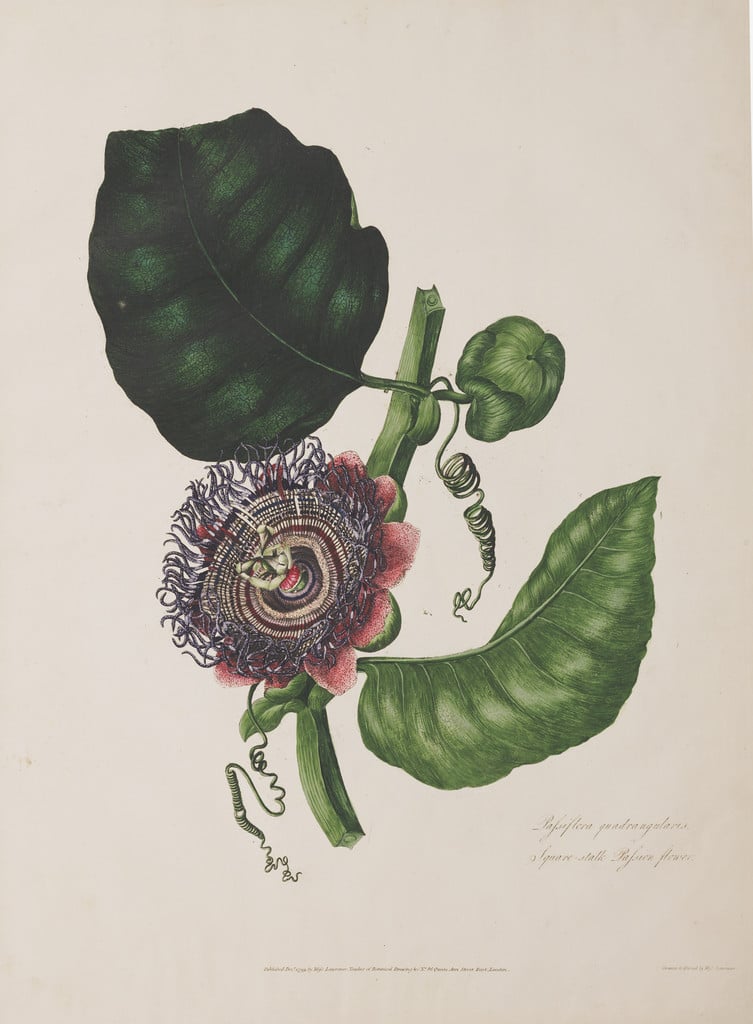
Passiflora quadrangularis (F)

RHS Plant Profile
giant granadilla
giant granadilla RHS

Other common names

square-stemmed passionflower

Award of Garden Merit
Climber Wall Shrub Conservatory Greenhouse

A vigorous evergreen climber, to 15m, with angled stems bearing large, broadly-ovate leaves and nodding, fragrant, light red flowers with large purple and white coronal filaments; fruit to 25cm, yellow, with edible pulp

Position

Full sun, Partial shade

Soil Types

Chalk, Loam, Sand

Max Height

Higher than 12 metres

Max Spread

1-1.5 metres

Size

Time to Maturity
5–10 years
Max Spread
1-1.5 metres
Max Height
Higher than 12 metres

Growing Conditions

Chalk Loam Sand
Moisture
Moist but well–drained
pH
Acid or Alkaline or Neutral

Position

Full sun Partial shade
Aspect
West–facing or South–facing
Exposure
Sheltered
Hardiness
H1A

Colour & Scent

Season Stem Flower Foliage Fruit
Spring
Summer
Autumn
Winter

Botanical Details

Family
Passifloraceae
Native to GB/Ireland
No
Foliage
Evergreen
Habit
Climbing
Genus
Passiflora are mostly tender tendril-climbing shrubs, with simple or palmately-lobed, generally evergreen leaves and showy flowers of distinctive structure with often colourful coronal filaments, followed by conspicuous fruits, edible in some species
Name Status
Correct
Horticultural Group
This genus produces fruit, but not necessarily edible fruit
Plant Range
Tropical America

How to Grow

Cultivation

Under glass grow in a container in peat-free, loam-based potting compost in full light with shade from hot sun. Water freely when in growth and keep just moist in winter with a minimum temperature of 13°C. May be grown outdoors in frost-free areas in most fertile, moist but well-drained soils and overwintered indoors, see passion flower cultivation

Propagation

Propagate by seed, semi-hardwood cuttings or by layering in spring or autumn

Suggested planting locations and garden types

  • City and courtyard gardens
  • Patio and container plants
  • Sub-tropical
  • Wall side borders
  • Edible fruit

Diseases

May be susceptible to honey fungus (rarely) and a virus