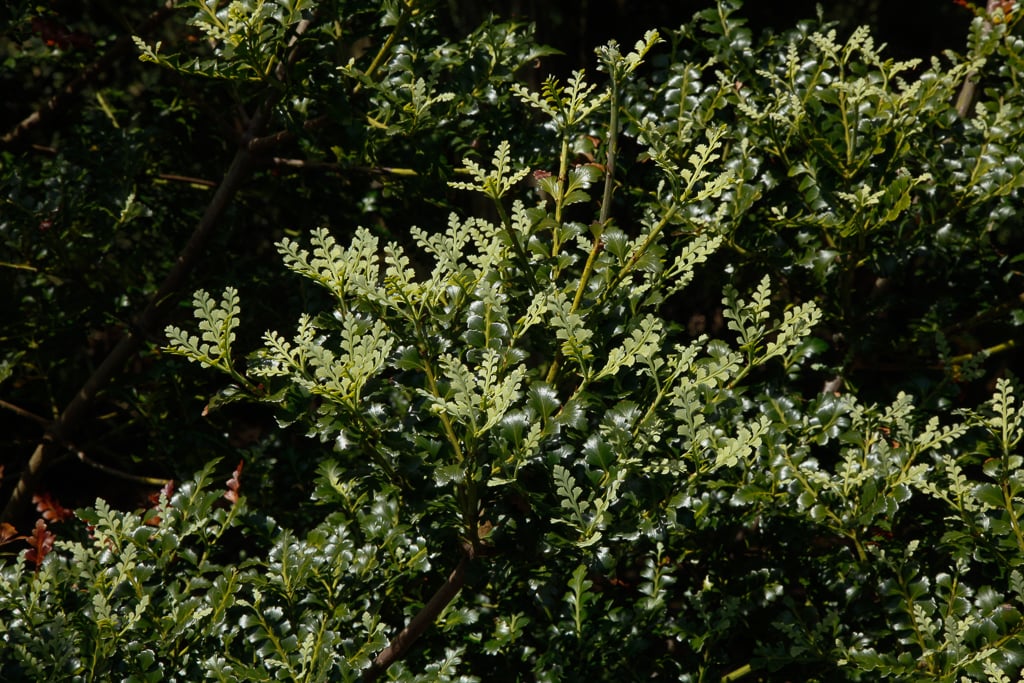
Phyllocladus trichomanoides

RHS Plant Profile
celery pine of New Zealand
celery pine of New Zealand John Fielding

Other common names

tanekaha

Trees Conifers

An upright, conical, evergreen tree, ultimately reaching 12m, with smooth, grey-black bark and branches in whorls. The foliage consists of 30cm-long phylloclades - flattened stems replacing the true leaves which are reduced to scales. They are divided into diamond-shaped segments, reddish-brown when young, then mid-green. In spring, produces spherical, dark blue or black, female cones, and catkin-like male cones which start purple, ripening to red then yellow

Position

Full sun

Soil Types

Loam

Max Height

4-8 metres

Max Spread

4-8 metres

Size

Time to Maturity
20–50 years
Max Spread
4-8 metres
Max Height
4-8 metres

Growing Conditions

Loam
Moisture
Moist but well–drained
pH
Neutral or Acid or Alkaline

Position

Full sun
Aspect
South–facing or West–facing
Exposure
Sheltered
Hardiness
H2

Botanical Details

Family
Podocarpaceae
Native to GB/Ireland
No
Foliage
Evergreen
Habit
Bushy, Columnar upright, Spreading branched
Genus
A small genus of evergreen conifer trees or shrubs known as 'celery pines' mainly found in New Zealand, Tasmania and the Southern Hemisphere. This genus has two types of leaf; scale-like, non-functioning ones and flattened ones which look like celery leaves. Bright pinkish-red cones appear in early spring
Name Status
Correct
Plant Range
New Zealand

How to Grow

Cultivation

Grow under glass in peat-free, loam-based compost with added leaf mould, and keep frost-free

Propagation

Propagate by seed in spring or by semi-ripe cuttings in summer

Suggested planting locations and garden types

  • Conservatory and greenhouse

Pruning

Pruning group 1

Pests

Generally pest-free

Diseases

Generally disease-free