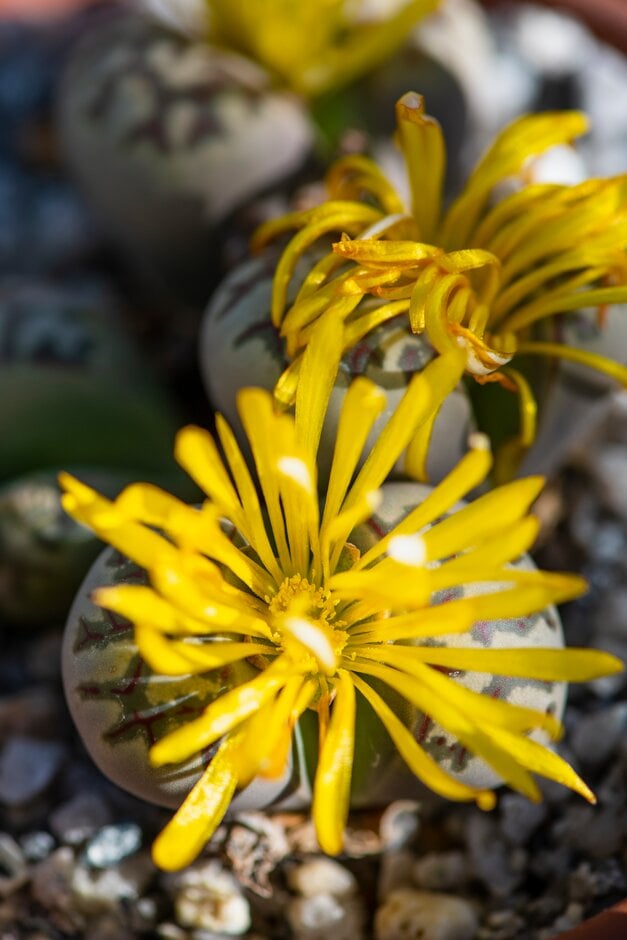
Lithops dorotheae

<em>Lithops</em> <em>dorotheae</em> RHS / Joanna Kossak
Award of Garden Merit
Cactus Succulent

A dwarf, clump-forming succulent with pairs of beige or buff leaves, forming inversely cone-shaped bodies with almost flat upper surfaces. Each leaf has a translucent grey-green panel marked with red lines and dots. Yellow flowers are produced in late summer

Position

Full sun

Soil Types

Loam, Sand

Max Height

Up to 10 cm

Max Spread

0-0.1 metre

Size

Time to Maturity
2–5 years
Max Spread
0-0.1 metre
Max Height
Up to 10 cm

Growing Conditions

Loam Sand
Moisture
Well–drained
pH
Acid or Alkaline or Neutral

Position

Full sun
Aspect
South–facing or West–facing
Exposure
Sheltered
Hardiness
H2

Colour & Scent

Season Stem Flower Foliage Fruit
Spring
Summer
Autumn
Winter

Botanical Details

Family
Aizoaceae
Native to GB/Ireland
No
Foliage
Evergreen
Habit
Submerged, Clump forming
Genus
Lithops are nearly stemless, succulent perennials forming bodies composed of a pair of very fleshy leaves, the flattish tips bearing translucent dots or patches; daisy-like flowers emerge from the fissure between the leaves
Name Status
Correct
Plant Range
South Africa (Northern Cape)

How to Grow

Cultivation

Grow in cactus compost with added leaf mould in full light. From early summer to late autumn, water freely and apply a half-strength liquid feed monthly. Keep dry at other times. See houseplant cacti and succulent cultivation for further information

Propagation

Propagate by sowing seed at 19-24°C in spring or early summer; remove offsets in summer

Suggested planting locations and garden types

  • Houseplants
  • Patio and container plants
  • Low Maintenance
  • Conservatory and greenhouse

Pruning

No pruning required

Pests

May be susceptible to aphids and mealybugs

Diseases

Generally disease-free