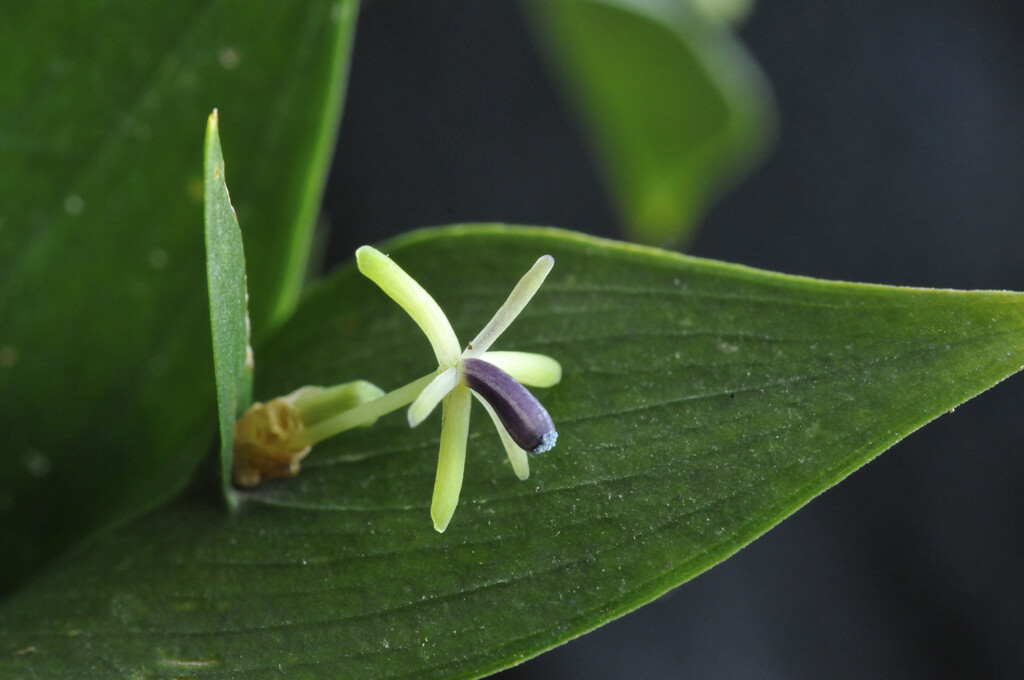
Ruscus hypoglossum

RHS Plant Profile
spineless butcher's broom
spineless butcher's broom visionspictures.com

Other common names

double-leaved butcher's broom, horse tongue, tongue blade, double tongue

Shrubs

A compact, evergreen shrub to around 50cm tall forming clumps of arching stems with pointed, glossy, bright green 'leaves' that are actually modified, flattened shoots called cladodes. Tiny, greenish-cream flowers are borne on the cladodes in spring and may be followed by bright red summer berries

Position

Full shade, Full sun, Partial shade

Soil Types

Chalk, Clay, Loam, Sand

Max Height

0.1-0.5 metres

Max Spread

0.5-1 metres

Size

Time to Maturity
10–20 years
Max Spread
0.5-1 metres
Max Height
0.1-0.5 metres

Growing Conditions

Chalk Clay Loam Sand
Moisture
Moist but well–drained or Well–drained
pH
Acid or Alkaline or Neutral

Position

Full shade Full sun Partial shade
Aspect
East–facing or North–facing or South–facing or West–facing
Exposure
Exposed or Sheltered
Hardiness
H5
Drought Resistance
Yes

Colour & Scent

Season Stem Flower Foliage Fruit
Spring
Summer
Autumn
Winter

Botanical Details

Family
Asparagaceae
Native to GB/Ireland
No
Foliage
Evergreen
Habit
Bushy
Genus
Ruscus are rhizomatous evergreen subshrubs with flattened, leaf-like cladophylls bearing small pale green flowers, followed on female or hermaphrodite plants by glossy red berries
Name Status
Correct
Plant Range
Europe to Turkey

How to Grow

Cultivation

Will grow in almost any garden situation, except waterlogged ground, including dry shade

Propagation

Propagate by seed or by division

Suggested planting locations and garden types

  • Low Maintenance
  • Banks and slopes
  • Flower borders and beds
  • Ground cover

Pruning

Cut out dead stems to the base in spring

Pests

Generally pest-free

Diseases

May be susceptible to honey fungus in gardens where it is present but insufficient data to determine degree of susceptibility