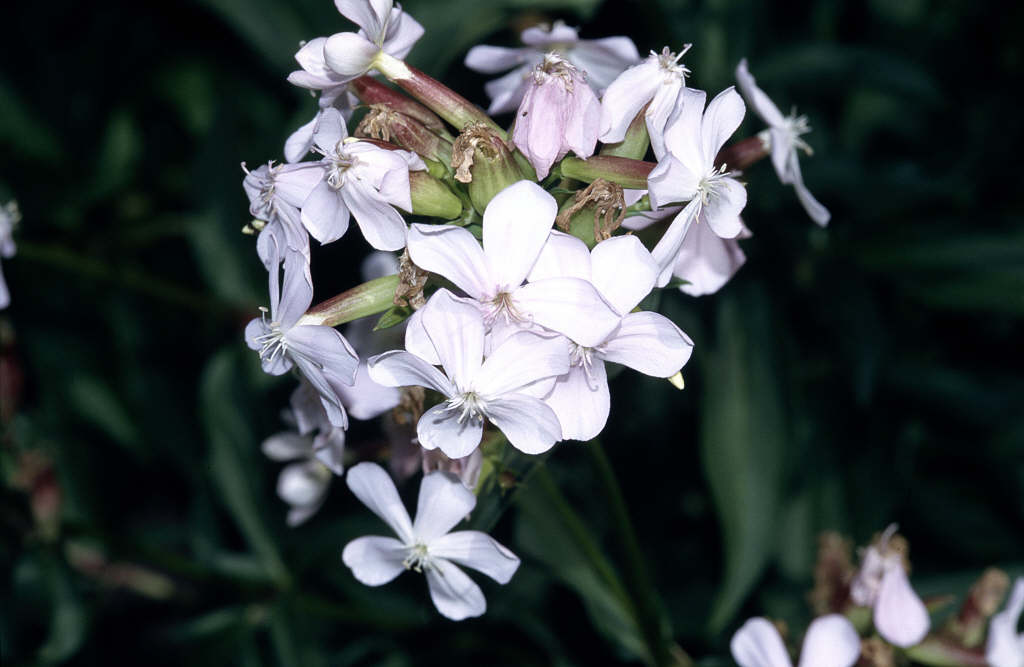
Saponaria officinalis

RHS Plant Profile
soapwort
soapwort RHS 2002

Other common names

Boston pink, bouncing bet, bouncing bett, chimney pink, common soapwort, devil in a bush, farewell to summer, flop top, fuller's herb, Gill-run-by-the-street, hedge pink, Jill-run-by-the-street, lady by the gate, mock gilliflower, old maid's pink, old maid's slipper, soap plant, soap root, sweet Betty, wild sweet William, wood phlox, world's wonder, bruisewort, crow soap, London pride, sheepweed, soapwort gentian

Herbaceous Perennial

A rhizomatous perennial forming wide clumps of upright stems bearing ovate leaves and terminal clusters of fragrant light pink or white flowers in summer and autumn

Position

Full sun

Soil Types

Chalk, Clay, Sand

Max Height

0.5-1 metres

Max Spread

0.1-0.5 metres

Size

Time to Maturity
2–5 years
Max Spread
0.1-0.5 metres
Max Height
0.5-1 metres

Growing Conditions

Chalk Clay Sand
Moisture
Well–drained
pH
Alkaline or Neutral

Position

Full sun
Aspect
West–facing or South–facing or North–facing or East–facing
Exposure
Exposed or Sheltered
Hardiness
H7

Colour & Scent

Fragrance Flower
Season Stem Flower Foliage Fruit
Spring
Summer
Autumn
Winter

Botanical Details

Family
Caryophyllaceae
Native to GB/Ireland
Yes
Foliage
Deciduous
Habit
Clump forming
Genus
Saponaria can be annuals or perennials, with opposite, entire leaves and small clusters of pink or purple flowers in summer
Name Status
Correct
Plant Range
Eurasia

How to Grow

Cultivation

Grow in moderately fertile, well-drained, neutral to alkaline soil in full sun. Tolerates poor soils. May be suitable for beds and borders, but has the potential to become a nuisance and should be carefully managed to control spread

Propagation

Propagate by seed or division

Suggested planting locations and garden types

  • Cottage and informal garden
  • Wildflower meadow
  • Wildlife gardens
  • Low Maintenance

Pruning

No pruning required

Pests

May be susceptible to slugs and snails

Diseases

Generally disease-free