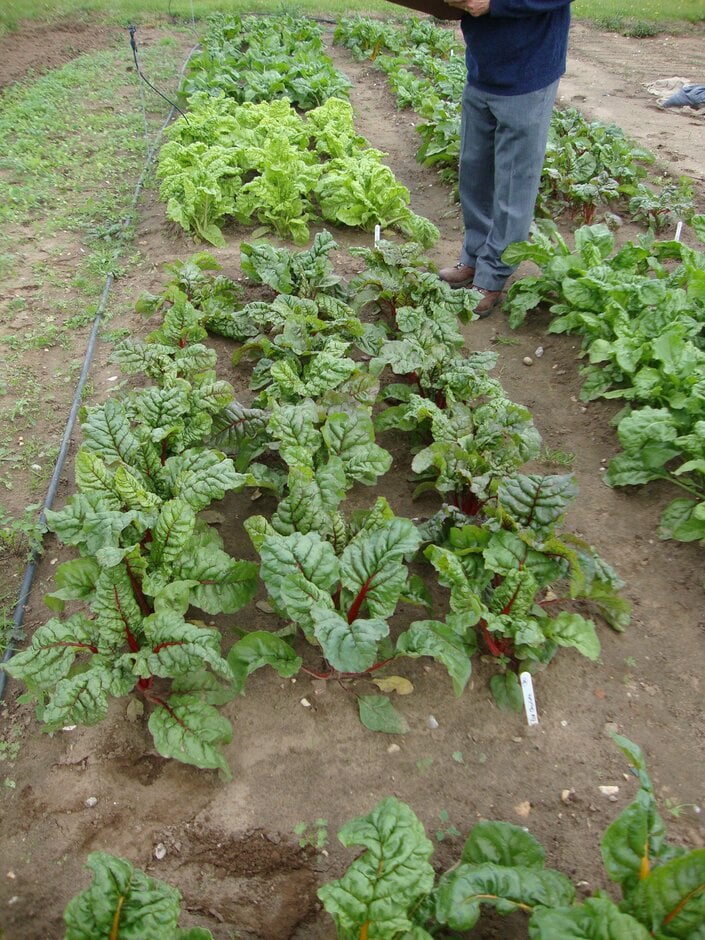
Beta vulgaris subsp. cicla var. flavescens 'Charlotte'

RHS Plant Profile
chard 'Charlotte'
chard 'Charlotte' Michael John Day
Award of Garden Merit
Annual Biennial

A highly ornamental chard with dark green foliage with dark red veining and long, dark red stalks which is why it is sometimes referred to as 'rhubarb chard'. Shows very good resistance to bolting and good for growing in pots and ornamental borders. Sow March-May, plant out May to September. Young leaves can be harvested for salads within around 8 weeks

Position

Full sun, Partial shade

Soil Types

Clay, Loam

Max Height

0.1-0.5 metres

Max Spread

0.1-0.5 metres

Size

Time to Maturity
1–2 years
Max Spread
0.1-0.5 metres
Max Height
0.1-0.5 metres

Growing Conditions

Clay Loam
Moisture
Moist but well–drained
pH
Acid or Alkaline or Neutral

Position

Full sun Partial shade
Aspect
East–facing or North–facing or South–facing or West–facing
Exposure
Sheltered
Hardiness
H3

Colour & Scent

Season Stem Flower Foliage Fruit
Spring
Summer
Autumn
Winter

Botanical Details

Family
Amaranthaceae
Native to GB/Ireland
No
Foliage
Deciduous
Habit
Clump forming
Genus
Beta can be annual, biennial or perennial plants, often with rosettes of basal leaves and thick, fleshy roots. The genus includes a range of wild species, as well as cultivated food crops such as beetroot, chard and sugar beet
Name Status
Unresolved

How to Grow

Cultivation

Grow in fertile soil in full sun or partial shade. Add compost or well-rotted manure in the autumn and keep watered in dry conditions. See chard cultivation for further advice

Propagation

Propagate by seed. See sowing vegetable seeds

Suggested planting locations and garden types

  • City and courtyard gardens
  • Cottage and informal garden
  • Patio and container plants
  • Flower borders and beds

Pruning

No pruning required. Remove outer leaves when large enough

Pests

May be susceptible to birds, cutworms, lettuce root maggot, root aphid, root knot eelworm and slugs and snails

Diseases

May be susceptible to grey mould, lettuce downy mildew, mosaic virus and ring spot