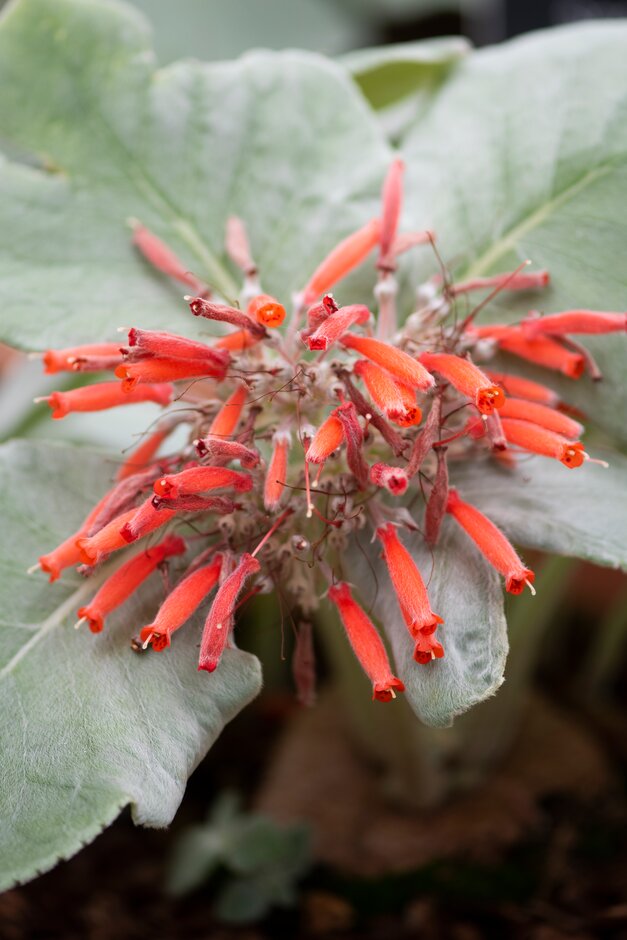
Sinningia canescens

RHS Plant Profile
Brazilian edelweiss
Brazilian edelweiss RHS / Joanna Kossak
Award of Garden Merit
Conservatory Greenhouse Herbaceous Perennial

An erect tuberous perennial to 30cm, with grey-green obovate leaves to 15cm in length, covered with silky hairs, and small clusters of tubular orange-red or rose-pink flowers 2.5cm in length

Position

Partial shade

Soil Types

Loam, Sand

Max Height

0.1-0.5 metres

Max Spread

0.1-0.5 metres

Size

Time to Maturity
1–2 years
Max Spread
0.1-0.5 metres
Max Height
0.1-0.5 metres

Growing Conditions

Loam Sand
Moisture
Moist but well–drained
pH
Acid or Neutral

Position

Partial shade
Aspect
West–facing or South–facing or East–facing
Exposure
Exposed or Sheltered
Hardiness
H1A

Botanical Details

Family
Gesneriaceae
Native to GB/Ireland
No
Foliage
Deciduous
Habit
Clump forming
Genus
Sinningia can be deciduous, tuberous perennials or small, deciduous or evergreen shrubs, with simple, fleshy leaves and large, bell-shaped, to tubular flowers in summer
Name Status
Correct
Plant Range
Brazil

How to Grow

Cultivation

Grow in moist but well-drained, humus-rich, neutral to acid soil in partial shade

Propagation

Propagate by seed or tubers

Suggested planting locations and garden types

  • Patio and container plants

Pruning

Cut back after flowering

Pests

May be susceptible to leafhoppers and thrips

Diseases

Generally disease-free