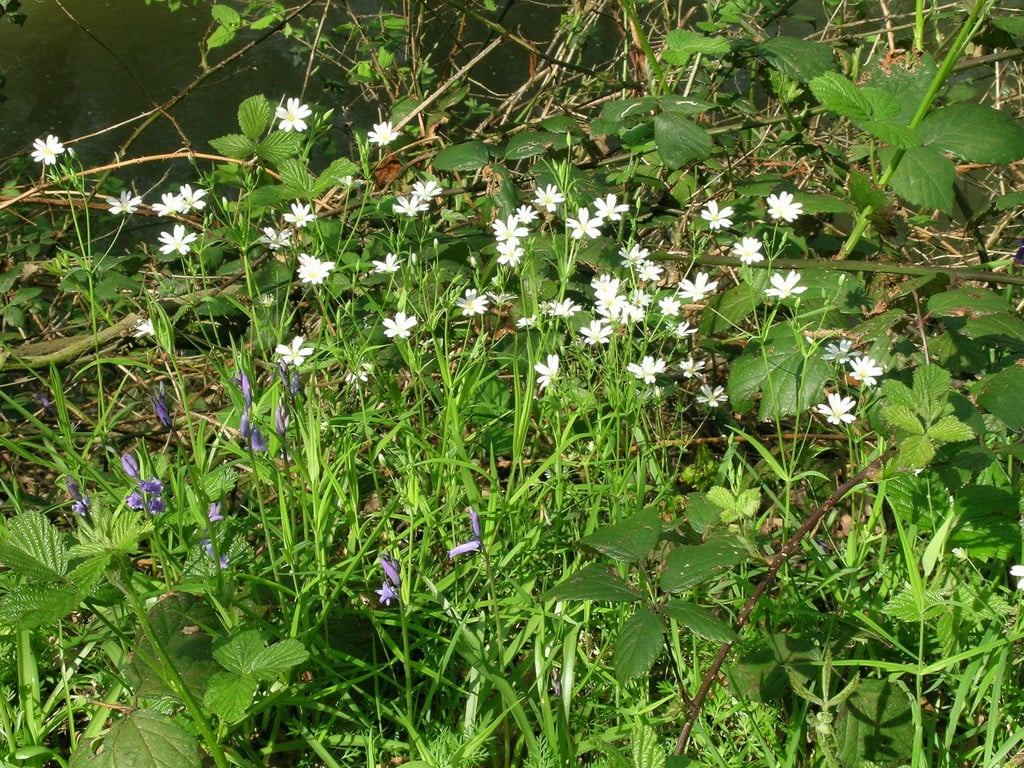
Stellaria holostea

RHS Plant Profile
greater stitchwort
greater stitchwort RHS

Other common names

ag-flower, ag-worm flower, all-bone, break-bones, devil's corn, Easter bells, greater starwort, lady's lint, lady's white petticoat, Latin flower, little John, May grass, miller's star, snap Jack, snappers, snap-stalks, starflower, thunder flower, tongue grass, adder's meat, bird's tongue, devil's eye, moonflower, satin flower, snake flower, snake grass

Plants for pollinators
Herbaceous Perennial

A perennial that reaches around 50cm in height. Stems are brittle, leaves are grass-like and both are rough-edged and greyish-green. White flowers, with five deeply-notched petals, are borne in spring and early summer, followed by seed capsules that make a popping sound when ripe

Position

Partial shade

Soil Types

Chalk, Clay, Loam

Max Height

0.5-1 metres

Max Spread

0-0.1 metre

Size

Time to Maturity
2–5 years
Max Spread
0-0.1 metre
Max Height
0.5-1 metres

Growing Conditions

Chalk Clay Loam
Moisture
Moist but well–drained
pH
Acid or Neutral

Position

Partial shade
Aspect
South–facing or West–facing or East–facing
Exposure
Exposed or Sheltered
Hardiness
H7

Colour & Scent

Season Stem Flower Foliage Fruit
Spring
Summer
Autumn
Winter

Botanical Details

Family
Caryophyllaceae
Native to GB/Ireland
Yes
Foliage
Semi evergreen
Habit
Clump forming
Genus
Stellaria can be annuals or herbaceous perennials, with slender stems bearing simple, opposite leaves and terminal cymes of white flowers with 5 deeply notched petals
Name Status
Correct
Plant Range
Europe, N. Africa

How to Grow

Cultivation

Prefers moist, mildly acidic infertile soils. Occurs in woodland and hedgerows in semi-shaded sites

Propagation

Propagate by seed

Suggested planting locations and garden types

  • Wildlife gardens
  • Wildflower meadow

Pruning

No pruning required

Pests

Generally pest-free

Diseases

Generally disease-free