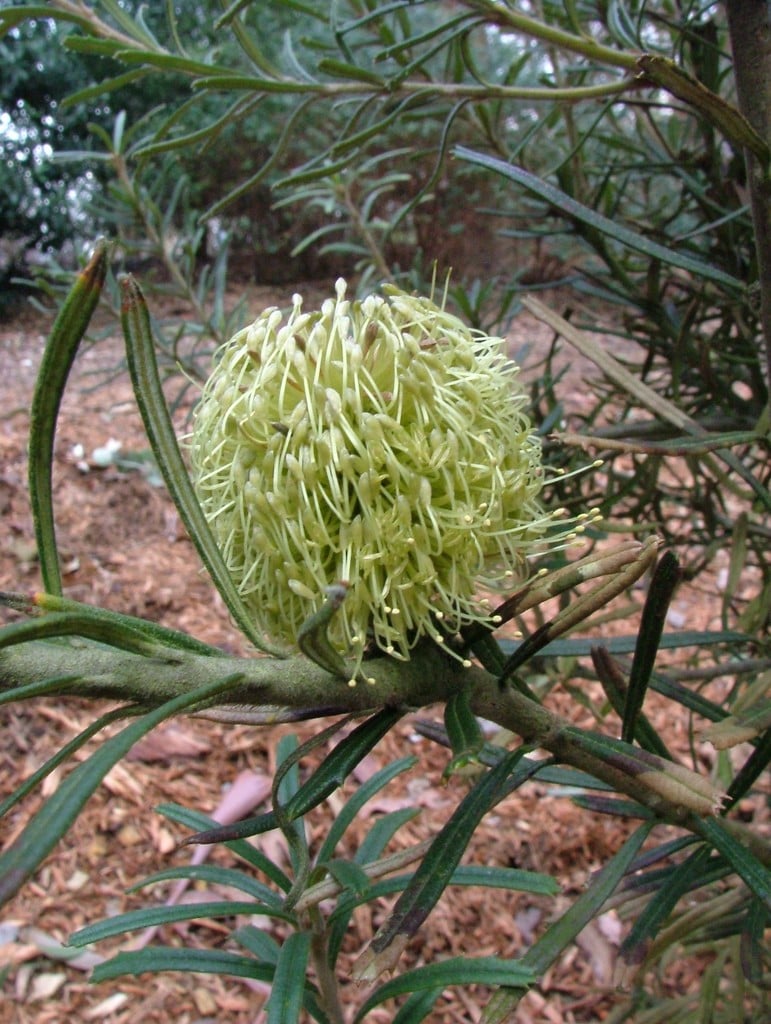
Banksia marginata

RHS Plant Profile
silver banksia
silver banksia RHS

Other common names

honeysuckle tree, Tasmanian honeysuckle

Conservatory Greenhouse Shrubs Trees

A very variable plant, usually a medium-sized shrub to about 2m but may be dwarf and spreading or develop into a large tree. The evergreen leaves are narrow, leathery, dark green on top with rolled edges and silvery underneath. Upright, cylindrical, pale yellow, bottlebrush flower heads appear in summer, followed by long-lasting, silvery- brown, cone-like fruit

Position

Full sun

Soil Types

Loam, Sand

Max Height

1.5-2.5 metres

Max Spread

1.5-2.5 metres

Size

Time to Maturity
5–10 years
Max Spread
1.5-2.5 metres
Max Height
1.5-2.5 metres

Growing Conditions

Loam Sand
Moisture
Well–drained
pH
Acid or Neutral

Position

Full sun
Aspect
West–facing or South–facing
Exposure
Exposed or Sheltered
Hardiness
H2
Drought Resistance
Yes

Colour & Scent

Season Stem Flower Foliage Fruit
Spring
Summer
Autumn
Winter

Botanical Details

Family
Proteaceae
Native to GB/Ireland
No
Foliage
Evergreen
Habit
Bushy
Genus
Banksia are evergreen shrubs and trees with leathery, often handsome, simple or pinnately lobed leaves and many small tubular flowers in dense spikes forming showy, cone-like heads, followed by woody fruiting clusters
Name Status
Correct
Plant Range
E Australia, Tasmania

How to Grow

Cultivation

Requires frost-free conditions, but can tolerate drought and salty wind. Outdoors, grow in free-draining, neutral to acid soil that is low in phosphates and nitrates, in full sun. Under glass grow in equal parts peat-free, loam-based potting compost, grit and peat substitute in full light with good ventilation. Apply half-strength, phosphate-free fertiliser once a month while in growth

Propagation

Propagate by seed sown singly in small containers at 18C in spring or by semi-ripe cuttings in summer with bottom heat

Suggested planting locations and garden types

  • City and courtyard gardens
  • Patio and container plants
  • Mediterranean climate plants
  • Coastal

Pests

Generally problem free

Diseases

Outdoors may suffer from phytophthora root rot