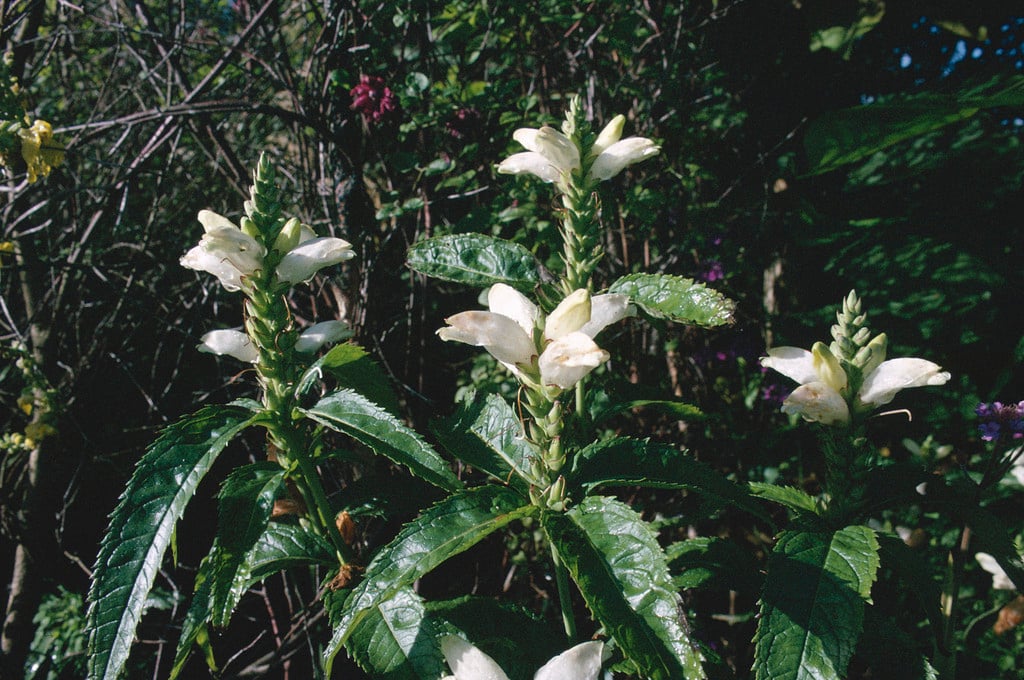
Chelone glabra

RHS Plant Profile
balmony
balmony RHS

Other common names

rheumatism wort, salt rheumweed, snakehead, turtle bloom, turtlehead, shell flower

Synonyms

Chelone glabra white-flowered
Chelone obliqua var. alba
Chelone glabra subsp. linifolia
Chelone glabra var. linifolia

Herbaceous Perennial

A moisture-loving plant of upright growth to 90cm tall, with lance-shaped leaves to 20cm long, and white or pink-tinged flowers 2.5cm long in late summer

Position

Full sun, Partial shade

Soil Types

Chalk, Clay, Loam

Max Height

0.5-1 metres

Max Spread

0.1-0.5 metres

Size

Time to Maturity
2–5 years
Max Spread
0.1-0.5 metres
Max Height
0.5-1 metres

Growing Conditions

Chalk Clay Loam
Moisture
Moist but well–drained or Poorly–drained
pH
Acid or Alkaline or Neutral

Position

Full sun Partial shade
Aspect
South–facing or East–facing or North–facing or West–facing
Exposure
Exposed or Sheltered
Hardiness
H5

Colour & Scent

Season Stem Flower Foliage Fruit
Spring
Summer
Autumn
Winter

Botanical Details

Family
Plantaginaceae
Native to GB/Ireland
No
Foliage
Deciduous
Habit
Bushy
Genus
Chelone are herbaceous perennials with undivided, paired leaves and short terminal spikes of showy, 2-lipped, tubular flowers opening from late summer to early autumn
Name Status
Correct
Plant Range
USA

How to Grow

Cultivation

Grow in moist to wet soil in part-shade to shade. More sun can be tolerated if the soil is wetter

Propagation

Propagate by seed or by division in spring. Stem-tip cuttings can be taken in spring (see softwood cuttings)

Suggested planting locations and garden types

  • Cottage and informal garden
  • Flower borders and beds

Pruning

No pruning required, other than cutting back at the end of the season

Pests

Generally pest-free

Diseases

Powdery mildews, rust diseases and a fungal leaf spot are sometimes problems