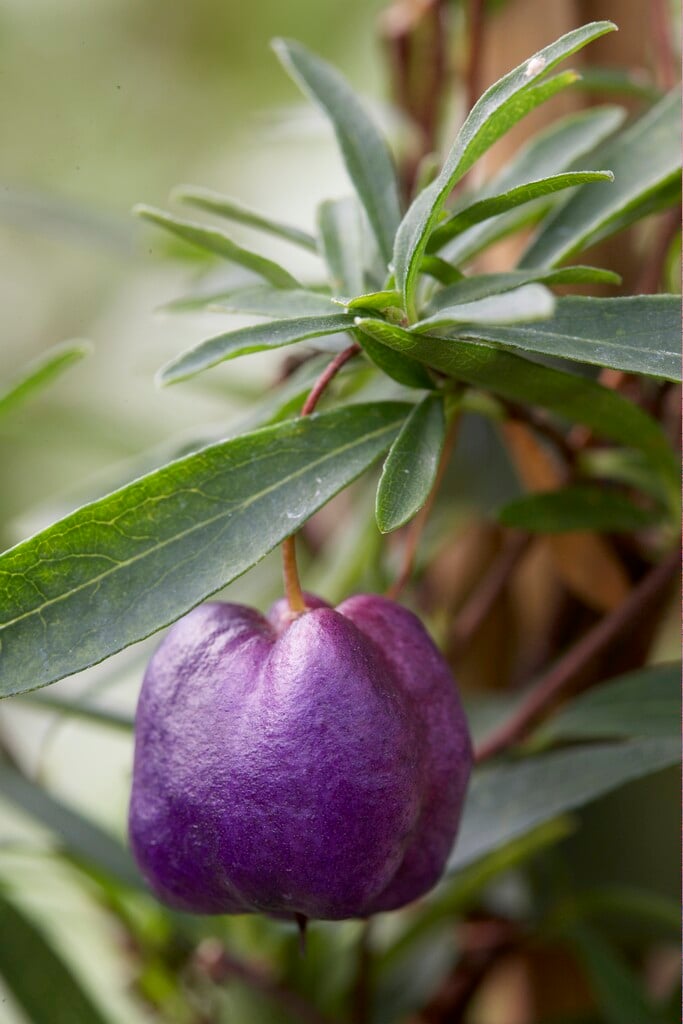
Billardiera longiflora

RHS Plant Profile
purple apple berry
purple apple berry visionspictures.com

Other common names

blueberry, long-flowered apple berry, oval-flowered apple berry

Climber Wall Shrub Conservatory Greenhouse

A twining evergreen perennial to 2m, with lance-shaped, dark green leaves and solitary, bell-shaped, yellow-green or purple-tinged flowers 3cm in length, followed by vivid violet berries 2.5cm in length

Position

Full sun, Partial shade

Soil Types

Chalk, Loam, Sand

Max Height

1.5-2.5 metres

Max Spread

0.5-1 metres

Size

Time to Maturity
2–5 years
Max Spread
0.5-1 metres
Max Height
1.5-2.5 metres

Growing Conditions

Chalk Loam Sand
Moisture
Moist but well–drained or Well–drained
pH
Acid or Alkaline or Neutral

Position

Full sun Partial shade
Aspect
East–facing or South–facing or West–facing
Exposure
Sheltered
Hardiness
H3

Colour & Scent

Season Stem Flower Foliage Fruit
Spring
Summer
Autumn
Winter

Botanical Details

Family
Pittosporaceae
Native to GB/Ireland
No
Foliage
Evergreen
Habit
Climbing
Genus
Billardiera are twining evergreen climbing perennials with simple, alternate leaves and solitary or clustered, bell-shaped flowers, followed by brightly coloured berries
Name Status
Correct
Plant Range
Tasmania, SE Australia

How to Grow

Cultivation

Under glass, grow in peat-free compost, in full light with shade from hot sun. During growth, water moderately and apply a balanced liquid fertiliser monthly. Maintain low to moderate humidity. Can be grown outdoors in frost-free areas in moderately fertile, humus-rich, moist but well-drained soil in full sun. Apply a dry winter mulch. Provide support for climbing stems

Propagation

Propagate by seed as soon as ripe at 13 to 15°C in autumn. Layering in spring or strike softwood cuttings in early summer with bottom heat or semi-ripe cuttings in late summer

Suggested planting locations and garden types

  • City and courtyard gardens
  • Cottage and informal garden
  • Mediterranean climate plants
  • Patio and container plants
  • Climber and wall shrubs
  • Conservatory and greenhouse
  • Wall side borders

Pruning

Pruning group 11, trim after flowering

Pests

May be susceptible to glasshouse red spider mite.

Diseases

Generally disease-free