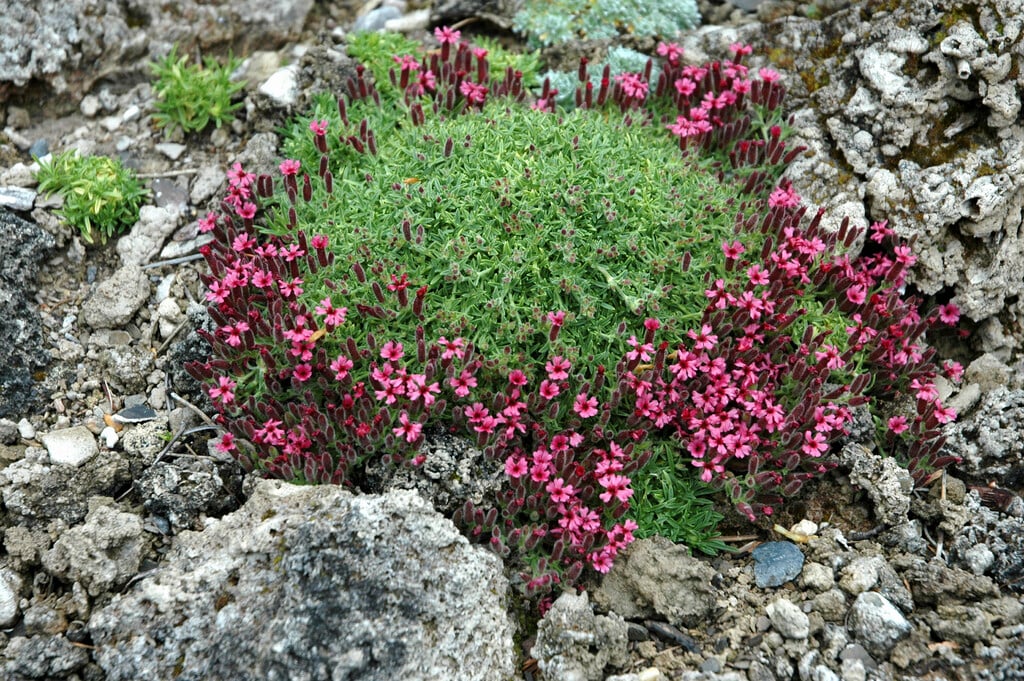
Saponaria pumilio Boiss.
A very compact, rhizomatous alpine perennial to around only 5cm in height, forming a cushion of small, thin, almost pine-needle shaped dark green foliage. Clusters of crimson-red to pale purple, rarely white flowers appear on the tips of the stems from late summer well into autumn

Size
Ultimate height
Up to 10cmTime to ultimate height
2–5 yearsUltimate spread
0.1–0.5 metresGrowing conditions
Moisture
Well–drainedpH
Alkaline, NeutralColour & scent
| Stem | Flower | Foliage | Fruit | |
| Spring | Green | |||
|---|---|---|---|---|
| Summer | Red Purple White | Green | ||
| Autumn | Red Purple White | Green | ||
| Winter |
Position
- Full sun
Aspect
South–facing
Exposure
Exposed or Sheltered Hardiness
H7Botanical details
- Family
- Caryophyllaceae
- Native to GB / Ireland
- No
- Foliage
- Deciduous
- Habit
- Clump forming
- Genus
Saponaria can be annuals or perennials, with opposite, entire leaves and small clusters of pink or purple flowers in summer
- Name status
Correct
How to grow
Cultivation
Grow in moderately fertile, well-drained, neutral to alkaline soil in full sun. Tolerates poor soils
Propagation
Propagate by seeds in spring, sown indoors in loamy compost, barely covering the seed, with a temperature of 13-18°C. Cuttings can be taken in late summer, or divide in early spring
Suggested planting locations and garden types
- City and courtyard gardens
- Cottage and informal garden
- Gravel garden
- Rock garden
- Patio and container plants
- Banks and slopes
Pruning
No pruning required
Pests
Diseases
Generally disease-free
Get involved
The Royal Horticultural Society is the UK’s leading gardening charity. We aim to enrich everyone’s life through plants, and make the UK a greener and more beautiful place.