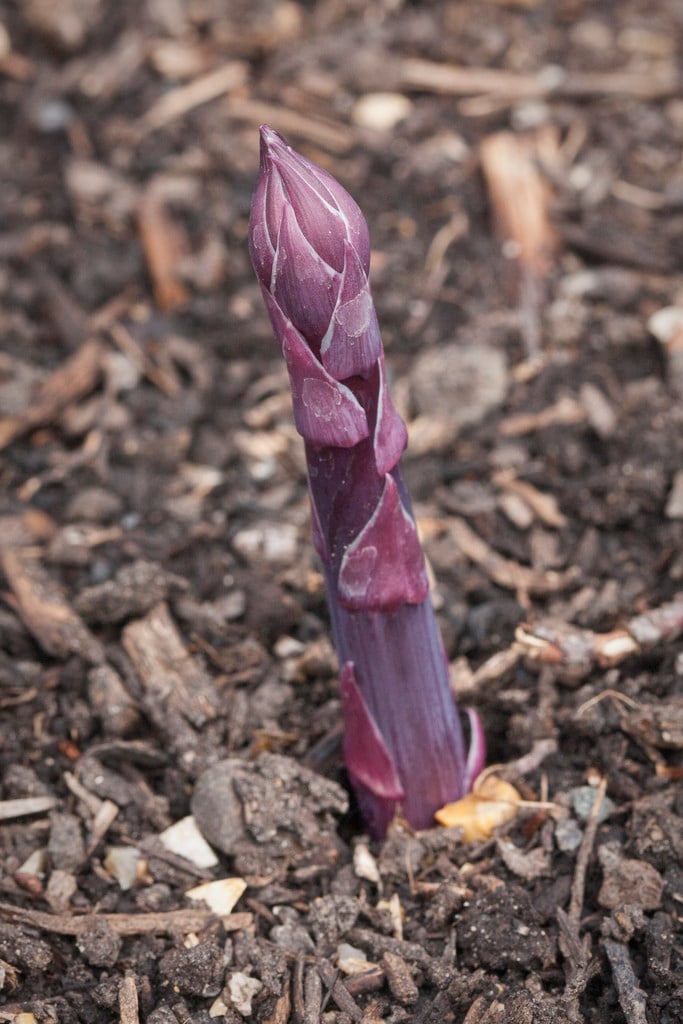
Asparagus officinalis 'Stewart's Purple'

<em>Asparagus</em> <em>officinalis</em> 'Stewart's Purple' RHS

Synonyms

Asparagus 'Stewart's Purple'

Plants for pollinators
Herbaceous Perennial

An upright, clump-forming perennial grown for its edible, rich dark purple shoots, known as spears, harvested from mid-spring to early summer. Once cropping has stopped, tall, branching stems develop with airy, feathery, mid-green foliage, 1.5 x 1.5m. Small, inconspicuous, green and white flowers may be followed by sparse red berries

Position

Full sun

Soil Types

Chalk, Clay, Loam, Sand

Max Height

1-1.5 metres

Max Spread

1-1.5 metres

Size

Time to Maturity
2–5 years
Max Spread
1-1.5 metres
Max Height
1-1.5 metres

Growing Conditions

Chalk Clay Loam Sand
Moisture
Well–drained
pH
Alkaline or Neutral

Position

Full sun
Aspect
South–facing or West–facing
Exposure
Sheltered
Hardiness
H4

Colour & Scent

Season Stem Flower Foliage Fruit
Spring
Summer
Autumn
Winter

Botanical Details

Family
Asparagaceae
Native to GB/Ireland
No
Foliage
Deciduous
Habit
Bushy, Columnar upright
Potentially harmful
The young shoots (spears) are edible when cooked. Wear gloves for picking spears as they may a cause skin allergy. Fruits are harmful if eaten
Genus
Asparagus can be evergreen or deciduous perennials or subshrubs, sometimes climbing, with tuberous rootstock. Stems bear both inconspicuous scale-like leaves and larger, leaf-like phylloclades, with small white or pinkish flowers followed by red berries
Name Status
Accepted

How to Grow

Cultivation

Grow in well-drained soil, or a raised bed, in a sunny position. See Grow your own asparagus

Propagation

Propagate by crowns. Although propagation by seed is possible, it is not advisable as seedlings take longer, and may not be male cultivars which produce better plants

Suggested planting locations and garden types

  • Wildlife gardens

Pruning

Cut foliage down to ground level once it yellows in autumn

Pests

May be susceptible to asparagus beetle, slugs and snails

Diseases

May be susceptible to foot and root rots and violet root rot