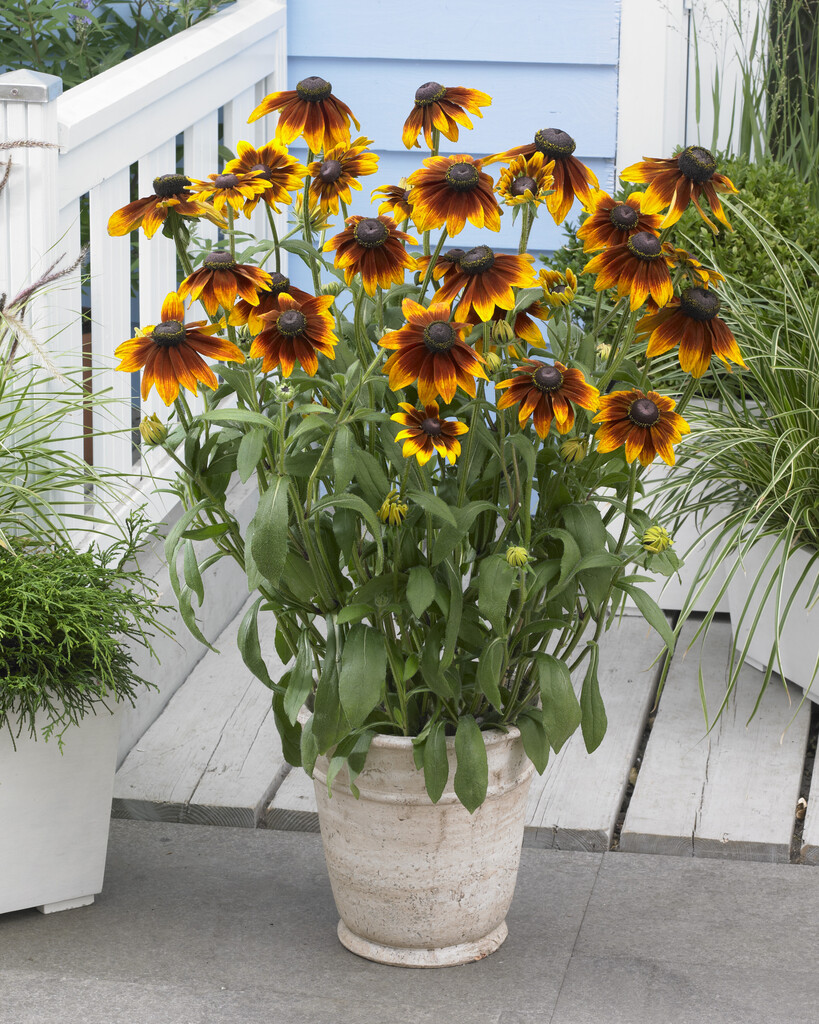
Rudbeckia 'Berlin'
coneflower 'Berlin'
A compact, deciduous perennial often grown as an annual/biennial with green foliage and broad, flat bright yellow and brown daisy-like sterile flowers with a dark mahogany red eyezone and dark brown button-shaped centre, appearing from July to September

Buy this plant
Size
Ultimate height
0.5–1 metresTime to ultimate height
1–2 yearsUltimate spread
0.1–0.5 metresGrowing conditions
Moisture
Moist but well–drained, Well–drainedpH
Acid, Alkaline, NeutralColour & scent
| Stem | Flower | Foliage | Fruit | |
| Spring | ||||
|---|---|---|---|---|
| Summer | ||||
| Autumn | ||||
| Winter |
Position
- Full sun
- Partial shade
Aspect
South–facing or West–facing
Exposure
Exposed or Sheltered Hardiness
H3Botanical details
- Family
- Asteraceae
- Native to GB / Ireland
- No
- Foliage
- Deciduous
- Habit
- Columnar upright
- Genus
Rudbeckia may be annuals, biennials or rhizomatous herbaceous perennials, with simple or pinnately divided leaves and large daisy-like flower-heads with yellow or orange rays surrounding a prominent conical disk
- Name status
Unresolved
How to grow
Cultivation
Plant in moderately fertile, well-drained soil in full sun. See rudbeckia cultivation for further advice
Propagation
Propagate by division
Suggested planting locations and garden types
- City and courtyard gardens
- Cottage and informal garden
- Patio and container plants
- Coastal
- Cut flowers
- Flower borders and beds
- Bedding
- Conservatory and greenhouse
Pruning
Deadhead spent flowers
Pests
Generally pest-free
Diseases
May be susceptible to grey moulds if air circulation is poor
Get involved
The RHS is the UK’s gardening charity, helping people and plants to grow - nurturing a healthier, happier world, one person and one plant at a time.