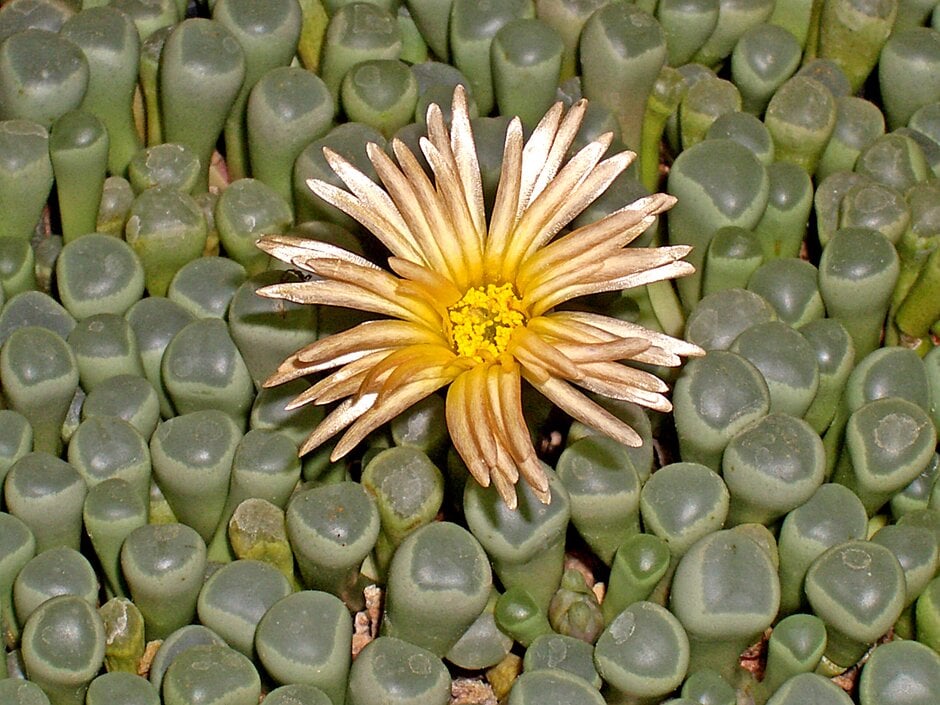
Fenestraria rhopalophylla subsp. aurantiaca

RHS Plant Profile
baby's toes
baby's toes Terence Smale

Synonyms

Fenestraria aurantiaca f. rhopalophylla
Fenestraria aurantiaca

Award of Garden Merit
Cactus Succulent Houseplants Conservatory Greenhouse

A succulent perennial which grows into a low mat of erect, club-shaped greyish leaves, with daisy-like bright yellow flowers to 7cm across from late summer

Position

Full sun

Soil Types

Loam, Sand

Max Height

Up to 10 cm

Max Spread

0.1-0.5 metres

Size

Time to Maturity
5–10 years
Max Spread
0.1-0.5 metres
Max Height
Up to 10 cm

Growing Conditions

Loam Sand
Moisture
Well–drained
pH
Acid or Alkaline or Neutral

Position

Full sun
Aspect
South–facing or North–facing or West–facing or East–facing
Exposure
Sheltered
Hardiness
H2

Colour & Scent

Season Stem Flower Foliage Fruit
Spring
Summer
Autumn
Winter

Botanical Details

Family
Aizoaceae
Native to GB/Ireland
No
Foliage
Evergreen
Habit
Clump forming
Genus
Fenetraria are cushion-forming perennial succulents with erect, club-shaped leaves with translucent windows in the tips, and daisy-like yellow, orange or whtie flowers in late summer and autumn
Name Status
Correct
Plant Range
S Africa (Cape)

How to Grow

Cultivation

Grow under glass in a standard cactus compost, in full light. Provide low humidity. Water freely when in growth and keep just moist at other times. Apply a dilute low nitrogen fertilizer fortnightly during late spring and summer. Stand outside in summer

Propagation

Propagate by seed or offsets

Suggested planting locations and garden types

  • Patio and container plants
  • Low Maintenance

Pruning

No pruning required

Pests

May be susceptible to mealybugs

Diseases

Generally disease-free