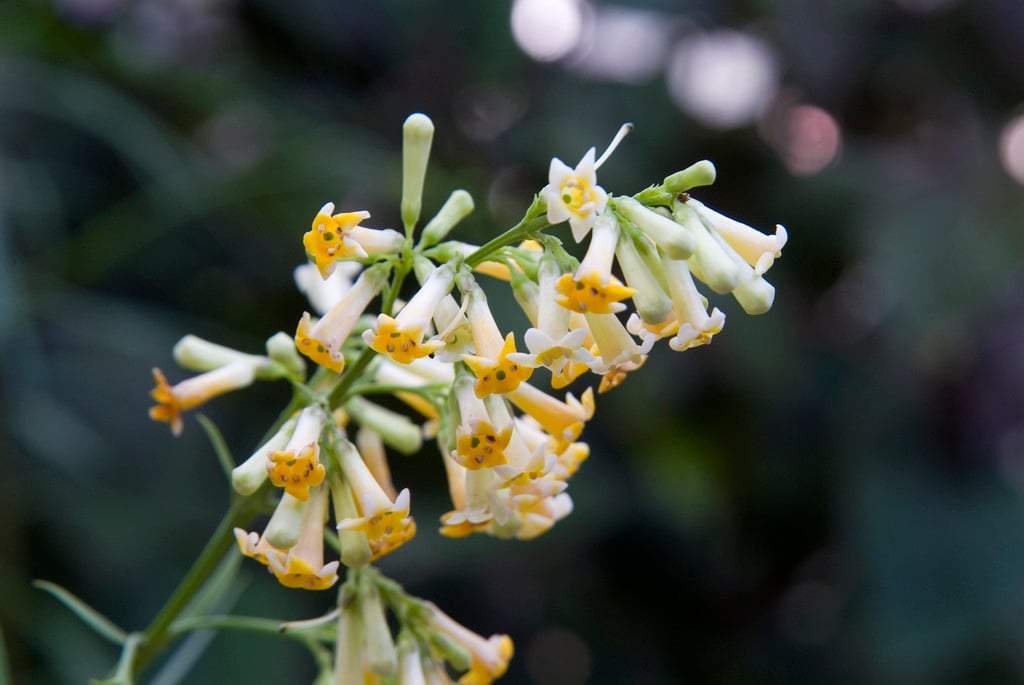
Freylinia lanceolata

RHS Plant Profile
honey bells
honey bells RHS

Synonyms

Freylinia cestroides
Capraria lanceolata

Shrubs

A large, evergreen shrub or small tree, with arching branches of willow-like foliage and large, terminal sprays of small, fragrant, tubular white, cream and gold flowers in late summer and early autumn

Position

Full sun

Soil Types

Clay, Loam

Max Height

2.5-4 metres

Max Spread

2.5-4 metres

Size

Time to Maturity
5–10 years
Max Spread
2.5-4 metres
Max Height
2.5-4 metres

Growing Conditions

Clay Loam
Moisture
Moist but well–drained
pH
Acid or Alkaline or Neutral

Position

Full sun
Aspect
South–facing or West–facing
Exposure
Sheltered
Hardiness
H3

Colour & Scent

Fragrance Flower
Season Stem Flower Foliage Fruit
Spring
Summer
Autumn
Winter

Botanical Details

Family
Scrophulariaceae
Native to GB/Ireland
No
Foliage
Evergreen
Habit
Bushy
Genus
Freylinia are evergreen shrubs with leaves varying from long and narrow to short and rounded, and producing terminal sprays or clusters of tubular white, cream, yellow, red or purple flowers with five petal lobes
Name Status
Correct
Plant Range
Temp S Africa

How to Grow

Cultivation

In mild areas grow in a sunny, sheltered position in moist, fertile soil; otherwise grow in an unheated greenhouse

Propagation

Propagate by seed or by semi-ripe cuttings

Suggested planting locations and garden types

  • City and courtyard gardens
  • Coastal
  • Mediterranean climate plants
  • Wall side borders

Pruning

Pruning group 1

Pests

Generally pest-free

Diseases

Generally disease-free