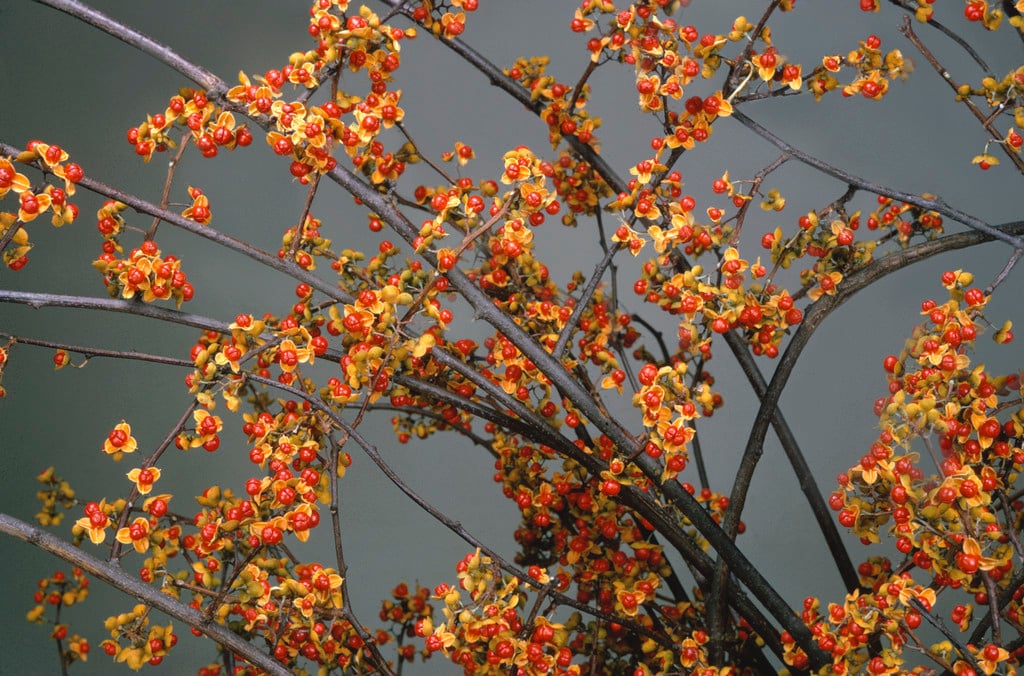
Celastrus orbiculatus

RHS Plant Profile
staff vine
staff vine RHS

Other common names

oriental bittersweet

Synonyms

Celastrus articulatus

Climber Wall Shrub Shrubs

A strong-growing deciduous climber with rounded leaves, colouring butter-yellow in autumn, and inconspicuous greenish flowers followed by yellow fruits which may split to show scarlet seeds. A hermaphrodite form is available, so fruit can appear from a single plant. This is a large species, growing as a twining vine, sometimes to more than 12m

Position

Full sun, Partial shade

Soil Types

Chalk, Loam, Sand

Max Height

8-12 metres

Max Spread

4-8 metres

Size

Time to Maturity
10–20 years
Max Spread
4-8 metres
Max Height
8-12 metres

Growing Conditions

Chalk Loam Sand
Moisture
Well–drained
pH
Acid or Alkaline or Neutral

Position

Full sun Partial shade
Aspect
North–facing or West–facing or East–facing or South–facing
Exposure
Exposed or Sheltered
Hardiness
H6

Colour & Scent

Season Stem Flower Foliage Fruit
Spring
Summer
Autumn
Winter

Botanical Details

Family
Celastraceae
Native to GB/Ireland
No
Foliage
Deciduous
Habit
Climbing
Potentially harmful
Harmful if eaten. Wear gloves and other protective equipment when handling Pets (dogs, cats): Harmful if eaten - see the HTA guide to potentially harmful plants for further information and useful contact numbers
Genus
Celastrus are fast-growing deciduous, rarely evergreen, climbers with scandent or twining stems bearing alternate leaves and inconspicuous greenish flowers followed by attractive fruits. Male and female flowers are often borne on separate plants
Name Status
Correct
Plant Range
NE Asia

How to Grow

Cultivation

Grows best in well-drained soil in full sun, but will tolerate partial shade. To ensure fruit production, plant a male and a female together. Can be grown up large trees of at least 10m in height. Strong supports are needed for this vigorous species

Propagation

Propagate by seed in containers in an open frame as soon as ripe, or in spring as soon as ripe, or in spring. Root cuttings in winter or semi-ripe cuttings in summer

Suggested planting locations and garden types

  • Wall side borders

Pruning

Pruning group 11 in spring or winter

Pests

Generally pest-free

Diseases

Generally disease-free