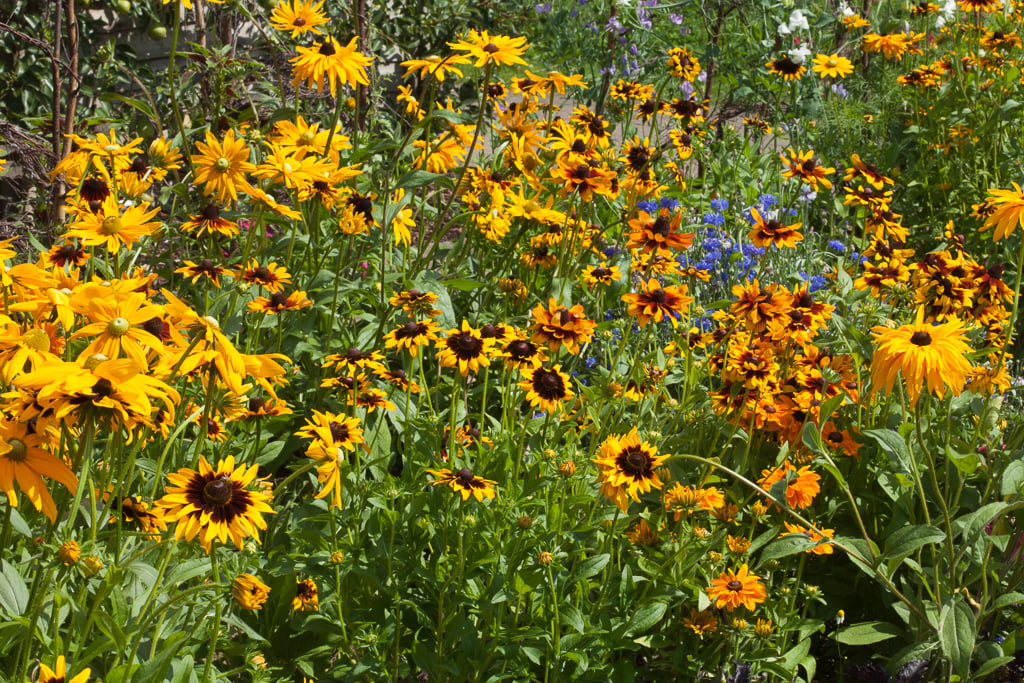
Rudbeckia Summerina Series

RHS Plant Profile
coneflower Summerina Series
coneflower Summerina Series John Fielding
Plants for pollinators
Herbaceous Perennial

Bushy upright, clump-forming herbaceous perennials to 60cm with lance-shaped somewhat toothed dark green hairy leaves. Numerous large flowers often darker towards the base around a brown central cone in shades of yellow, orange and coppery browns produced in summer. This series incorporates the appearance of a rudbeckia and the hardiness of an echinacea, flowering over a long period from summer into autumn

Position

Full shade, Partial shade

Soil Types

Clay, Loam

Max Height

0.5-1 metres

Max Spread

0.5-1 metres

Size

Time to Maturity
2–5 years
Max Spread
0.5-1 metres
Max Height
0.5-1 metres

Growing Conditions

Clay Loam
Moisture
Moist but well–drained or Well–drained
pH
Acid or Alkaline or Neutral

Position

Full shade Partial shade
Aspect
South–facing or West–facing
Exposure
Exposed or Sheltered
Hardiness
H4

Colour & Scent

Season Stem Flower Foliage Fruit
Spring
Summer
Autumn
Winter

Botanical Details

Family
Asteraceae
Native to GB/Ireland
No
Foliage
Deciduous
Habit
Columnar upright
Genus
Rudbeckia may be annuals, biennials or rhizomatous herbaceous perennials, with simple or pinnately divided leaves and large daisy-like flower-heads with yellow or orange rays surrounding a prominent conical disk
Name Status
Unresolved

How to Grow

Cultivation

Grow in well-drained or moist, but well-drained, moderately fertile soil in a sunny spot or light dappled shade. Able to tolerate drought conditions once well established

Propagation

Propagate by division

Suggested planting locations and garden types

  • City and courtyard gardens
  • Cottage and informal garden
  • Patio and container plants
  • Prairie planting
  • Cut flowers
  • Flower borders and beds

Pruning

Cut back stems after flowering or leave for winter interest

Pests

Generally pest-free

Diseases

May be susceptible to grey moulds if air circulation is poor