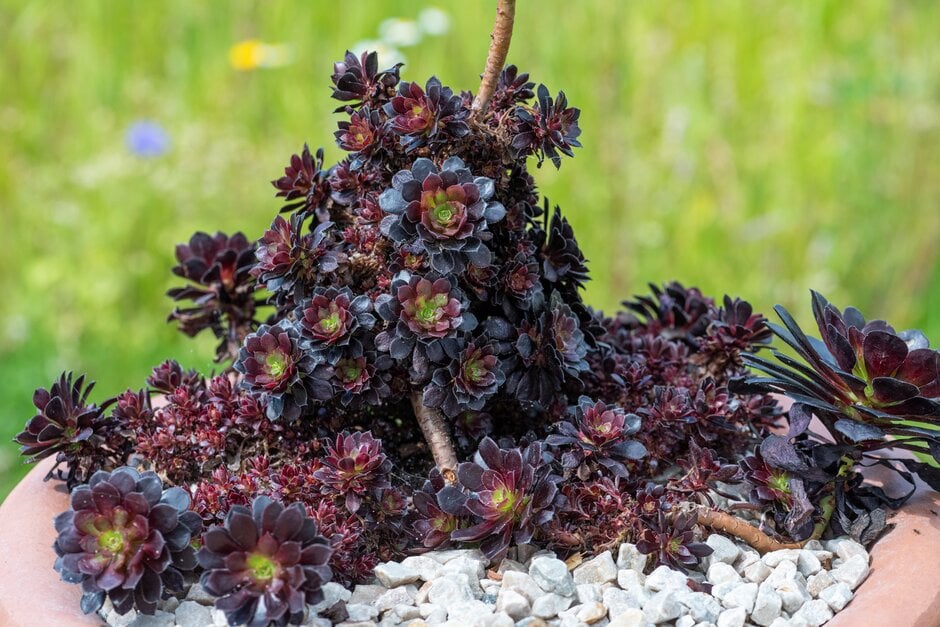
Aeonium arboreum 'Tip Top'

RHS Plant Profile
houseleek tree 'Tip Top'
houseleek tree 'Tip Top' RHS
Cactus Succulent Conservatory Greenhouse

A frost-tender, evergreen sub-shrub making a compact mound of closely-packed leaf rosettes. The succulent leaves are are green at the centre of the rosette, darkening through burgundy to almost black at the edge of the rosette. Domed clusters of small, starry yellow flowers are sometimes produced in summer. A good patio pot plant but will require winter protection in all but the mildest of areas

Position

Full sun, Partial shade

Soil Types

Sand, Loam

Max Height

0.1-0.5 metres

Max Spread

0.1-0.5 metres

Size

Time to Maturity
2–5 years
Max Spread
0.1-0.5 metres
Max Height
0.1-0.5 metres

Growing Conditions

Sand Loam
Moisture
Well–drained
pH
Acid or Alkaline or Neutral

Position

Full sun Partial shade
Aspect
East–facing or South–facing or West–facing
Exposure
Sheltered
Hardiness
H2
Drought Resistance
Yes

Colour & Scent

Season Stem Flower Foliage Fruit
Spring
Summer
Autumn
Winter

Botanical Details

Family
Crassulaceae
Native to GB/Ireland
No
Foliage
Evergreen
Habit
Spreading branched
Genus
Aeonium are evergreen succulents often of shrubby habit, with fleshy leaves in terminal rosettes on the shoots, and racemes or panicles of small, star-shaped flowers with numerous narrow petals
Name Status
Unresolved

How to Grow

Cultivation

Grow in pots of peat-free, loam-based compost with added extra grit. Water moderately when in growth, not at all when dormant. Apply a balanced liquid fertiliser 2 or 3 times during the growing season. In winter move plants to a frost-free greenhouse or conservatory. See houseplant cacti and succulent cultivation for further information

Propagation

Propagate by rosette cuttings

Suggested planting locations and garden types

  • Architectural
  • City and courtyard gardens
  • Coastal
  • Houseplants
  • Mediterranean climate plants
  • Patio and container plants
  • Rock garden
  • Sub-tropical
  • Conservatory and greenhouse

Pruning

No pruning required

Pests

May be susceptible to aphids, vine weevil grubs and mealybugs

Diseases

Generally disease-free