Dendrobium Hewitt Glow gx
rock orchid 'Hewitt Glow'
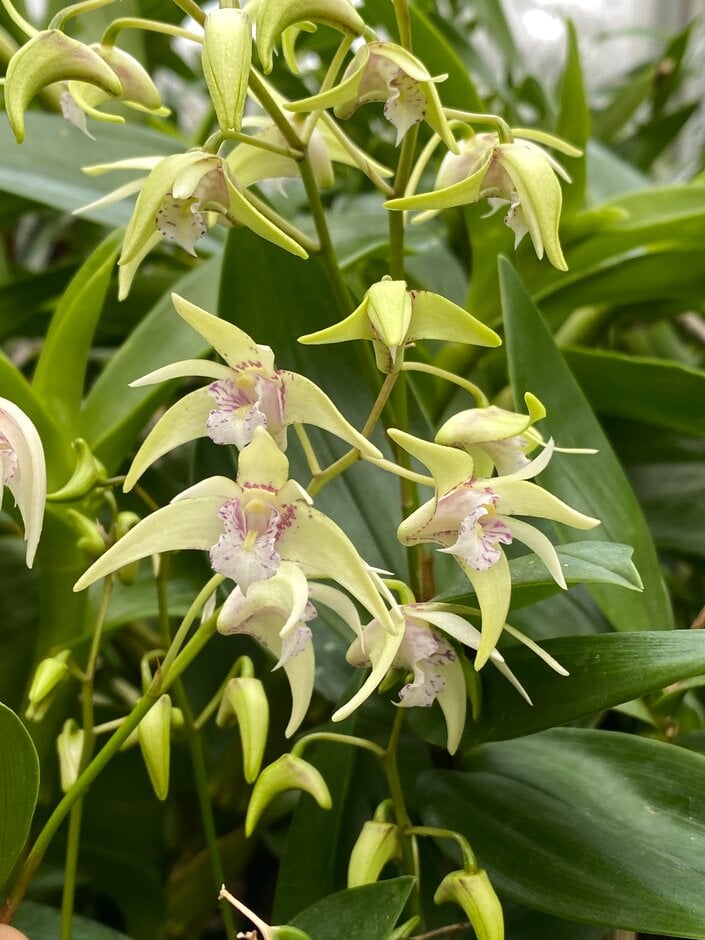
A medium-sized, evergreen or semi-evergreen, clump-forming orchid with 40-50cm long, upright stems (pseudobulbs). Noded stems are covered with thin, leaf-bearing sheaths. Four to six lance-shaped, dark green leaves are arranged on the upper half, or near the top of each stem. Upright flowering stems up to 30cm long emerge from the axils of leaves and the tip of mature pseudobulbs and carry 12-15 pale yellow, 3-4cm large flowers
Size
Ultimate height
0.1–0.5 metresTime to ultimate height
5–10 yearsUltimate spread
0.1–0.5 metresGrowing conditions
Moisture
Well–drainedpH
NeutralColour & scent
| Stem | Flower | Foliage | Fruit | |
| Spring | Green Grey Silver | Yellow White Pink | Green | |
|---|---|---|---|---|
| Summer | Green Grey Silver | Green | ||
| Autumn | Green Grey Silver | Green | ||
| Winter | Green Grey Silver | Green |
Position
- Full sun
- Partial shade
Aspect
East–facing or South–facing or West–facing
Exposure
Sheltered Hardiness
H1CBotanical details
- Family
- Orchidaceae
- Native to GB / Ireland
- No
- Foliage
- Evergreen or Semi evergreen
- Habit
- Clump forming, Columnar upright
- Genus
Dendrobium are epiphytic and terrestrial orchids with elongated, stem-like pseudobulbs bearing linear to ovate leaves. Racemes or panicles of showy flowers are produced from nodes along the stems mainly in spring
- Name status
Accepted
How to grow
Cultivation
Plants are best grown in a pot in an epiphytic, medium grade, bark-based potting mix with addition of sustainably sourced perlite, moss, or coir. As with many orchids, they grow best when the roots are slightly restricted. Therefore, avoid over-potting or frequent root disturbance. Provide dappled shade and higher humidity in spring and summer, then move the plant to a bright, but cool room in autumn and winter. Reduce watering and feeding until warmer temperatures initiate flowering and new growth in spring. See indoor orchid cultivation
Propagation
Propagation by seed is only possible in controlled laboratory environment. Mature plants may be divided when the plant overgrows the pot. Sideshoots (keiki) may develop on older canes - remove and pot them into sphagnum moss when the new roots are at least 2cm long
Suggested planting locations and garden types
- Houseplants
- Conservatory and greenhouse
Pruning
No pruning required. Remove spent flowers as necessary, but do not cut the whole cane unless completely shrivelled. Oldest canes may be removed as long as there are enough, younger, thick, leaf-bearing canes on the plant
Pests
May be susceptible to scale insects, aphids, mealybugs and red spider mite
Diseases
Generally disease-free
Get involved
The Royal Horticultural Society is the UK’s leading gardening charity. We aim to enrich everyone’s life through plants, and make the UK a greener and more beautiful place.