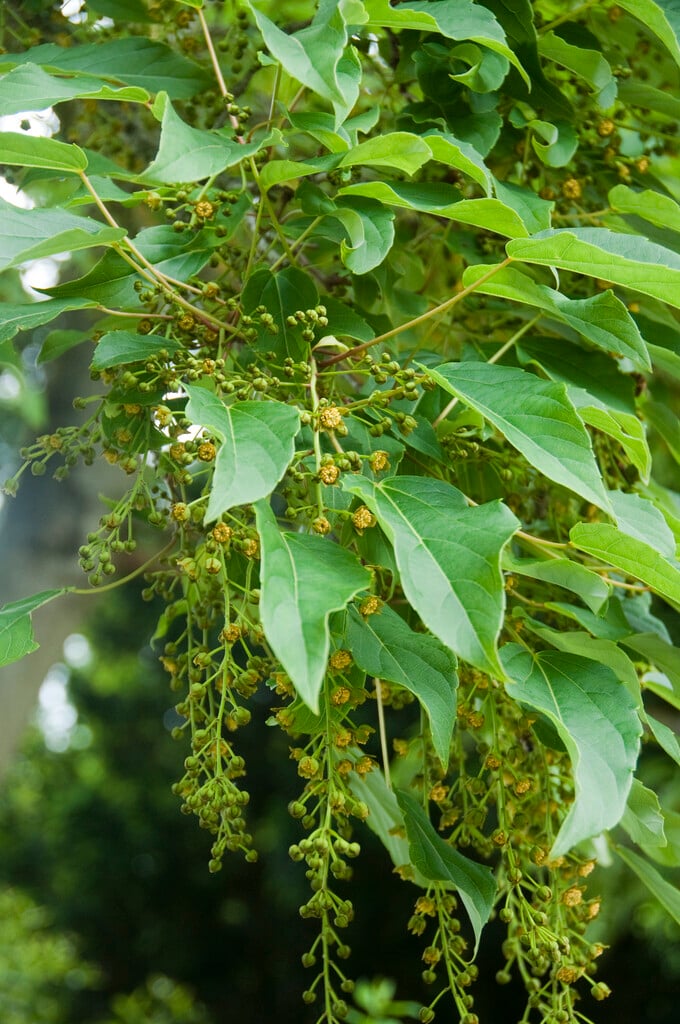
Idesia polycarpa

RHS Plant Profile
Igiri tree
Igiri tree visionspictures.com
Trees

A deciduous tree with an open, branching habit and large, heart-shaped, slightly toothed, glossy green leaves, held on reddish stems and sometimes tinted red when young. Long, hanging clusters of small, fragrant yellow-green flowers are produced on mature trees in midsummer. If pollinated, these are followed by hanging clusters of round red berries on female trees, which sometimes persist into winter

Position

Full sun, Partial shade

Soil Types

Clay, Loam, Sand

Max Height

8-12 metres

Max Spread

wider than 8 metres

Size

Time to Maturity
20–50 years
Max Spread
wider than 8 metres
Max Height
8-12 metres

Growing Conditions

Clay Loam Sand
Moisture
Moist but well–drained
pH
Neutral or Acid

Position

Full sun Partial shade
Aspect
East–facing or South–facing or West–facing
Exposure
Sheltered
Hardiness
H5

Colour & Scent

Fragrance Flower
Season Stem Flower Foliage Fruit
Spring
Summer
Autumn
Winter

Botanical Details

Family
Salicaceae
Native to GB/Ireland
No
Foliage
Deciduous
Habit
Spreading branched
Genus
Name Status
Correct
Plant Range
S China to Temp E Asia

How to Grow

Cultivation

Grow in deep, moderately fertile, moist but well-drained, neutral to slightly acid soil in full sun or light shade. Female trees need a male tree nearby to produce berries reliably

Propagation

Propagate by softwood cuttings in late spring or by semi-ripe cuttings in midsummer

Suggested planting locations and garden types

  • Architectural

Pruning

Minimal pruning required, see pruning group 1

Pests

Generally pest-free

Diseases

Generally disease-free