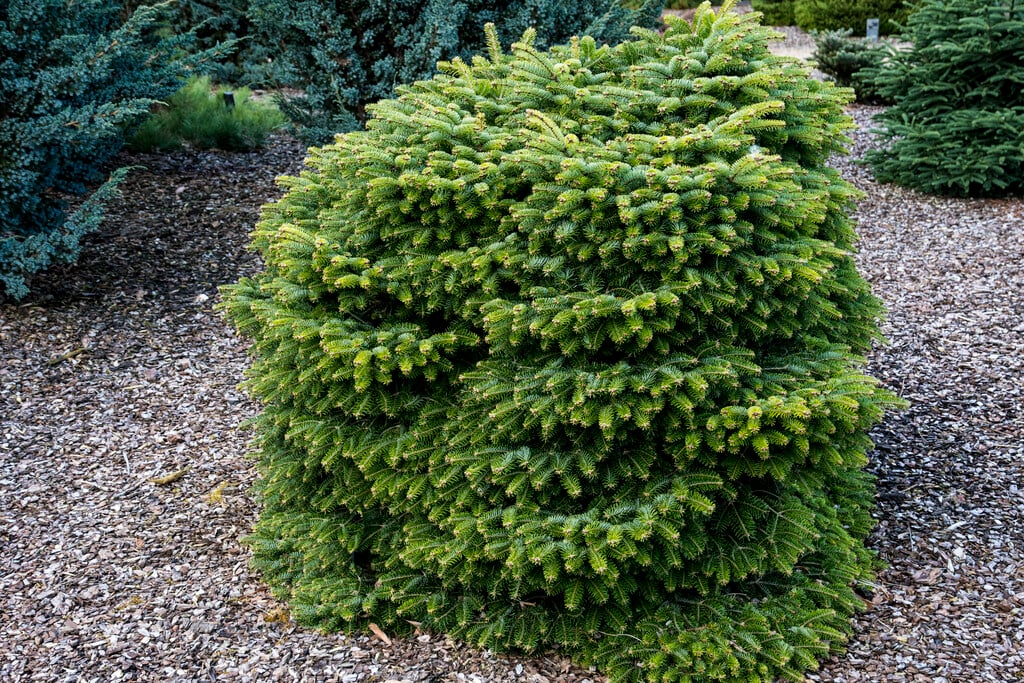
Abies nordmanniana subsp. nordmanniana 'Barabits' Compact'

RHS Plant Profile
Caucasian fir 'Barabits' Compact'
Caucasian fir 'Barabits' Compact' visionspictures.com
Conifers Trees

A low, flat-growing cultivar raised in 1985 in Hungary. Forms a flat topped globose form up to 2m tall and 3m wide. It is very slow growing, in ten years the plant may reach 50cm height and 60cm width. Needles are short, densely arranged around the shoots. They are bright green or golden yellow-green colour in spring, turning dark green in autumn.

Position

Full sun

Soil Types

Clay, Loam, Sand

Max Height

1.5-2.5 metres

Max Spread

2.5-4 metres

Size

Time to Maturity
20–50 years
Max Spread
2.5-4 metres
Max Height
1.5-2.5 metres

Growing Conditions

Clay Loam Sand
Moisture
Moist but well–drained
pH
Acid or Neutral

Position

Full sun
Aspect
East–facing or North–facing or South–facing or West–facing
Exposure
Exposed or Sheltered
Hardiness
H7

Colour & Scent

Season Stem Flower Foliage Fruit
Spring
Summer
Autumn
Winter

Botanical Details

Family
Pinaceae
Native to GB/Ireland
No
Foliage
Evergreen
Habit
Bushy, Spreading branched, Matforming
Genus
Abies are evergreen conifers, often very tall, with whorled branches bearing flattened, linear leaves, often whitish beneath, and on the upper branches, large cones which break up whilst attached to the tree
Name Status
Unresolved

How to Grow

Cultivation

Grows best in deep, slightly acidic, moist but well-drained soils in cooler climates. See conifer cultivation

Propagation

Propagate by grafting.

Suggested planting locations and garden types

  • Architectural
  • City and courtyard gardens

Pruning

No pruning required

Pests

May be susceptible to adelgids and aphids

Diseases

Generally disease-free, but may be susceptible to honey fungus