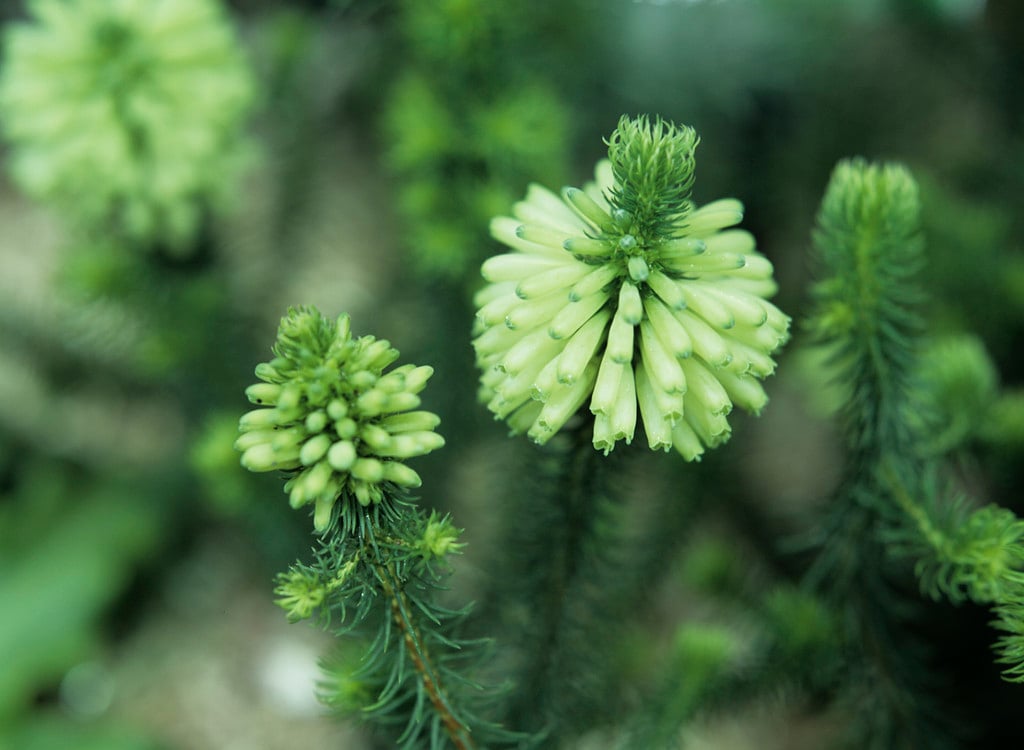
Erica sessiliflora

RHS Plant Profile
white bottlebrush heath
white bottlebrush heath RHS

Other common names

green heath

Shrubs

An erect shrub, to 2m in height, with upright or spreading, needle-like leaves. Dense clusters of greenish-white, tubular flowers are produced from late winter to spring. Later, the sepals swell, protecting the seeds, to produce red or greenish-yellow fruiting clusters that turn brown and remain on the plant for several years

Position

Full sun

Soil Types

Loam, Sand

Max Height

1.5-2.5 metres

Max Spread

0.5-1 metres

Size

Time to Maturity
10–20 years
Max Spread
0.5-1 metres
Max Height
1.5-2.5 metres

Growing Conditions

Loam Sand
Moisture
Moist but well–drained
pH
Acid

Position

Full sun
Aspect
South–facing or West–facing
Exposure
Sheltered
Hardiness
H2

Colour & Scent

Season Stem Flower Foliage Fruit
Spring
Summer
Autumn
Winter

Botanical Details

Family
Ericaceae
Native to GB/Ireland
No
Foliage
Evergreen
Habit
Bushy
Genus
Erica can be prostrate or erect, evergreen shrubs with fine, needle-like leaves in whorls, and racemes or panicles of small, bell-shaped or tubular flowers
Name Status
Correct
Plant Range
South Africa (Cape)

How to Grow

Cultivation

In mild areas, grow in moist but not waterlogged, acidic soil in full sun in a sheltered position. Elsewhere grow in an unheated greenhouse in lime-free potting compost with extra sharp sand, making sure the compost is kept moist

Propagation

Propagate by semi-ripe cuttings in mid- or late summer

Suggested planting locations and garden types

  • Mediterranean climate plants
  • City and courtyard gardens
  • Coastal
  • Patio and container plants

Pruning

Pruning group 8

Pests

Generally pest-free

Diseases

May be susceptible to fungal diseases, including honey fungus (rarely), and Phytophthora root rot, in wet conditions