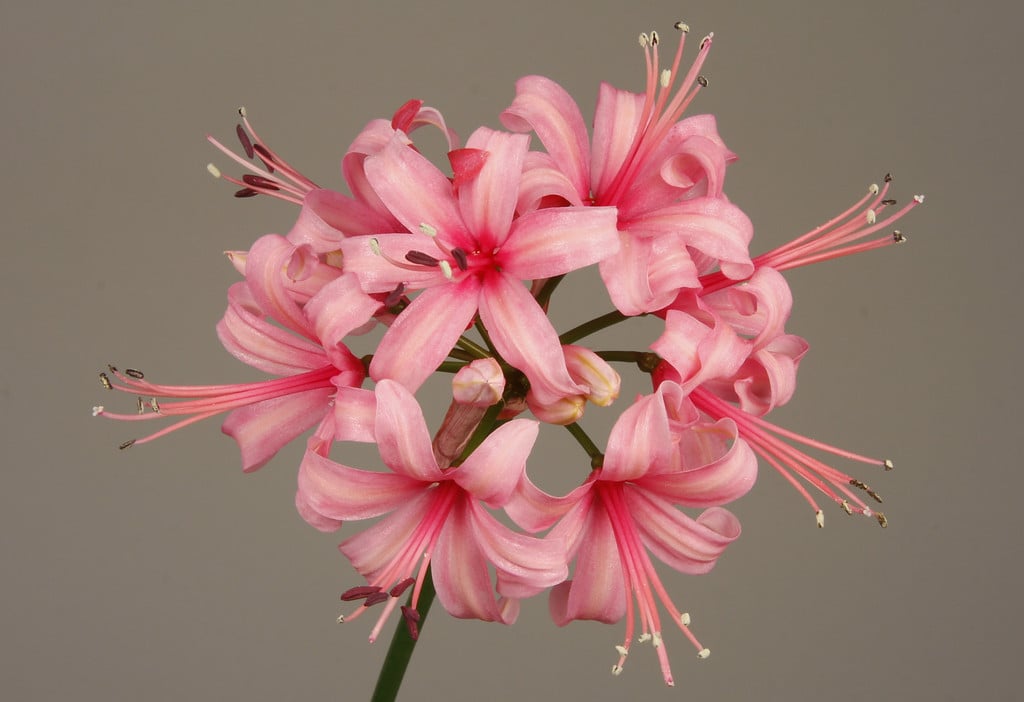
Nerine 'Stephanie'

RHS Plant Profile
nerine 'Stephanie'
nerine 'Stephanie' RHS

Synonyms

Nerine sarniensis 'Stephanie'

Bulbs Conservatory Greenhouse

A bulbous herbaceous perennial, 50cm high, with green strap-shaped leaves which die down in summer. Umbels of 9-10 flowers with broad, only slightly wavy, warm pink tepals, slightly paler pink along the centre of each tepal, and darker pink in the throat, appear in autumn; not to be confused with N. bowdenii 'Stefanie'

Position

Full sun

Soil Types

Chalk, Loam, Sand

Max Height

0.1-0.5 metres

Max Spread

0.1-0.5 metres

Size

Time to Maturity
2–5 years
Max Spread
0.1-0.5 metres
Max Height
0.1-0.5 metres

Growing Conditions

Chalk Loam Sand
Moisture
Well–drained
pH
Acid or Alkaline or Neutral

Position

Full sun
Aspect
South–facing or West–facing
Exposure
Sheltered
Hardiness
H2
Drought Resistance
Yes

Colour & Scent

Season Stem Flower Foliage Fruit
Spring
Summer
Autumn
Winter

Botanical Details

Family
Amaryllidaceae
Native to GB/Ireland
No
Foliage
Deciduous
Habit
Clump forming
Potentially harmful
Ornamental bulbs - not to be eaten. Wear gloves and other protective equipment when handling. Pets: Ornamental bulbs - not to be eaten - see the HTA guide to potentially harmful plants for further information and useful contact numbers
Genus
Nerine are summer-dormant, perennial bulbs with erect leafless stems each bearing a terminal umbel of funnel-shaped flowers in autumn, and strap-shaped or linear leaves appearing after the flowers
Name Status
Accepted

How to Grow

Cultivation

Plant with the tips of the bulbs just above the surface: in frost-prone areas, grow in full light in a greenhouse or conservatory, in an open free-draining medium, water during active growth, give potassium-rich liquid fertilizer after flowering, and keep slightly dry when dormant in summer; in frost-free areas, grow outside in well-drained soil in a sunny position, for example by a south-facing or west-facing wall, and protect with a deep, dry mulch over winter; for more advice, see Nerine cultivation

Propagation

Propagate by division of congested clumps in early summer

Suggested planting locations and garden types

  • City and courtyard gardens
  • Coastal
  • Mediterranean climate plants
  • Cottage and informal garden
  • Gravel garden
  • Patio and container plants
  • Cut flowers
  • Wall side borders

Pruning

No pruning required

Pests

May be susceptible to slugs

Diseases

May be susceptible to virus diseases