Quick Facts
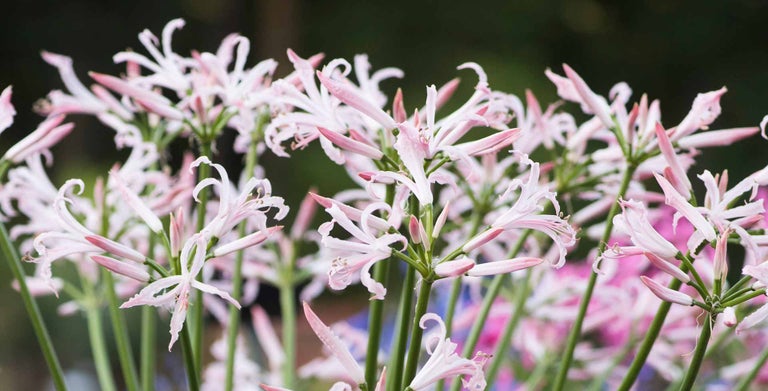
Long-lasting blooms in shades of pink, white and sometimes red
1
Nerines flower in autumn
2
Purchase and plant dry bulbs in late summer
3
Hardy Nerine bowdenii bloom well in moisture retentive but well-draining, sunny sites
4
Grow frost-tender nerines like Nerine sarniensis (Guernsey lily) in pots and provide greenhouse protection
5
Cut off spent flower heads, unless seed is required, and remove foliage once it's died back
6
Propagate nerines by seed, division of clumps, or by chipping the bulbs
7


Before you get started
Choosing a nerine
Choosing nerines depends on whether you want to leave them growing in the garden all year round – the hardy ones - or whether you have a frost-free greenhouse to overwinter the tender types.
- If you have a sunny, warm spot and well-drained soil in your garden, the hardy Nerine bowdenii will grow and flower well in these conditions as temperatures drop in mid September to late October. This species and its cultivars are the most commonly sold nerines.
- Consider growing Nerine undulata Flexuosa Group outdoors too, but as it flowers in November to December, it's more at risk from weather damage, so it's best suited to warmer gardens (such as those in cities) or grown in pots and overwintered in a greenhouse or conservatory
- Tender nerines such as the scarlet-flowered Nerine sarniensis(the Guernsey lily) and its cultivars, are ideal for cool greenhouse display, flowering in late autumn. But as a species that hails from the mountainous region of the Cape, it doesn't want to bake in summer above around 30oC ideally.
Buying nerines
Nerine bowdenii is on sale in garden centres as dry from late summer and as potted, flowering plants in autumn. Nerine bulbs are also available by mail-order from bulb specialists in spring and autumn.
More in–depth information
If you're interested in specialist growing then follow this link to a report of a Nerine and Amaryllid Society study day with tips on growing and morphology.
Planting
When to plant nerines
Plant nerine as soon as possible after purchase.
The same applies to hardy Nerine bowdenii that have been potted and can be planted out in the garden even if they are in growth (have leaves or flower).
Where to plant nerine
- For hardy nerine such as Nerine bowdenii, pick a warm, sheltered spot such as a bed near a sunny wall in well-draining soil that retains moisture.
- Grow frost-tender nerines such as Nerine sarniensis (Guernsey lily) in pots as these will need to be moved inside for winter and outside for summer or shaded to reduce scorching temperatures
How to plant nerine
Plant bulbs of Nerine bowdenii 10cm (4in) apart and with the neck of the bulb showing above ground. around them with a layer of grit. They like to be planted on their own in clumps rather than mixed in with plants.
When growing in containers, use an open, free-draining growing medium ( ) made of equal amounts of peat-free John Innes No. 3, peat-free multipurpose compost and gritty sand. A 10cm (4in) pot is suitable for a single bulb. When planting several bulbs together, choose a container size in which the bulbs will be close together, but not touching. Plant with the neck of the bulb just exposed. Tender nerines, Nerine sarniensis and N. undulata, will need additional care over winter (see below).
While you can grow the hardier N. bowdenii in pots, these do not want to be indoors all year round as they need that drop in temperature in late summer to flower.
Ongoing Care
in pots will need repotting when dormant in summer every two to three years. They often don’t need a bigger pot, just a fresh mix to support good growth and flowering.
Top tip
Leave bulbs undisturbed in the ground for the best flowering, only splitting and dividing (see Propagation below) when clumps become congested and flowering declines.
Watering
Water is important for nerine bulbs to grow and produce flowers, even though the popular misconception is that they like baking in summer.
In the garden (hardy species and their cultivars)
If you plant Nerine bowdenii at the base of a wall, they can be shielded from rain and become overly dry, so watering once a week during dry weather through the (April to July). The best indicator to stop watering is when the foliage naturally dies back in summer.
Pot-grown nerines (tender species and their cultivars)
Begin watering pot-grown nerine as soon as their flower spikes emerge in autumn. Increase frequency as the flowers and then the foliage develop, but allow the surface to dry between waterings. Check regularly as the surface can become dry quickly during warm weather. You can stop watering your nerines in pots when the leaves turn yellow and begin die down in late summer.
Feeding
Feeding bulbs grown in containers can help them reach a good size and improve flowering. From January to April feed them every two weeks with a phosphorous and potassium-rich liquid feed, such as a tomato fertiliser, diluted to half strength (i.e. half what it says on the label for bulbs or containers) to stimulate flower production.
Deadheading
Unless you fancy raising some new plants from seed, deadhead the flowers after they have finished, so that the nerine’s energy is used to build the bulb for next year’s flowering, rather than for seed production.
Overwintering
Nerine bowdenii planted in the garden require no special treatment overwinter.
For tender species such as Nerine sarniensis (Guernsey lily), once nights get colder in autumn, move pots of into a cool greenhouse for the winter. They will need a minimum temperature of 7°C (45°F) as the bulbs rot away at lower temperatures.
Pruning and Training
Nerines don’t really need pruning. Just pull away leaves after they have died back in late summer, and cut off spent flower stems at the base in the autumn.
Propagating
You can increase your stock of nerines by dividing them, sowing seed or chipping. Learn more about these techniques on our propagating bulbs page.
Division
Repotting is a good time to divide pot-grown, tender species. Hardier types, (N. bowdenii cvs) are happy to grow in congested clumps and are best left undisturbed, but when you do want to split them, do this in early summer. Carefully divide into smaller sections and replant.
Seed
Growing from seed is fun, but the resulting will take three to five years to reach flowering size. Sow nerine seed as soon as it is ripe – nerine seed is fleshy and easily detached from the old flower spike when ripe. Use a well-drained mix of peat-free John Innes with about 25 per cent added grit. Sow thinly with just the lightest covering of – just enough to make the seed disappear from view. Water and keep at a temperature of 10-13°C (50-55°F) until the seeds germinate.
Seedling will remain in growth during the whole of the first year if kept frost-free and watered, after which they can be potted individually into 5-7.5cm (2-3in) pots.
Chipping
Large bulbs can also be chipped.
Further details on propagating nerine can be found on the Pacific Bulb Society website.
Problems
Nerine sometimes fail to flower in the first year or two after planting as they adjust to their new growing environment. The flower buds in N. bowdenii are initiated in mid to late summer, so adverse conditions at this time of year ( such as very hot and dry conditions) mean they fail to develop. Curiously, in both N. bowdenii and N.sarniensis, inside a bulb at any one time are two flower initials (buds) of differing ages. So in N. bowdenii, a flower initial that starts in late summer one year will develop and then bloom, not the next year, but the year after.
Pests and diseases rarely bother nerines, although mealybug can be a problem if you grow them under glass. Slugs and snails can damage flowers
Virus diseases can cause striped, mottled and/or distorted foliage and flowers, so if you spot this, get rid of the plant to spot the virus spreading.