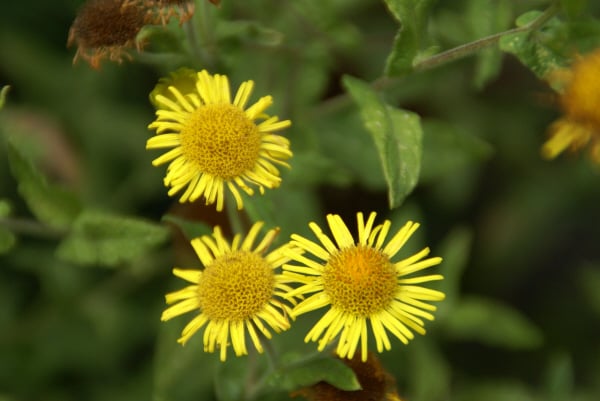
Pulicaria dysenterica

RHS Plant Profile
common fleabane
common fleabane Christopher Whitehouse

Other common names

greater fleabane, wild marigold, codowydd

Synonyms

Inula dysenterica

Plants for pollinators
Herbaceous Perennial

A distinctly downy perennial 50-90cm tall, with creeping rhizomes and slightly heart-shaped, wavy-edged leaves that clasp the stems. Woolly flowering stems reach up to 1m in height with clusters of flat, yellow, daisy-like flower heads with short ray petals and are borne from midsummer to early autumn

Position

Full sun, Partial shade

Soil Types

Clay, Loam

Max Height

0.5-1 metres

Max Spread

0.5-1 metres

Size

Time to Maturity
2–5 years
Max Spread
0.5-1 metres
Max Height
0.5-1 metres

Growing Conditions

Clay Loam
Moisture
Poorly–drained or Moist but well–drained
pH
Acid or Alkaline or Neutral

Position

Full sun Partial shade
Aspect
East–facing or South–facing or West–facing
Exposure
Sheltered
Hardiness
H6

Colour & Scent

Season Stem Flower Foliage Fruit
Spring
Summer
Autumn
Winter

Botanical Details

Family
Asteraceae
Native to GB/Ireland
Yes
Foliage
Deciduous
Habit
Bushy
Genus
Pulicaria are perennials with a preference for damp to marshy conditions. Growing to a height of around 50 to 90cm, they have hairy stems and lanceolate leaves with a wavy edge to them. The yellow flowers are short-lived appearing between August and September on long, thin stems. Flower heads are yellow and daisy-like, growing between 2 and 3 cm in width.
Name Status
Correct

How to Grow

Cultivation

Grows naturally in wet marshy ground and enjoys sunny locations with reliably moist soil but can tolerate a range of soil conditions

Propagation

Propagate by division or propagate by seed

Suggested planting locations and garden types

  • Wildlife gardens
  • Wildflower meadow

Pruning

No pruning required

Pests

Generally pest-free

Diseases

Generally disease-free