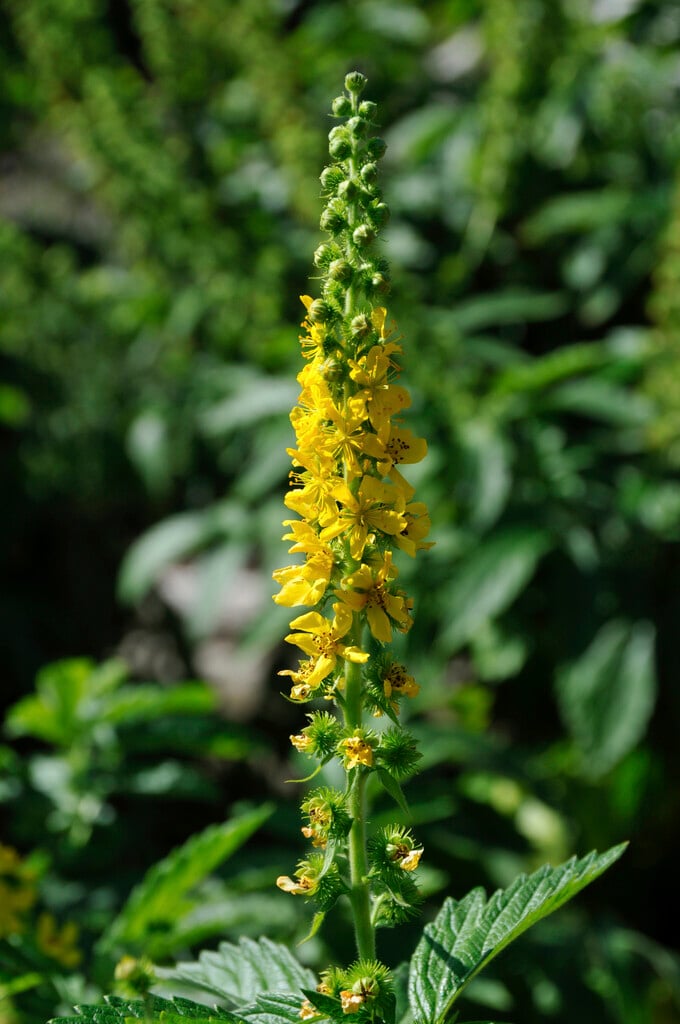
Agrimonia eupatoria

RHS Plant Profile
agrimony
agrimony visionspictures.com

Other common names

beggar's lice, beggar's ticks, church steeples, clot bur, cockle bur, common agrimony, sticklewort, llysiau'r dryw

Synonyms

Agrimonia asiatica

Plants for pollinators
Herbaceous Perennial

A hairy perennial with deeply veined pinnate leaves, and bearing flower spikes up to 50cm in height of star-shaped, 5-petalled, yellow flowers from June to August

Position

Full sun, Partial shade

Soil Types

Chalk, Loam, Sand

Max Height

0.1-0.5 metres

Max Spread

0.5-1 metres

Size

Time to Maturity
1–2 years
Max Spread
0.5-1 metres
Max Height
0.1-0.5 metres

Growing Conditions

Chalk Loam Sand
Moisture
Moist but well–drained or Well–drained
pH
Alkaline or Neutral

Position

Full sun Partial shade
Aspect
East–facing or North–facing or South–facing or West–facing
Exposure
Exposed or Sheltered
Hardiness
H7

Colour & Scent

Season Stem Flower Foliage Fruit
Spring
Summer
Autumn
Winter

Botanical Details

Family
Rosaceae
Native to GB/Ireland
Yes
Foliage
Deciduous
Habit
Columnar upright
Genus
Name Status
Correct
Plant Range
Europe, N & S Africa, N Asia

How to Grow

Cultivation

Prefers well-draining neutral soils in sun or partial shade. Occurs naturally in grassy places, verges and hedgerows. The burred fruit is dispersed by animals

Propagation

Propagate by seed in spring or autumn

Suggested planting locations and garden types

  • Wildlife gardens
  • Wildflower meadow

Pruning

No pruning required

Pests

Generally pest-free

Diseases

Generally disease-free