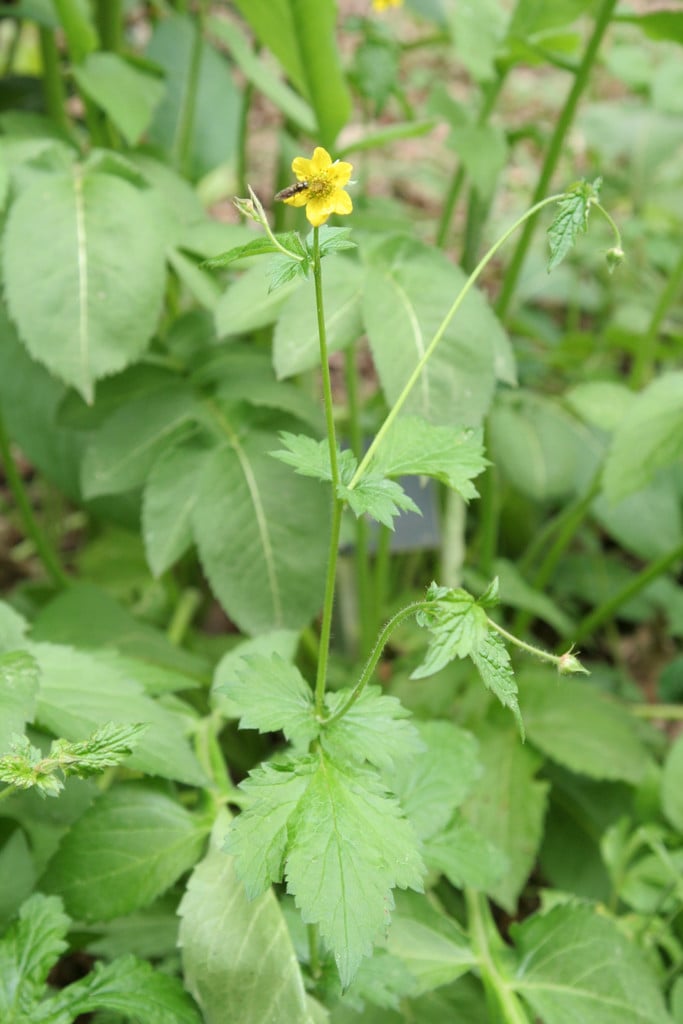
Geum urbanum

RHS Plant Profile
wood avens
wood avens RHS

Other common names

blessed herb, city avens, clove root, colewort, herb bennet, Indian chocolate, minarta, St Benedict's herb, star of the earth, water flower, mapgoll

Plants for pollinators
Herbaceous Perennial

A hairy perennial forming overwintering rosettes of leaves with five or three rounded lobes; the largest lobe at the tip. Flower stems nod before the simple, yellow, strawberry-like flowers, 5-20mm across open from May until late autumn. Fruits, held in spherical clusters, are burred with red hooks

Position

Partial shade

Soil Types

Chalk, Clay, Loam, Sand

Max Height

0.5-1 metres

Max Spread

0.1-0.5 metres

Size

Time to Maturity
2–5 years
Max Spread
0.1-0.5 metres
Max Height
0.5-1 metres

Growing Conditions

Chalk Clay Loam Sand
Moisture
Moist but well–drained or Well–drained
pH
Acid or Alkaline or Neutral

Position

Partial shade
Aspect
South–facing or North–facing or West–facing or East–facing
Exposure
Exposed or Sheltered
Hardiness
H7

Colour & Scent

Season Stem Flower Foliage Fruit
Spring
Summer
Autumn
Winter

Botanical Details

Family
Rosaceae
Native to GB/Ireland
Yes
Foliage
Evergreen
Habit
Bushy
Genus
Geum are rhizomatous perennials, occasionally spreading by stolons, with a basal rosette of pinnately lobed leaves and saucer-shaped flowers in loose clusters
Name Status
Correct
Plant Range
Europe to Himalaya

How to Grow

Cultivation

Occurs naturally on a wide range of soils from acid to lime-rich in semi-shaded sites such as woods and hedgerows. A good evergreen for wildlife in a shady spot. See herb bennet for more information

Propagation

Propagate by seed in autumn; self-seeds readily

Suggested planting locations and garden types

  • Wildlife gardens
  • Wildflower meadow

Pruning

No pruning required

Pests

Generally pest-free

Diseases

Generally disease-free