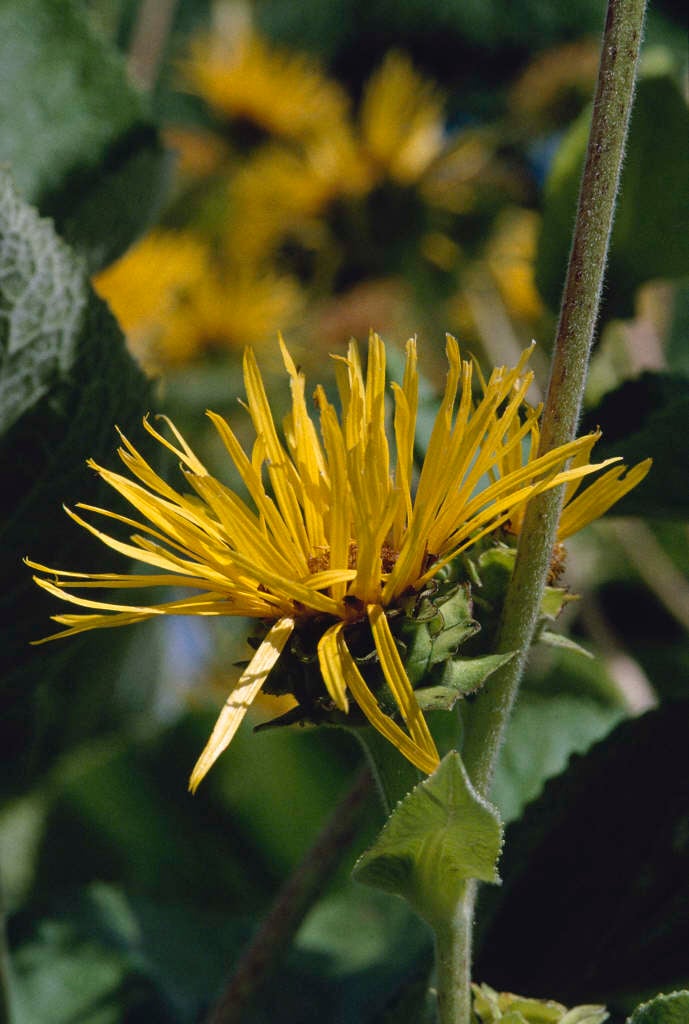
Inula helenium

RHS Plant Profile
elecampane
elecampane RHS

Other common names

allicampane, elf dock, elf wort, else dock, enula campana, horse elder, horse heal, scabwort, wild sunflower, yellow starwort, marchalan

Plants for pollinators
Herbaceous Perennial

A robust perennial to 2m tall, with toothed, narrowly elliptic leaves to 60cm long, white-hairy beneath, and yellow daisy-like flower heads to 9cm wide, with narrow rays and a darker centre

Position

Full sun, Partial shade

Soil Types

Clay, Loam

Max Height

1.5-2.5 metres

Max Spread

0.5-1 metres

Size

Time to Maturity
2–5 years
Max Spread
0.5-1 metres
Max Height
1.5-2.5 metres

Growing Conditions

Clay Loam
Moisture
Moist but well–drained
pH
Acid or Alkaline or Neutral

Position

Full sun Partial shade
Aspect
South–facing or East–facing or West–facing
Exposure
Exposed or Sheltered
Hardiness
H6

Colour & Scent

Season Stem Flower Foliage Fruit
Spring
Summer
Autumn
Winter

Botanical Details

Family
Asteraceae
Native to GB/Ireland
Yes
Foliage
Deciduous
Habit
Bushy
Genus
Inula may be annuals, herbaceous perennials or sub-shrubs, moslty with large basal leaves and daisy-like yellow flower-heads, often with narrow ray-florets
Name Status
Correct
Plant Range
W & C Asia

How to Grow

Cultivation

It prefers deep, rich, moisture-retentive soil in full sun or partial shade. May need support if planted in windy situation

Propagation

Propagate by division in autumn or spring. Take basal softwood cuttings in spring. Propagate by seed in spring; germinate at 10°C (50°F)

Suggested planting locations and garden types

  • Cottage and informal garden
  • Wildlife gardens
  • Wildflower meadow
  • Flower borders and beds

Pruning

Trim back faded foliage in the autumn or early spring

Pests

Generally pest-free

Diseases

Generally disease-free