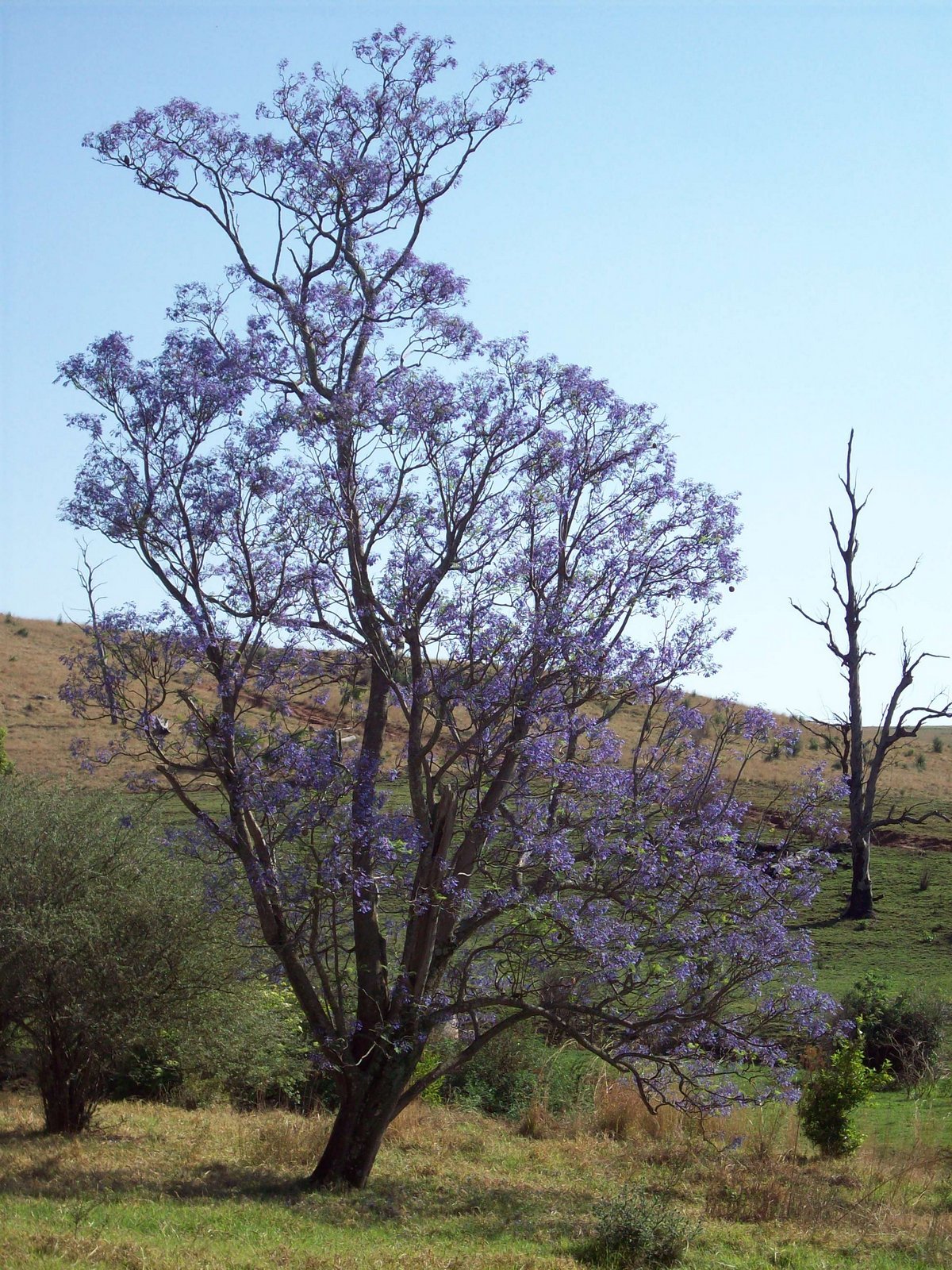
Jacaranda mimosifolia

RHS Plant Profile
green ebony tree
green ebony tree Janet Cubey

Synonyms

Jacaranda ovalifolium
Jacaranda acutifolia misapplied

Trees

A fast-growing, deciduous, rounded tree growing up to 15m tall. Its fern-like leaves up to 45cm long comprise many small bright green leaflets each up to 1cm long. Trusses of blue-purple, trumpet-like flowers each up to 5cm in diameter are borne in spring and early summer and are followed by woody seed pods containing flat, winged seeds

Position

Full sun, Partial shade

Soil Types

Chalk, Clay, Loam, Sand

Max Height

Higher than 12 metres

Max Spread

wider than 8 metres

Size

Time to Maturity
10–20 years
Max Spread
wider than 8 metres
Max Height
Higher than 12 metres

Growing Conditions

Chalk Clay Loam Sand
Moisture
Well–drained
pH
Acid or Alkaline or Neutral

Position

Full sun Partial shade
Aspect
West–facing or East–facing or South–facing
Exposure
Sheltered
Hardiness
H1C

Colour & Scent

Fragrance Flower
Season Stem Flower Foliage Fruit
Spring
Summer
Autumn
Winter

Botanical Details

Family
Bignoniaceae
Native to GB/Ireland
No
Foliage
Deciduous
Habit
Columnar upright
Genus
Jacaranda is a genus of 49 species of large flowering trees or shrubs, native to tropical and subtropical regions such as Mexico, Central and South America and Jamaica. Leaves are mainly bipinnate and flowers are purple to blue, very occasionally white, produced in large panicles.
Name Status
Correct
Plant Range
South America

How to Grow

Cultivation

Grow in any fertile, well-drained soil in full sun. Frost tender

Propagation

Propagate from seed or by semi-ripe cuttings

Suggested planting locations and garden types

  • Architectural
  • Sub-tropical
  • Low Maintenance

Pruning

Light pruning see pruning group 1

Pests

Generally pest-free

Diseases

Generally disease-free