


10 award-winning groundcover plants
Groundcover plants are some of the hardest-working elements of a garden. Choose wisely and they’ll give you year-round interest and form

Add softness to edges and gentle movement to your planting schemes with trailing alpines that spill, cascade and brighten any display
Back in the days when alpines and rock plants were grown in rock gardens, trailing types were invaluable in hugging the rocks to hide their bulk and cascading down to create sheets of colour. Although times have changed and we now prefer raised beds, gravel gardens and large containers for our alpines, trailing plants are just as valuable. They can tumble over the edge of raised beds, creep across gravel and make a verdant backdrop to small . Growing in cracks and crevices in stone or brick walls, they’re superb.
Here are 10 trailing alpines, all of which have received the coveted RHS Recommended: Award of Garden Merit.

Arabis is a classic May-flowering alpine that anyone can grow. This double-flowered form, Arabis alpina subsp. caucasica ‘Flore Pleno’ extends the flowering period compared to single forms, and adds a little class to the act. Spreading about three times as wide and high, the neat, grey-green, evergreen leaves make an ideal background for the pure white flowers and an attractive carpet for the remainder of the year. Height can reach 20cm (8in). Hardiness rating: H5.

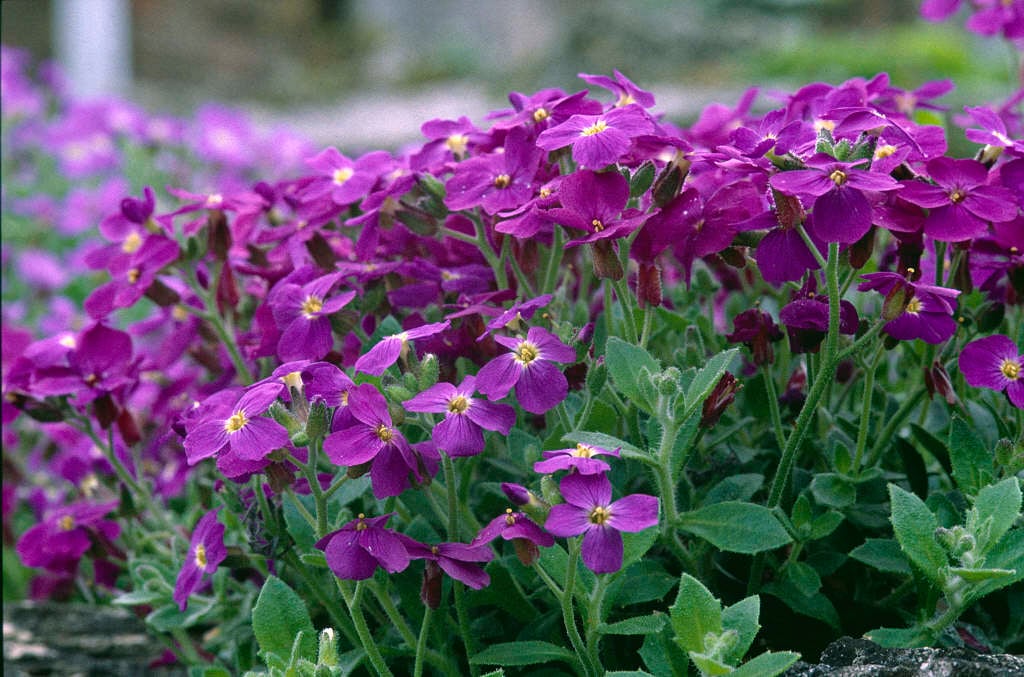
Another special form of an old favourite. The vivid flower colour sets Aubrieta ‘Doctor Mules’above the more widely seen forms whose colouring is often rather pale and thin. The evergreen foliage spreads happily over sunny banks, trails from cracks in walls, or over the edge of a raised bed, and can spread to 50cm (19in). It isdensely covered in flowers during April. Height can reach 10cm (4in). RHS hardiness rating: H5.

A slightly bushy trailer, the clouds of yellow flowersthat coverAurinia saxatilis in May are unusual in the richness of their mustard-tinted colouring. Billowing over the edges of raised beds, or even as a specimen in a terracotta pot, the hairy grey-green leaves make the ideal background. This is a resilient little plant, more like a twiggy little shrub than a traditional alpine. Height can reach 20cm (8in). RHS hardiness rating: H5.

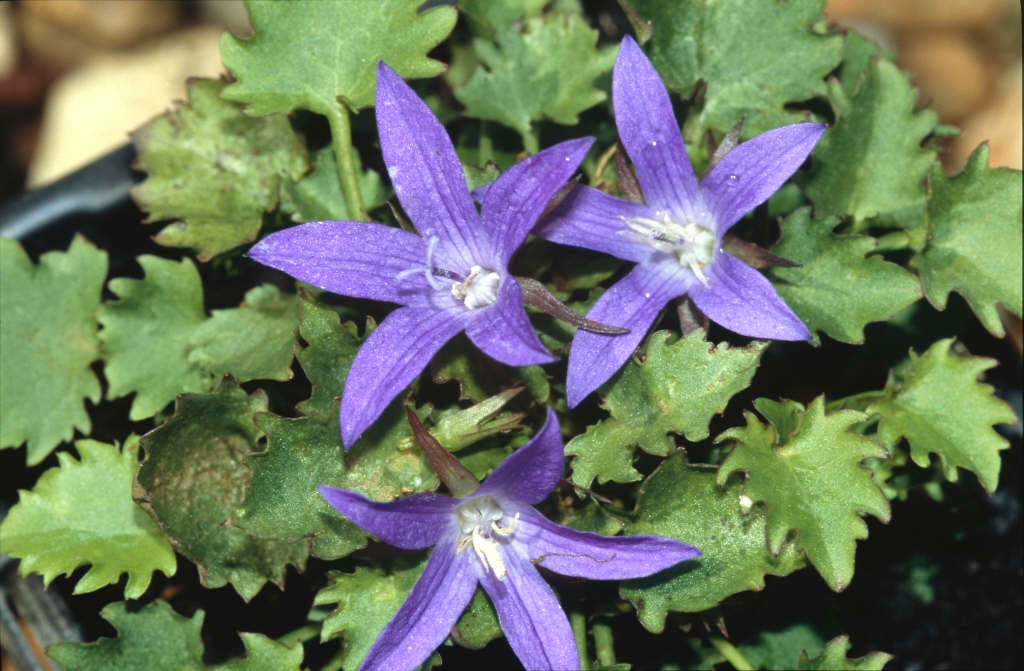
Campanula poscharskyana ‘Stella’ is an easy, vigorous – sometimes too vigorous – alpine, especially suited to cracks in walls. In fact, plant it at the edge of a raised bed and before long the shoots will be bursting through the wall lower down. The long trails of bright, violet-blue summer flowers are charming and open over many weeks. Height can reach 15cm (6in). RHS hardiness rating: H5.

Dianthus gratianopolitanus is a rare British , found only in the Cheddar Gorge, Somerset. It is a lovely evergreen, mat-forming with slender leaves that create a harmonious background to the clusters of highly scented, deep pink flowers that open over many weeks in summer. Ideal planted to creep over a gravel mulch, in a sunny raised bed or well-drained soil. Height can reach 15cm (6in). RHS hardiness rating: H6.

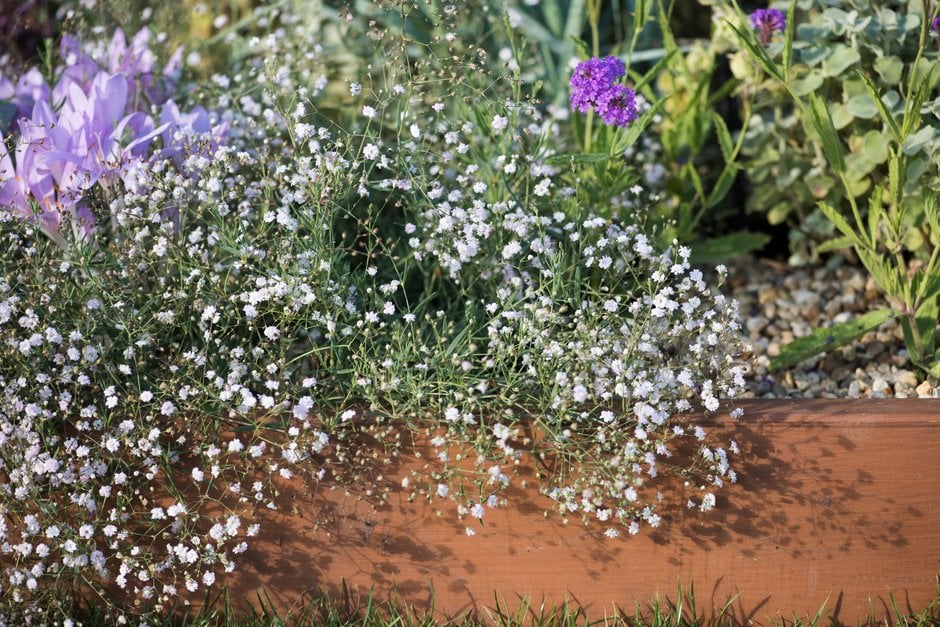
Gypsophila ‘Rosenschleier’,also known as baby's breath 'Rosenschleier', is a compact, semi-evergreen perennial with slender stems and narrow, grey-green leaves. Large, open panicles of pale pink double flowers bloom to 1cm in width in the summer. Height can reach 30cm with moist soil and full exposure to the sun. RHS hardiness rating: H6.

Another of this selection featuring greyish-green foliage, Hypericum olympicum is a twiggy little plant spreading up to 50cm (19in). This is another summer-flowering alpine with large, rather starry, deep yellow flowers that have a bright, sunny appearance. They also produce seeds that tend to germinate and spread the plant around the garden. Tolerates drought well. Height can reach 20cm (8in). RHS hardiness rating H5.

In May and June (and often earlier), thesparkling, deep blue, five-pointed flowers of Lithodora diffusa ‘Heavenly Blue’ bring a colour to alpine plantings that is not often seen. This widely spreading, mat-forming, evergreen shrub has dark green, slightly bristly foliage. Best grown in pockets of humus-rich, , it is also well suited for growing as a specimen in a container or trough. Height can reach 15cm (6in). RHS hardiness rating: H5.

Persicaria affinis ‘Superba’ is aninvaluable late-flowering trailer from August to October, bringing colour to alpine plantings at a time of year when other alpines are long finished. An interlocking mat of reddish stems carries tightly packed, evergreen leaves, which develop bronze-brown tints in autumn. The 7cm (3in) long, upright, cylindrical spikes of small flowers open pale pink and become increasingly dark as the weeks pass. Height can reach 20cm (8in). RHS hardiness rating: H5.

The two creeping alpine Phlox species. Phlox douglasii and Phlox subulata, should be at the top of the list of trailing alpines and Phlox douglasii ‘Red Admiral’ serves as a fine representative of the six cultivars given an award. Phlox douglasii is the more compact of the two, spreading to 30-40cm (12-16in), the fresh green, evergreen foliage hidden in spring by a mass of rounded flowers, in this case in deep reddish-pink. Height can reach 10cm (4in). RHS hardiness rating: H5.
RHS hardiness rating
The system of hardiness ratings enables gardeners to understand the hardiness of plants and gives a guide to the best growing conditions.
Find out more >