Quick Facts
Many dendrobiums can be grown as tender, flowering houseplants
1
Some flower in winter/spring whilst others flower throughout the year
2
Cool-growing dendrobiums need temperatures of 10-24°C
3
Tropical warm-growing types need to be grown at 15-30°C
4
Dendrobiums like bright light, but shade from strong, direct sun
5
They grow well in bark-based orchid compost, in pots, baskets or terrariums
6


Before you get started
What are dendrobiums?
Dendrobiums are tropical and subtropical orchids, originating from East Asia, the Pacific, Australia and New Zealand. There are 1,600 accepted species, and five times as many hybrids have been created.
Popular dendrobiums found in garden centres can be placed into two main groups, based on their flowering cycle and temperature requirements:
- Cool-growing dendrobiums: D. nobile and D. kingianum hybrids prefer cooler growing conditions, with an optimum temperature range of 10-24°C. They usually flower in winter and spring and require bright and slightly drier growing conditions in autumn and winter.
- Warm-growing dendrobiums: Descendants of D. phalaenopsis (Phalaenopsis type) or D. antennatum (‘Antelope’ type) need warm, tropical conditions, with temperatures between 15-30°C. They can flower throughout the year and do not need a period of .
Other Dendrobium species may have different, more specific growing requirements.
Choosing
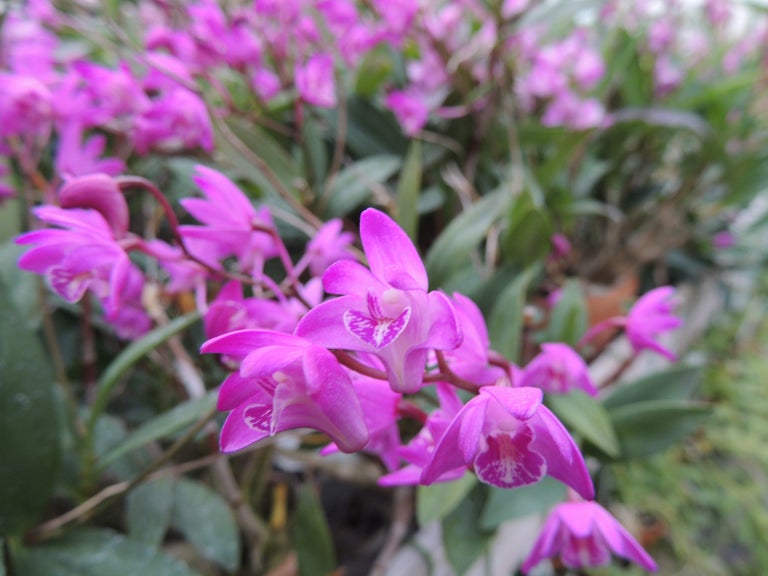
Dendrobium flowers come in all sorts of shapes and colours: from white and cream to yellow, pale or dark pink, orange, brown and purple.
Dendrobium Berry gx and Dendrobium kingianum have an RHS Recommended: Award of Garden Merit, which means they performed well in our trials.
Buying
Dendrobium orchids are available from many houseplant retailers, including garden centres, florists and some supermarkets, mainly from autumn to spring. They are also available from online plant suppliers and tropical plant nurseries. For the widest choice, go to specialist orchid nurseries.
The RHS annual orchid shows (usually taking place in early spring) have many specialist growers and nurseries exhibiting and selling a wide range of these and other orchids.
When buying your orchid, bear in mind the temperature and time of the year. Ensure the plants aren’t exposed to frosts or very cold temperatures on the way home. Sudden temperature changes can cause buds and flowers to drop prematurely.
Did you know?
The Glasshouse at Wisley houses some wonderful examples of many Dendrobium species and hybrids. Be quick to catch them flowering in late winter/early spring.
Ongoing care
Location
Depending on the type and species, each has its own location requirements. But what most have in common is that they prefer good, bright light, especially in winter.
Temperature requirements for most Dendrobium hybrids:
- Cool-growing dendrobiums are best for houses with conservatories or cooler but bright rooms, such as hallways or bathrooms, ideally within the range of 15-24°C. They need a drop in night temperatures to flower and grow reliably.
- Warm-growing dendrobiums don’t need temperatures to drop below 16-18°C and so are better suited to centrally heated rooms. They require good light and .
For Dendrobium species, you can find their specific growing conditions by searching RHS Find a Plant.
Watering
Use rainwater or filtered water whenever possible, especially in hard-water areas. Water from above, making sure excess water can drain out straight away. Don’t leave plants sitting in water, as this can lead to root rot.
Water dendrobiums when needed in spring and summer. In a warm summer, this might be multiple times per week. Plants growing in pots will generally need less watering than those mounted on or grown in baskets. Let the dry out a little before the next watering. Lift the pot and assess the weight – dry compost feels a lot lighter than moist compost. Reduce the frequency of watering slightly in winter (to approximately once per 10 to 12 days). Mist exposed roots regularly.
There are also Dendrobium species that are semi-evergreen or (ones that drop their leaves in winter). Deciduous dendrobiums will prefer a dry period in winter to encourage flowers.
Feeding
To encourage strong growth and flowering, dendrobiums (like other orchids) need feeding with a specially formulated orchid fertiliser.
- In spring and early summer – apply orchid fertiliser according to the manufacturer’s recommendations for three out of four waterings. Use only water (ideally rainwater) for the fourth time to flush the compost and avoid potential build-up of any salts.
- In late summer and autumn – switch to a high-potassium specialist orchid fertiliser, to stimulate flowering, for three out of every four waterings (using just water the fourth time).
- In winter – continue feeding plants that are developing flowers, or are actively growing or flowering, with high-potassium feed. Withdraw feeding from deciduous species or those that need a season of .
Potting up
If your plant is growing strongly and has plenty of healthy roots, pot it up into a larger pot. Choose a pot that can accommodate at least two to three seasons of future growth. To decide on the correct size, hold the plant inside the pot. You should have a 1-5cm gap (depending on the size of the plant) between the roots and the edge of the pot. Avoid using a much larger pot (overpotting), as the compost will stay wet for longer, which can cause root rot.
Top Tip
You can also grow Dendrobium orchids in baskets. Some are naturally pendulous and their stems produce a cascade of flowers. Baskets provide excellent drainage for happy roots, but may dry out faster – so make sure to adjust your watering schedule accordingly.
Did you know?
Some Dendrobium species don’t need to be in a pot at all. As epiphytes, they are adapted to grow on trees and branches and can be grown pot-free, mounted on a piece of bark or other material. They should be kept in a place with high humidity (such as a houseplant terrarium). They need to be re-mounted only if they outgrow their allocated space or if the bark slab starts to deteriorate.
Encourage re-flowering
Some cool-growing dendrobiums (especially D. kingianum and similar) may be reluctant to re-flower and will produce new plantlets instead. Very often, this is caused by watering the plants in autumn when the flower buds should naturally form. Reducing watering and misting, and keeping plants in a cool place with low humidity may help. Avoid using high-nitrogen feed, especially after mid-summer.
You can also move the plants outside for summer. Lowered humidity and a clear difference between day and night temperatures helps to stimulate the formation of flower buds. Remember to gradually acclimatise them first, by , to prevent leaf scorch from strong sun or cooler temperatures. See our tips on moving houseplants outdoors for the summer.
Light can also play a crucial role in forming flower buds. Try to provide as much light in autumn as possible, by moving them into a well-lit, sunny room.
Warm-growing dendrobiums can flower anytime during the year. They need higher humidity and warmer locations. Follow the feeding guidelines above to support strong growth and flowering. Tropical dendrobiums naturally occur in areas with plenty of sunshine each day. To help them flower, ensure they get enough light in the autumn and winter months.
Repotting
A newly purchased plant can be kept in its original pot for the first year or two. After two years, and then every subsequent two to three years, the potting compost needs to be refreshed before it starts to deteriorate.
Repotting is best done as soon as the plant finishes flowering in spring, which gives it the longest time to recover and establish before the next flowering season.
Repotting dendrobiums is a fairly simple process:
- Carefully tip the plant out of its container. If needed, repeatedly turn and squeeze the sides of the pot to loosen and remove the plant.
- Remove all the old compost and inspect the roots. Dendrobiums, like other orchids, grow best when slightly . If the plant came out of the pot easily, it may mean that there aren’t many roots. If the plant holds onto the pot when lifted, this might be a good sign of a healthy root system.
- Untangle roots if necessary and snip off any dead or rotten roots (these may be brown, mushy, shrivelled or hollow).
- Choose a new pot size based on the size of the root system. If there are plenty of healthy roots that won’t fit into the original pot, you can pot on into the next size up (see section below). If the plant fits back once the roots are trimmed, use the same size pot. Orchids don’t like to be over-potted so, if necessary, they can be potted into smaller pots (for example, if there is a lack of healthy roots).
- Hold the plant in the centre of the new container at the level it was previously growing, with the fingers of one hand. Fill in the spaces around the roots with fresh orchid compost with your other hand. Gently shake the pot and firm it in as you go, especially around the edges. This will let the compost settle around the roots, without leaving large gaps.
- Ensure the plant remains central and at the correct level. If done properly, when you pick up the plant by its stems, the container and compost should come with it and not fall away. Loose compost will cause the plant to be unstable and may damage the new root tips, stopping them from growing.
- Finally, give the plant a thorough watering, ensuring the entire is moistened. Use a small, houseplant watering can and let the water drain straight out – don’t leave the plant sitting in water.
Pruning and training
Dendrobiums need very little pruning – simply cut the flowered stems back to the main stem once all the blooms have faded. Do not cut off the long stems (pseudobulbs) unless they are completely shrivelled and pale brown.
There’s no need to prune or remove the plantlets (keiki) that may form on the older stems. Only remove them if you wish to have more plants (see more details in the Propagating section below).
Propagating
Large, can simply be divided. When dividing dendrobiums, you will need a sharp, clean tool to cut through the rhizome. Make sure each division has several healthy, green pseudobulbs with thick, fleshy roots. Pot up each division separately using -based orchid . Ensure that they are firm enough; tall pseudobulbs may need support using pea sticks or bamboo canes until they have rooted. Smaller divisions can take up to three years to flower.
Some dendrobiums also create young plantlets from the nodes on their stems – these are known as keikis. Once the keiki is at least one-third the size of the mother plant and has produced several pseudobulbs and roots, you can detach it and pot it individually into coir or bark-based potting compost. The new plant will be identical to its parent. It may take a year or two to flower.
Problems
Dendrobiums are generally healthy and long-lived houseplants, but look out for the following:
If you have problems getting your orchid to re-flower, see our tips above in the Ongoing care section.