Urban gardens strategy needed for new homes
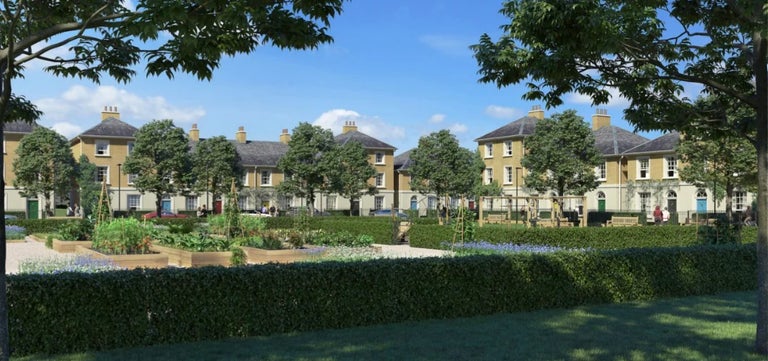
Provision of gardens needs to be central to UK housebuilding targets to ensure liveability of Government’s 1.5 million new homes

Compiled by leading scientists and horticulturists, the RHS State of Gardening Report 2025 is the first in-depth look at gardening’s impact on health, communities, the economy and the environment
A new report has mapped the UK’s gardens* – domestic, public and private – and the people inspired to grow in them, for the first time.
The RHS State of Gardening 2025 paints a picture of a hugely popular practice already benefitting people and planet, but with the potential to reap far greater environmental and societal reward if better understood, recognised and supported by policymakers.
The RHS, working in collaboration with Gentian, assessed ultra-high resolution satellite imagery and used AI and machine learning algorithm technology to provide precise insights into cultivated green space across Britain. This included form and function, such as number of trees, ponds and ground cover.
Researchers plotted 25.8 million gardens in Great Britain, amounting to 959,800 hectares or 4.6% of the total land area. The provision of gardens and green space varies across the UK, with 41% of London’s total area categorised as garden, compared to just 27% of Cardiff, 25% of Edinburgh and 19% of Leeds.
Of the 25.8 million total gardens in Britain, 20.6 million are domestic gardens (front and/or back), accounting for 502,757 hectares.
The mapping found that:
Accompanying RHS polling also reveals the number of adult gardeners – defined as those who garden at least once a month – to be 34 million*. Of those that said they hadn’t gardened in the last 12 months, more than a third (38%) cited not having access to an indoor or outdoor space.
"The inequality in access to growing space in the UK reinforces the need for garden provision in the 1.5 million new homes promised by Government"
The State of Gardening and accompanying Space to Grow: Realising the potential of the community gardening movement reports also found:
Across the UK, 2.5 million adults have gardened in their community in the last three years. 14.7 million more people said they were interested in gardening in the community, with two fifths of community gardening groups (47%) reporting an increase in volunteer numbers. But, over half of groups (56%) fear for their viability, with more than a quarter (30%) surviving on budgets below £500 per year. Just 3% own their own land.
This is in spite of the majority of community gardens saying they exist to bring their community together (85%), benefit participants’ physical (80%) and mental (79%) wellbeing, and encourage enjoyment of gardening (79%). Improving and wildlife habitats (76%) and creating cleaner, greener or more attractive surroundings (71%) were also important motivations for many community gardeners.
To maximise the benefits of cultivated green space and protect them for the future, the RHS is urging:
Clare Matterson, RHS Director General, said: “Gardens are the most important touchstone to nature, fostering an active engagement with and understanding of plants and wildlife.
“The lack of equality in access to growing space in the UK reinforces the need to shore up garden provision in the 1.5 million new homes promised by Government this Parliament. It also demonstrates the need to ring-fence space, and increase support and funding for the community growing spaces that should be considered an infrastructural basic.
“For too long, the reach, impact and potential of gardens has been largely overlooked. Understanding the who, what, where and why of gardening is a crucial step towards the RHS, partners, and local and national Government helping to build more resilient and sustainable places.”
The State of Gardening will be repeated every three years, enabling the public, industry and policymakers to track the size and shape of cultivated garden space and engagement with it over time. The findings will also inform RHS outreach activities from 2026.
Read the full State of Gardening report and theassociated Space to Grow report.

*Spaces mapped as part of the RHS State of Gardening report and referred to as cultivated garden space are: domestic private gardens, allotments, public parks/community gardens/undefined gardens, botanical/heritage/private gardens, gardens and fields linked to education institutions, and gardens linked to business or commercial properties.