10 ways to save the planet while gardening
Gardening, and how we garden, can make a positive difference to several of Earth’s biggest challenges. Here’s how to garden sustainably

How to make a bee hotel and more: five simple features to make any outdoor space a refuge for native bees and help declining populations
Did you know that the UK is home to around 270 species of wild bee? The vast majority of the UK’s buzzers are solitary bees, accounting for over 240 species. Then there are 24 bumblebees, and one species of honeybee, though most of the UK’s honeybees live in colonies managed by humans.
While honeybee hives can be useful for ensuring local crops are , the best ways to help wild bees don’t involve installing hives – these only support the one honeybee species, which at a local scale can be present in such large numbers that they actually compete with wild bees for food.
Rather than using hives, wild bees nest in holes, burrows and cavities in trees, walls, the ground and more, depending on species. Make sure there are plenty of plants for pollinators around so that everyone’s well fed, then try creating some of these easy wild bee habitats in your garden, school, park or community space to support our declining native bees.

It’s easy to make a simple DIY bug hotel that’s specially designed for native solitary bees. The beauty of this design is that you don’t need a garden or even any outdoor space – just a wall or fence to hang it on – but it’s also a great addition to community spaces such as schools and parks.
A simple model like this may need to be replaced every few years as all the holes fill up.

Don’t fancy making your own?Buy one here from RHS Plants. This model can be taken apart when needed to clean out old debris from the holes.

If you have any fenceposts or dead tree trunks in your garden, you could simply drill some holes in these instead, to the same spec as above. Alternatively, you can install a drilled post, such as a reclaimed fence post, in a border or wildlife area and make it a design feature. Again, ensure the wood hasn’t been treated with anything other than heat and that holes are drilled as smoothly as you can.

You can spot bee posts in the Clover Hill borders at RHS Garden Hyde Hall. “These are reclaimed fence posts that had been used elsewhere in the garden and had become bent,” says horticulturist Sarah Wilson-Frost. “I drilled various size holes into them, 2-10mm across and 10-15cm deep. I placed three of them in the border in a staggered way that draws the eye through to the gazebo beyond. There was interest within three days and by two weeks later, holes were inhabited. Build it and they will come.”
Leave room in the post for drilling new holes as they gradually fill up, or expect that you may need to replace the post every few years.


If you don’t fancy drilling holes, another option is to cut bamboo canes into lengths and tie these into bundles. This is another feature that doesn’t require any outdoor ground space – just a sunny wall, fence or tree to hang it on.
Check that your bamboo sections are hollow down the centre, and again take care to smooth off any rough cut edges.


In a sunny spot, leave a patch of soil bare or mostly bare to allow it to become a nesting site for ground-nesting solitary bees such as mining bees. Sandy soil is especially popular, as it’s easy to burrow into.
Look out for little holes and cones of soil appearing – a sure sign residents have moved in – and try to avoid disturbing these, even if they pop up in the lawn!


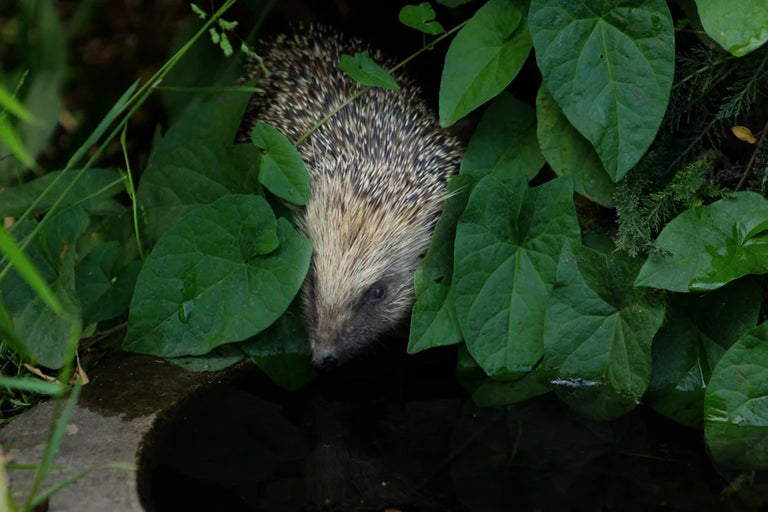
Set aside an area of your garden that you can allow to become wilder and the lawn to grow long – even if it’s only a small corner. This will benefit a wide range of wildlife, from butterflies to hedgehogs, but it could also provide the perfect nesting opportunity for ground-nesting bumblebees. As well as digging burrows of their own, they’ll often reuse old mouse holes.
No space is too small – a single square metre of long grass is enough space for a bumblebee to make a nest. Of course, the more space you can spare, the more habitat you’ll provide for all the wildlife sharing your garden.

See how many of these easy habitat features you can add to your outdoor space to make it a haven for bees. Don’t forget to add some plants for bees if you can, then sit back and enjoy watching to see who moves in!
Download the RHS Grow app to see how many wildlife-friendly gardening badges you can collect for your outdoor space.
About the author – Olivia Drake
With a background in biology, Olivia is passionate about sustainable horticulture and the role gardening can play in conservation. She is professionally trained as a botanical horticulturist and has worked in public gardens around the UK and abroad.