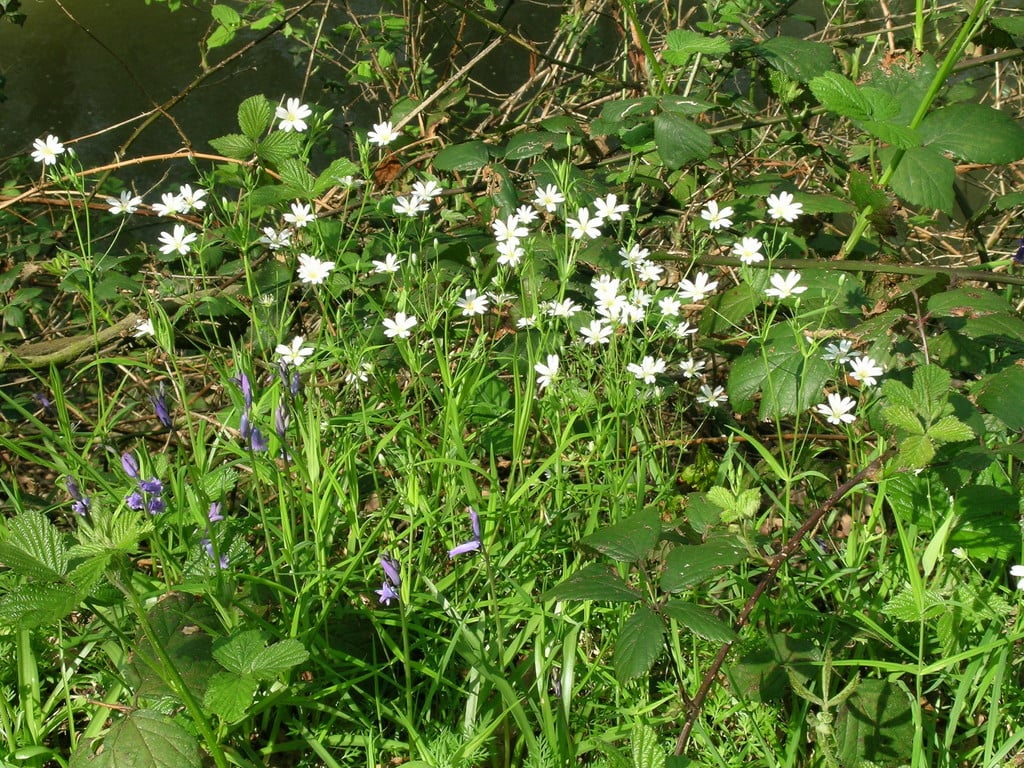
Stellaria holostea

RHS Plant Profile
greater stitchwort
greater stitchwort RHS

Other common names

adder's meat, ag-flower, ag-worm flower, all-bone, bird's tongue, break-bones, devil's corn, devil's eye, Easter bells, greater starwort, lady's lint, lady's white petticoat, Latin flower, little John, May grass, miller's star, moonflower, satin flower, snake flower, snake grass, snap Jack, snappers, snap-stalks, starflower, thunder flower, tongue grass

Herbaceous Perennial

A perennial that reaches around 50cm in height. Stems are brittle, leaves are grass-like and both are rough-edged and greyish-green. White flowers, with five deeply-notched petals, are borne in spring and early summer, followed by seed capsules that make a popping sound when ripe

Position

Partial shade

Soil Types

Chalk, Clay, Loam

Max Height

0.5-1 metres

Max Spread

0-0.1 metre

Size

Time to Maturity
2–5 years
Max Spread
0-0.1 metre
Max Height
0.5-1 metres

Growing Conditions

Chalk Clay Loam
Moisture
Moist but well–drained
pH
Acid or Neutral

Position

Partial shade
Aspect
South–facing or West–facing or East–facing
Exposure
Exposed or Sheltered
Hardiness
H7

RHS Recommended: for People & Planet

Growing conditions for maximum benefit

This plant will provide the maximum benefits if it is healthy and allowed to grow to maturity

For Bio-Diversity

  • Plants for Pollinators

Colour & Scent

Season Stem Flower Foliage Fruit
Spring
Summer
Autumn
Winter

Botanical Details

Family
Caryophyllaceae
Native to GB/Ireland
Yes
Foliage
Semi evergreen
Habit
Clump forming
Genus
Stellaria can be annuals or herbaceous perennials, with slender stems bearing simple, opposite leaves and terminal cymes of white flowers with 5 deeply notched petals
Name Status
Correct
Plant Range
Europe, N. Africa

How to Grow

Cultivation

Prefers moist, mildly acidic infertile soils. Occurs in woodland and hedgerows in semi-shaded sites

Propagation

Propagate by seed

Suggested planting locations and garden types

  • Wildlife gardens
  • Wildflower meadow

Pruning

No pruning required

Pests

Generally pest-free

Diseases

Generally disease-free