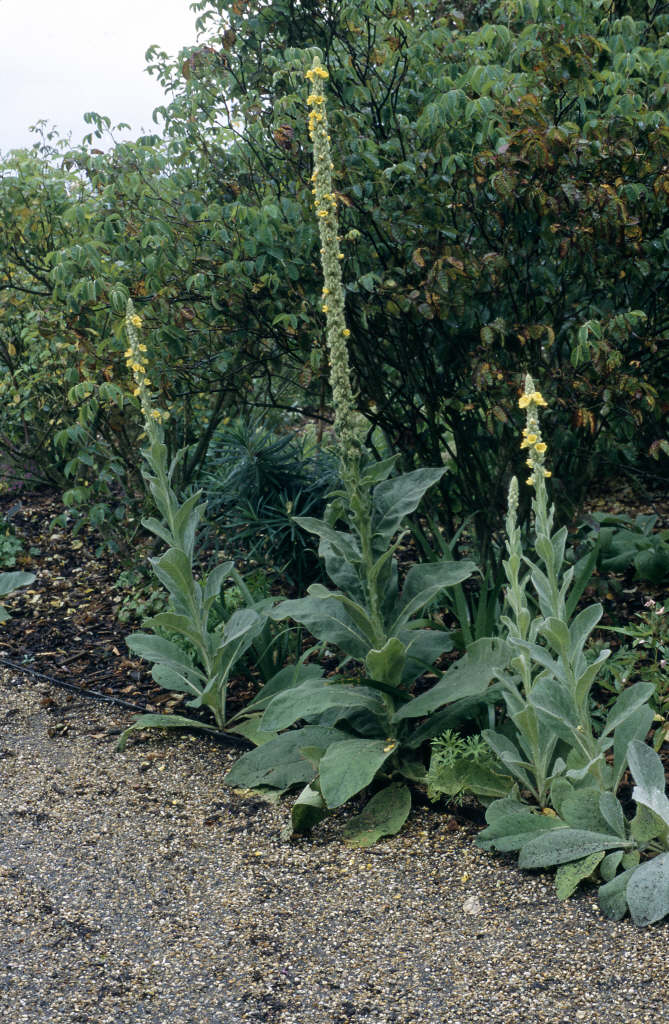
Verbascum thapsus

RHS Plant Profile
great mullein
great mullein RHS 2002

Other common names

Aaron's rod, ag leaf, beggar's blanket, blanket leaf, bullock's lungwort, candlewick, clown's lungwort, common mullein, cow's lungwort, duffle, feltwort, flannel, flannel leaf, flannel plant, fluffweed, hag taper, hag's taper, hare's beard, hedge taper, high taper, Jupiter's staff, king's taper, lady's candles, lady's foxglove, light of the Lord, lucernaria, mullein dock, old man's flannel, rag paper, shepherd's club, torch lily, torches, velvet dock, velvet plant, white mullein, woollens, woundweed, Adam's flannel, felt, Jacob's staff, lamb's wool, velvet leaf

Plants for pollinators
Annual Biennial

Tall grey or white-woolly biennial up to 2m in height, forming a rosette of large mid-green leaves to 50cm long in its first year, with a stout, upright, woolly stem bearing a succession of light yellow, saucer-shaped flowers 3cm across in the summer of the second year

Position

Full sun

Soil Types

Chalk, Loam, Sand

Max Height

1.5-2.5 metres

Max Spread

0.1-0.5 metres

Size

Time to Maturity
2–5 years
Max Spread
0.1-0.5 metres
Max Height
1.5-2.5 metres

Growing Conditions

Chalk Loam Sand
Moisture
Well–drained
pH
Alkaline

Position

Full sun
Aspect
East–facing or South–facing or West–facing
Exposure
Sheltered
Hardiness
H6

Colour & Scent

Season Stem Flower Foliage Fruit
Spring
Summer
Autumn
Winter

Botanical Details

Family
Scrophulariaceae
Native to GB/Ireland
Yes
Foliage
Deciduous
Habit
Clump forming
Genus
Verbascum can be annuals, biennials, perennials or subshrubs mostly with hairy leaves and 5-petalled, saucer-shaped flowers
Name Status
Correct
Plant Range
Eurasia

How to Grow

Cultivation

Suitable for herbaceous border and gravel garden. Grow in poor alkaline well-drained soil in full sun

Propagation

Propagate by seed or division in spring

Suggested planting locations and garden types

  • Cottage and informal garden
  • Wildlife gardens
  • Wildflower meadow
  • Flower borders and beds

Pruning

No pruning required

Pests

May be susceptible to caterpillars and figwort weevil

Diseases

May be susceptible to powdery mildews