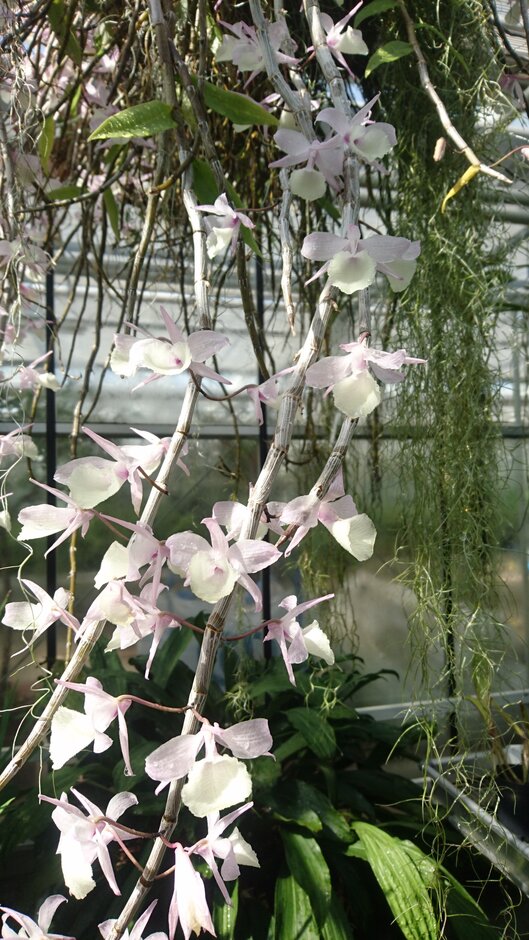
Dendrobium aphyllum

RHS Plant Profile
hooded orchid
hooded orchid Valeria Valkova

Synonyms

Dendrobium pierardii

Conservatory Greenhouse

A large-sized, deciduous, epiphytic orchid with pendulous, cane-like stems, 60-80cm long and 0.5cm thick. Each noded stem carries alternate, bright green, glossy, lance-shaped leaves, 6-8cm long and 2cm wide. Short flowering stems, carrying one to three flowers, appear from the nodes along leafless stems in winter and spring. Each flower is approximately 4cm large, fragrant and fairly short-lived. Petals and sepals are usually pale pink, with large, rounded, or slighly pointed white lip, with hairy edge.

Position

Full sun, Partial shade

Max Height

0.5-1 metres

Max Spread

0.5-1 metres

Size

Time to Maturity
5–10 years
Max Spread
0.5-1 metres
Max Height
0.5-1 metres

Growing Conditions

Moisture
Well–drained
pH
Neutral

Position

Full sun Partial shade
Aspect
East–facing or West–facing or South–facing
Exposure
Sheltered
Hardiness
H1A

Colour & Scent

Fragrance Flower
Season Stem Flower Foliage Fruit
Spring
Summer
Autumn
Winter

Botanical Details

Family
Orchidaceae
Native to GB/Ireland
No
Foliage
Deciduous
Habit
Clump forming, Pendulous weeping
Genus
Dendrobium are epiphytic and terrestrial orchids with elongated, stem-like pseudobulbs bearing linear to ovate leaves. Racemes or panicles of showy flowers are produced from nodes along the stems mainly in spring
Name Status
Correct
Plant Range
SE Asia

How to Grow

Cultivation

Plants are best grown in basket or mounted on cork bark or wood if grown in conditions where sufficient humidity can be provided during the growing season. Grow in an epiphytic, medium grade, bark-based potting mix with added perlite, moss, or coir. As with many orchids, they grow best when the roots are slightly restricted. Therefore, avoid over-potting or frequent root disturbance. Provide bright, filtered light throughout the year. Plant requires frequent watering and relatively high humidity during summer months and a period of rest in winter - reduce watering and feeding in October, until warmer temperatures initiate flowering and new growth in spring. See indoor orchid cultivation

Propagation

Propagation by seed is only possible in controlled laboratory environment. Mature plants may be divided when the plant overgrows the pot. Sideshoots (keiki) may develop on older canes - remove and pot them into sphagnum moss when the new roots are at least 2cm long.

Suggested planting locations and garden types

  • Houseplants
  • Conservatory and greenhouse

Pruning

No pruning required. Remove spent flowers as necessary, but do not cut the whole cane unless completely shrivelled. Oldest canes may be removed as long as there are at least three, younger, thick, leaf-bearing canes on the plant.

Pests

May be susceptible to scale insects, aphids, mealybugs and red spider mite.

Diseases

Generally disease-free.