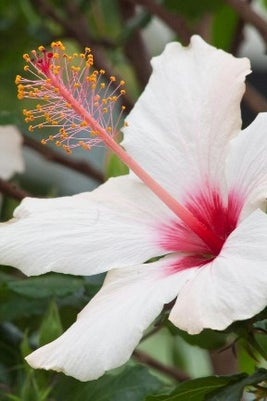
Hibiscus rosa-sinensis

Tropical hibiscus is native to China but widely grown throughout the tropics and subtropics where it can be tree-like. It is tender in Britain and is grown as a pot plant indoors where it may reach 2m (6½ft). Although widely grown as houseplant it can be tricky to manage in a dwelling. The large showy blooms only last a day or two but in a warm, bright greenhouse or conservatory plants will flower over an extended period.


Hibiscus rosa-sinensis 'Apple Blossom' RHS/Carol Sheppard

Quick facts

Common name - Tropical hibiscus, rose of China, Hawaiian hibiscus

1

Botanical name - Hibiscus rosa-sinensis

2

Group - Evergreen houseplant for warm greenhouse or conservatory

3

Flowering time - May to October

4

Planting time - April

5

Height and spread - May reach 2m (6½ft)

6

Aspect - Bright, filtered light

7

Hardiness - Tender minimum 7-10ºC (45-50ºF)

8

Difficulty - Moderate

9

Cultivation notes

Hibiscus requires bright, humid conditions with good , protected from direct sunlight and a minimum night temperature of 7ºC (45ºF). Plants can be placed outdoors in summer but need to be brought indoors before temperatures drop below 12ºC (59ºF).

Spring and summer

  • Re-pot in February or early March using a peat-free, ideally one formulated specifically for houseplants. Soil based such as John Innes No 2 are also suitable
  • Increase watering as the increasing light levels and temperatures stimulate growth
  • Begin feeding weekly with a balanced liquid fertilizer for house plants, about six to eight weeks after re-potting

Overwintering

  • A warm, humid glasshouse with minimum night temperatures of 7-10ºC (45-50ºF) is ideal, but a warm conservatory or south-facing windowsill will suffice
  • Avoid placing plants near open fires, radiators or draughts and move away from windows in frosty weather
  • Increase by placing the plant on a tray containing damp gravel or clay pellets. Plants can be grouped together to maintain a humid microclimate
  • Reduce watering as growth slows and only water when the top layer of compost is dry. Cease feeding
  • In cool conditions plants will overwinter in a semi- condition

Pruning and training

Plants can be kept small and bushy with regular pruning and may live for up to 20 years.

  • Shorten the previous season’s growth in February or early March to leave a framework from which new flower-bearing shoots will develop. Stronger growth can be reduced to 4-7 cm (2-3in) from the base
  • Remove thin unproductive shoots and prevent overcrowding
  • Trim the tips of young plants to encourage bushiness

Propagation

Softwood tip cuttings or semi-ripe cuttings taken in late spring or early summer, root readily;

  • Dip 7-10cm (3-4in) long in and insert into trays or pots of sandy cutting
  • Ideally use a , although placing pots within plastic bags in warm windowsills can be effective
  • Provide bottom heat of 24-27ºC (75-80ºF) and high to encourage rooting in about two weeks
  • Pot rooted cuttings in 9cm (3½in) pots and leave undisturbed over winter

Cultivar Selection

Unfortunately houseplants are not reliably listed in the RHS Plant Finder, as stocks offered in garden centres tend to be sourced abroad making it difficult to identify availablity. Also the range of available Hibiscus rosa-sinensis cultivars is continually changing with new introductions, so it is difficult to make recommendations.

For a form, consider Hibiscus rosa-sinensis ‘Cooperi’ (v) AGM, a compact plant with heavily marbled olive-green and white leaves, sometimes tinted pink and bearing red flowers, height 1-2m (3-6ft)

RHS Find a Plant

Problems

Generally trouble free but may suffer from common glasshouse pests such as aphids, red spider mites and glasshouse whitefly.

Flower and leaves turn yellow and drop in winter when light levels are low indoors but plants can survive in this semi- state if watering is reduced.

RHS Guides, you may also like