
Why gardening makes us feel better – and how to make the most of it
Gardens can be great for the environment and for wildlife – and they’re good for people too, according to an increasing body of research

Anyone with a garden knows that plants and nature improve your mood. As spring arrives, Zia Allaway speaks to three people about how being outside helps with their wellbeing
Adam Frost has won seven Gold medals at RHS Chelsea Flower Show and is co-presenter of BBC Gardeners’ World. He’s also an RHS Ambassador and author of RHS books The Creative Gardener and How to Create Your Garden.
"Gardens improved my wellbeing from a very young age"

“My earliest memories are of gardening with my grandparents and feeling safe and calm in their gardens when my home life was quite volatile. I’m dyslexic, and struggled at school, but both my grans gave me the freedom and confidence to achieve success, whether it was dropping a leek into a hole and watching it grow, or planting seeds and seeing them sprout. Gardens helped to improve my wellbeing from a very young age and influenced my choice of career when I left home at 16 to work for the North Devon Parks Department. I have fond memories of that time and am grateful to the old fellas who guided me. I then got a job at Barnsdale with the late Geoff Hamilton, the much-loved presenter of BBC Gardeners’ World, who was working in tune with nature and wildlife back in the ’80s and ’90s. Geoff gave me my gardening moral compass and introduced me to eminent garden designer David Stevens, who taught me about design.

“After Geoff passed away in 1996, I set up a design and build company, working mainly for David Stevens. Then I built Sir Terence Conran’s Peace Garden at RHS Chelsea Flower Show 2005, and a year later, I won my first of seven Chelsea gold medals. TV interviews there led to work as a presenter and ultimately to co-hosting Gardeners’ World.
“More recently, I’ve been designing hospital gardens that focus on improving the wellbeing of patients and staff. Mrs Frost was in hospital for many weeks during the pandemic so I’m acutely aware of how hard NHS staff work and that getting out into nature offers a way to relax and recuperate. The Wellbeing Garden at University Hospital Lewisham, London, was a joint project with the RHS that transformed an overgrown space by the Mental Health Unit into a calm, green oasis. After asking lots of questions I distilled the staff’s experiences and needs to create a garden that would bring people together and everyone could enjoy. We included quiet spots to sit and reflect, areas to bring patients outside for therapies and space to grow edibles.
“I’m still finalising plans for the garden at Colchester Hospital, Essex, which will include curved paths, plenty of seating, areas and a dry garden with boulders and rocks. Both hospital gardens are a thank you for the support the NHS has given my family in these tough times.
“I think of gardening as ‘moments’ that make me happy. They could be sitting in a sheltered spot in the cool shade of a tree in summer, or walking through a winter garden enjoying the beautiful tree and brown seedheads. The views from the windows in a house are particularly important, connecting us with nature even when we’re indoors. I’ve designed these spaces in my own home and in gardens for others using a range of , perennials, berried shrubs and evergreens that hold the interest through the seasons, so that each day brings a little joy.”
Adam’s year of wellbeing
Get your hands dirty
“I’m never happier than when my hands are in the soil. Mulching your beds with a thick layer of composted bark or rotted manure in spring sets you up for the seasons ahead.”
SummerMake a holiday pot
“Create a few pots with plants that remind you of places that bring back happy memories. My holiday pots of aeoniums and dahlias remind me of my gran who loved Gran Canaria.”
AutumnPlant the promise of new life
“I love planting spring bulbs, with their promise of flowers to come. I pot up alliums, camassias and tulips, then plant them out in spring.”

Ozichi Brewster works at RHS Garden Bridgewater, using nature to help a wide range of people improve their wellbeing.
"I support people who’ve been prescribed gardening therapy"
“My early childhood was spent in a village in Nigeria, where we grew our own food and I spent all my time outdoors. When I was 10 I moved to South London, which was a huge cultural and emotional shock and the garden became my refuge.
“In my early 20s I moved to Somerset for a job at the Paddington Farm Trust, working the land with people suffering from addictions and mental health problems. I’ve also worked for Women’s Aid, and then Advocacy for Croydon, supporting those with mental health issues through the legal system. That role was extremely stressful and after 15 years I felt burned out and knew I needed to get back to nature.
“Combining my experience in mental health and gardening, I support those who’ve been prescribed green therapy by their GP or have been nominated by organisations such as Age UK and Childline. There are many benefits, but most people find the endorphins released when outdoors improves their mood.”
Ozichi’s year of wellbeing
Sow seeds of hope
“For a sense of relaxation and calm, sow a few sweet peas or tomatoes, to plant out in warmer weather.”
SummerMake a productive plot
“Direct-sow more veg – try carrots, beetroot and salad leaves – for more harvests to look forward to later.”
AutumnReap the rewards
“It’s therapeutic and reassuring to pick the crops you’ve grown, and reflect on how plants close down for winter, only to come back to life next spring.”

Katy Lee is a forest bathing specialist, yoga teacher and natural mindfulness guide.
"The idea of forest bathing immediately connected with me"
“My background is in dance, specialising in outdoor performances, and I’ve always loved working in the natural environment. After I had children, I took up yoga as a way to keep fit between dance projects and enjoyed it so much I decided to train as a teacher. My husband Vince is a furniture maker and our journey into forestry and conservation began in 2008 when we bought Courage Copse woodland in Devon. We then moved on to the woodland site in 2012 and set up our company Courage Copse Creatives. Living in the woods is a wonderful experience – the trees provide raw materials for Vince’s work and allow me and our girls to be more in touch with nature.
“When I was introduced to the Japanese practice of shinrin-yoku, also known as forest bathing, the idea immediately connected with me because it combines the mindfulness of yoga with the woodlands that I love. It’s based on research sponsored by the Japanese government in the 1980s, which aimed to reduce the time people were taking off work due to stress. Dr Qing Li undertook extensive research studies and discovered that walking in a park or woodland for two hours once a month helped to lower stress levels and improved the overall wellbeing of those involved.
He also found that trees emit airborne chemicals called phytoncides, which protect them from insect attacks and possess antibacterial and antifungal qualities that help them fight disease. When we’re exposed to phytoncides, they appear to have an anti-inflammatory effect, helping reduce stress and anxiety. Conifers give off more phytoncides than broadleaf trees and we have a good selection of both here. “I run sessions in our woods and at RHS Garden Rosemoor. Unlike just going for a walk in nature, where your mind may be skipping between the shopping list and picking up the kids, forest bathing is more like meditation with your eyes open. It requires you to be present in the moment, and to really look at the leaves, flowers, grasses, birds and insects around you. However, unlike meditation, where you’re trying not to be distracted, in shinrin-yoku your mind is allowed to wander when a bird, for example, flies by and you follow it to see what it’s doing. The key is to focus on the plant or creature in that moment, but not mull over things in the past or worry about the future.
“One of my favourite ways to de-stress is to go to my ‘sit spot’. In this special place in the woods I simply sit and allow all my senses to engage with the natural world around me, be that listening to a bird singing, watching a bee on a flower, or taking in the earthy scent of the forest floor, while also noticing what’s changed since my last visit. I try to be in the present, but if a thought naturally bubbles up – maybe the smell of mud reminding me of my grandmother gardening – I let it take me momentarily on that emotional journey. You can do this too in your own garden, or any green space, to help you unwind. The only challenge for gardeners is not to be tempted to snip off a dead flowerhead or pull out a weed they spot, but simply to notice their form and beauty.”
Katy’s year of wellbeing
Go outside and see
“Look at the beauty around you in your garden or local green space. See the catkins developing on hazels or willows. Watch leaf buds unfurling on trees and feel how soft they are, even young holly foliage.”
SummerNotice the deepening colours
“After the summer solstice, colours take on more depth and tiny fruits start to emerge on the leaf-laden trees. Lighten your mood by taking time to appreciate these changes and feeling the warm sun on your skin.”
AutumnCrunch through fallen leaves
“Embrace the soft diffused light of autumn, the crunching of dried foliage underfoot and its earthy smell, and hear the changes in birdsong as robins become more territorial after nesting.”
The RHS is using the Wellbeing Garden at RHS Garden Wisley to conduct studies into how and why gardening improves people’s moods

The Wellbeing Garden was designed by award-winning designer Matt Keightley in collaboration with RHS Wellbeing Fellow Dr Lauriane Chalmin-Pui, the curatorial team at Wisley and experts in neuroscience and mental health. Matt says: “Visitors can now experience a range of different features, such as reflective pools, fountains and a variety of plants, to explore their emotional reactions to them.”
Lauriane and PhD student Bethany Harries have also compiled a list of elements to improve mental health. “Plants with a diversity of colours, textures, scents and shapes have a positive effect on mood by stimulating all the senses – just avoid toxic or allergenic plants if you want to touch them,” says Lauriane. She recommends features that bring a sense of peace and tranquillity. “Soothing sounds of gently flowing water, tall grasses rustling in the breeze, or even wind chimes help foster serenity, while adding plants that provide food for birds (or a bird feeder) brings in restorative birdsong.”
Including more invigorating areas is helpful, too, so you can retreat to the spot that suits your mood. You can do this even in a small space with plants, colours and structural elements.
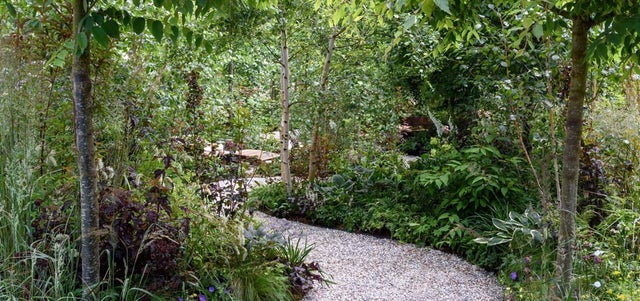
The RHS Wellbeing Garden also encourages exploration, which Lauriane says “invokes curiosity and surprise, with its meandering pathways that are accessible to people of all ages and abilities, allowing you to wander at your own pace.”
Lauriane also suggests including elements that are culturally significant to your family. Heirloom plants that remind you of grandparents, colours that symbolise a homeland or a memorial tree to commemorate a person or place evoke fascination, belonging and a sense of safety and familiarity.
Experimenting with these ideas and features helps you see which brings you the most enjoyment. You can also take part in the ongoing research into how natural sounds, smells and colours affect our moods at the Wellbeing Garden and Hilltop Atrium at Wisley.
This page is an adaptation of an article published in the March 2024 edition of The Gardenmagazine, free to RHS members every month when you join the RHS.
About the author - Zia Allaway
Zia is a horticulturist, journalist and author of a number of RHS books.