
Daffodil days at RHS Partner Gardens
The cheerful sight of golden daffodils is a welcome prelude to warmer spring days. Many RHS Partner Gardens put on jubilant displays and organise dedicated events. Here are a few you might like to visit

Rare old daffodil found in a plant pot now thrives in village churchyard
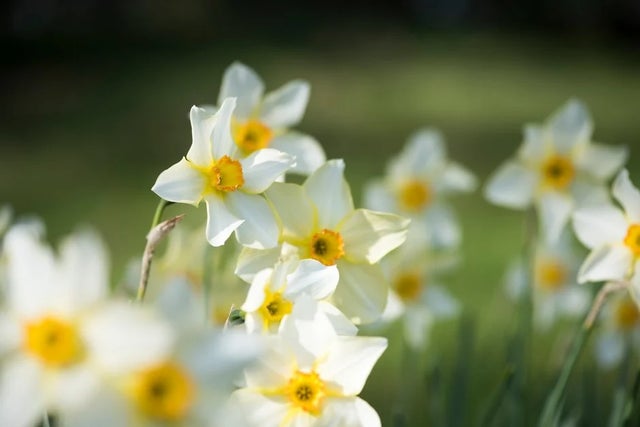
Narcissus‘Weardale Perfection’ is a daffodil with an elegant bi–coloured, lemon–yellow trumpet and a creamy ivory perianth. It stands proud and tall on sturdy stems with larger, long–lasting flowers that can weather April winds.
In the Victorian era, it was a daffodil set apart from the rest. Its arrival marked a turning point in breeding as the first known tetraploid daffodil. A tetraploid has four sets of chromosomes, so tends to be more robust, larger and more vigorous than early diploid and triploid cultivars. Its genetics made it a great breeding parent‚ and so ‘Weardale Perfection’became the ancestor of many of the successful daffodils we see today.

The Victorians widely admired and prized it in their gardens and shows, and it commanded extraordinary prices, regularly appearing in nursery catalogues. William Backhouse II, a Quaker banker and pioneering daffodil hybridist in the mid–19th century, raised large, vigorous cultivars such as Narcissus ‘Emperor’ and ‘Narcissus ‘Empress’.

But Victorian daffodil fever meant that the last century was marked by endless new daffodil introductions – over 31,000 cultivars. As generations of gardeners embraced newer hybrids, ‘Weardale Perfection’slowly vanished from commercial circulation, eventually dropping from nursery lists and disappearing from most collections by the 1930s.
Weardale Perfection was nearly lost, until one man turned that around.
Dr David Willis, an internationally respected authority on Narcissus‚ developed the Guy L Wilson Daffodil Garden at the University of Ulster between 1973 and 1984. The collection had gained National Plant Collection and National Heritage Garden status and he’d spent 30 years working on a book entitled Yellow Fever, considered the comprehensive resource on daffodils.

So when the Weardale Societyembarked on a millennium project to save the lost daffodil in 1998, David seemed to be the man to track this lost botanical treasure.
He set about tracking down the daffodil with initial searches proving fruitless until one crucial lead: a single mixed tub of old from the garden of a retired district nurse‚ Jessie Young‚ in Wolsingham, County Durham, a town close to the daffodil breeding Backhouse families’ old estate, St John's Hall.

“How Jessie Young may have acquired ‘Weardale Perfection’ was unknown to me when I identified the plant in the pot,” said Dr David Willis.
“What I later discovered was that when she retired‚ she used to look after the Bonas offspring at Bedburn Hall in Teesdale. She also helped in the garden and admired some daffodils growing by the lake and was given some by the owner of the Hall‚ Mrs Bonas. Apparently, the Hall was a meeting place many years ago for a group of local Quakers who would gather there for Sunday lunch. One was Charles James Backhouse who brought a gift of ‘Weardale Perfection’bulbs requesting they be planted where he could see them on subsequent visits and so they were planted by the lakeside where it fringes the entrance drive.”
“Jessie Young planted the bulbs in her garden and the next owner of the house, Sarah Stephenson lifted bulbs from the garden for the planter and luckily one was ‘Weardale Perfection’.”

Sarah Stephenson allowed David to take the planter back to his home near York. While disappointingly there was no sign of ‘Weardale Perfection’ in 1999, a single flower did appear in 2000 which matched with all Dr Willis's carefully compiled criteria for the missing cultivar.
“This was a breakthrough as we now had a provenance for the bulb, which I had identified as the true Weardale Perfection, it coming direct from the son of the breeder William Backhouse,” said David.
With painstaking propagation techniques, including twin–scaling (a method that encourages rapid bulbil formation from a single bulb), he increased the stock.
“By the year 2000, I had located a single bulb and with the single bulb, I had produced 538 bulbs by 2007. Of these, 450 were of flowering size. Approximately 215 were planted in the grounds of the Wolsingham parish church of St Mary and St Stephen in September of that year to coincide with the 200th anniversary of William Backhouse's birth. Another 188 were planted at 13 reserve sites to protect them.”
By 2007, hundreds of bulbs had been multiplied and those bulbs not planted in the grounds of the Parish Church were planted in several other recorded locations within Weardale as a conservation safety measure.
Since 2008 each Spring flowers of ‘Weardale Perfection’have emerged to bring joy to local residents and visitors.
Wolsingham historian Anita Atkinson said the daffodils now form the heart of the village: “No one can say for certain how many daffodils will flower this spring‚ but last spring, it ran into scores and scores – perhaps well over 200.”

“As to how local people feel when they see them‚ one lady said that as soon as she sees the ‘Weardale Perfection’, she immediately thinks of a lady who died several years ago, a retired history teacher who helped with the research into the lost flower. Another, who is of Welsh descent, said they made her think about her father’s late best friend‚ whom she admired very much.”
“The flowering of ‘Weardale Perfection’ seems to remind people of others whom they associate with the history of it.”
“I make a point myself of going into the churchyard to see them, to remember the Backhouse family, one of whom cultivated it and who gave so much to the local area. They really do make a stunning scene with the church as a backdrop.”
“A friend of mine who lives in Wolsingham and is noted locally for her interest in nature, especially birds‚ said that she also goes to see the daffodils in the churchyard and they always make her feel that new life and new beginnings are all around her.”
As the people of Wolsingham await the heralding of spring in their village each year, ‘Weardale Perfection’with its creamy bi–colour trumpets shows them it's arrived and that history is not lost.
Its bulbs have now been shared with botanical gardens and heritage collections, reintegrating this historic cultivar into the living tapestry of British horticulture.

David Willis said: “Keeping our plant heritage alive is important, with that of the daffodil being particularly so, because it happened relatively recently and we know so much about it due to the excellent records of their work left by many of the people involved.”
"I doubt any flower has a more interesting or romantic history than the daffodil"
For the past 15 years‚ David has advised Caroline Thomson‚ a direct descendant of the Backhouse daffodil dynasty which raised important daffodil cultivars over three generations and 100 years, on the development of the Narcissus Backhouse National Collection of Daffodils at Backhouse Rossie Estate in Fife, Scotland. The collection recently gained National Scientific status‚ becoming the world’s only scientifically recognised daffodil collection.
Backhouse Rossie is an RHS Partner Garden and can be visited by RHS Members on select days.