Dame Mary Berry on gardening
As her new book My Gardening Life is published, national treasure and RHS Ambassador Dame Mary Berry tells us why gardening has always been a constant in her life, the plants and tools she loves most, and how she still gardens in her nineties
You’re so closely associated with cooking, people may be surprised to see you’ve written a book about gardening. Why did you want to write it?
Gardening has been a constant throughout my life and this book is all about what it means to me. I have no training and a blank spot for the Latin names, but I have a passion for the great outdoors and the joy a garden gives. I’ve learned a lot from a lifetime of doing it. When I’ve been away, the first thing I do when I come home is go straight out there with my dogs Freddie and Darcey to do a bit of deadheading. Over the years I’ve found great solace in gardens. In another life I may have been a gardener rather than a cook.
Do gardening and cooking have things in common?
Well, gardening is quite different from cooking. With cooking, you get the result as soon as you’ve done it. So you decide you’re going to make a chicken pie, you do it, you see it finished, you enjoy it. Gardening is a totally different, you have to have patience. It doesn’t happen in a day, and it’s best not to rush it, but as a result the enjoyment is enormous. In cooking you can often salvage a mistake, but gardening can be infuriating because if you make one mistake – you’ll prick something out, then you’ll forget to water it – it’s dead and gone. There’s no coming back. You’ve got to follow the rules, which is more like baking. That’s a definite science. You have to be
accurate with your measurements, you have to be precise. There are rules for gardening, too – you need to give a plant the right soil, the right light, the right watering. You can ignore the rules, but they do help!
You’ve said you’d never be without your kitchen mixer. Do you have a garden tool equivalent?
Are there any weeds you do put up with?
When I was small, we had wild garlic growing in the garden. It was considered a weed and my dad used to try to get rid of it. Nobody tried to cook with it like we do now. Now, on woodland walks, the smell of it takes me right back to my childhood.
What else do you cook with now that you didn’t then?
I hear young nettles can be made into nettle soup. I made it once – no, thank you! And I gather you can use chickweed and dandelion when young. I mean, I guess you could, if you wanted to. There have been so many changes in what we grow and eat: Butternut squash wasn’t a vegetable when I was young, nor tenderstem broccoli. I don’t know why kale is so popular now when you could have a lovely sweet pointed cabbage instead. Though I have grown kalettes – a cross between kale and a Brussels sprout that has edible
What about cooking with flowers?
© Britt Willoughby Dyer![]()
Mary in the greenhouse‚ where she propagates pelargoniums‚ delphiniums and more
It sounds like you take gardening as seriously as baking. How have you learned to get things right?
Mary in the greenhouse‚ where she propagates pelargoniums‚ delphiniums and more
I learned from my mistakes. In the early days I didn’t have much confidence and we didn’t have a TV so I didn’t watch gardening shows but I was always asking and watching other gardeners, as well as reading. I learned a lot from my best friend Penny’s mum, who was an amazing gardener. But now, things have changed and it’s easier than ever to find out from the experts. When you want to know something, you can go straight to an expert on YouTube, if you’re clever enough to find it. Jekka McVicar is on there for herbs, or you can find Tom Stuart-Smith talking about his excellent designs. After I come back from the nursery with my new plants the first thing I do is look up online how to care for them.
In your book, you write fondly about some non-expert gardeners too, such as your dad, who also influenced you. What impact did he have?
Well my dad was a reluctant gardener really, but I can remember him collecting leaves from different trees and then we would learn about which tree they came from, which fruit they had and so on. When we went for a walk, there was always so much to learn from him about every wild plant and so forth. It was wartime, so very different to now – we had to make our own entertainment.
Have you passed on that love of the outdoors to your own children?
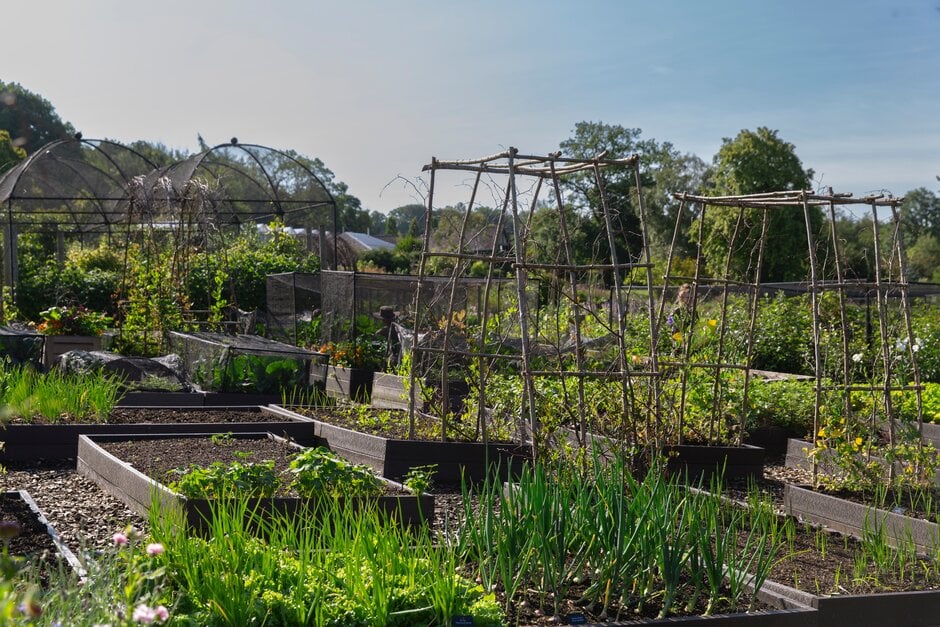
Raised beds and a greenhouse in Mary’s veg garden
William died tragically young in a car accident, after which you said you found some comfort in gardening. How did it help?
It happened on 21 January 1989, and at the end of that month a neighbour rang and invited me to go along to the RHS Chelsea Flower Show the following May. I didn’t want to go, but said “how very kind, I’d love to”. Anyway I’m so glad I went – it was a breath of fresh air. We were given many plants after William died – white-flowered Helleborus niger in particular, which was in bloom around the time. We brought them with us from our last house to this because I couldn’t part with them. I brought many plants from that house – such as Romneya coulteri, and Alstroemeria because they hold happy memories of Will.
After facing such difficulty, do you think gardening has helped keep you resilient?
I’ve always found that gardens are a great place for thought and finding peace. Whatever life may bring, being out in the garden usually makes me feel a bit better about it. It’s good to be outdoors and a huge enjoyment. Gardening is marvellous for health. At 90, I do have to be careful and I have help from our gardener, Kevin.
I don’t lift, I don’t dig, and we’ve got raised beds to make things a little easier, but I love pruning, trimming, I love doing my pots.
Whatever you do, if you’re outside in the garden, you feel good.