
5 top-performing dahlias to plant for pollinators
Discover award-winning dahlias and show garden stars to turn your outdoor space into a late-summer nectar bar
Dahlias really come into their own in August and September. Enduringly popular and endlessly versatile, they inject borders and sunny container displays with vibrant late summer colour, are perfect for picking, and even yield edible flowers.
But this classic cottage garden is also the RHS Wildlife Wonder Plant of the Month for August, meaning our wildlife experts have highlighted it as a top plant we can all grow to support .
With so many dahlias out there, in a myriad of shapes, sizes and colours, there’s one for everyone – but it can be hard to know which to choose. Here are five dahlias that provide for pollinators as well as being top garden performers.
What makes dahlias great for wildlife?

If you want a dahlia that will support pollinators as well as packing a punch in your garden, look for types with single or semi-double blooms. These are open flowers with just one or two layers of petals surrounding a fully visible yellow centre, indicating that unlike in elaborate, double-flowered varieties such as pompom and cactus types, the pollen and is still accessible to insect visitors.
These open-flowered dahlias are a magnet for butterflies, bumblebees and other pollinators, providing a top-up of pollen and nectar just when many summer-flowering plants are starting to fade.
Five fabulous dahlias to plant for wildlife
1. Dahlia 'Tangerine Gem'

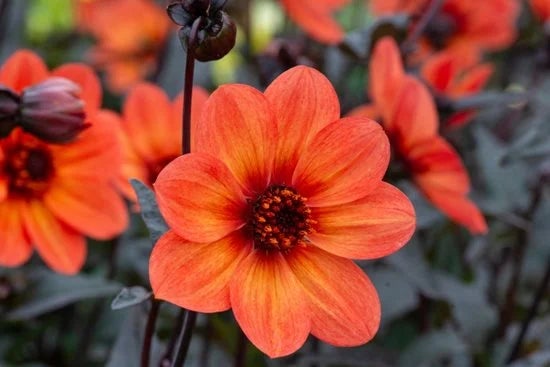
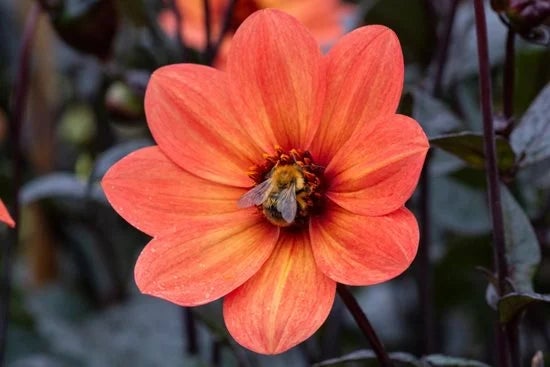
This striking dahlia, with trendy orange blooms that contrast magnificently with deep purple-bronze foliage, recently earned an RHS Recommended: Award of Garden Merit in the 2023–24 dahlia trials at RHS Wisley.
The judging forum said: “Star performer. Dark foliage complements the bright zingy orange blooms beautifully. Full and healthy habit, good proportions and colour contrast, long flowering season. Just stunning.”
Height: 75cm.
Find out more
2. Dahlia 'Sarah Raven'

This quirky dahlia, with slightly reflexed petals surrounding a large centre, is also a recent recipient of an RHS Recommended: Award of Garden Merit, impressing the judging forum in the 2023–24 trial.
They said: “Stunning. Open habit allows it to breathe and move beautifully. Ideal for delicate planting. Dark stems compliments foliage well and ideal for cutting! Gorgeous deep red and orange blend, unlike any other dahlia. Long flowering season. Unique – nothing similar on the market.”
Height: 90cm.
Find out more
3. Dahlia 'Hadrian's Sunlight'

Boasting dreamy peachy-apricot blooms offset by dark bronze foliage and holding an an RHS Recommended: Award of Garden Merit from a previous trial, this is a striking taller dahlia that’s perfect for the back of a border.
Height: 120cm.
Find out more
4. Dahlia Pretty Woman

There really is a dahlia for everyone – even if you only have a balcony or a front doorstep. Packing all the same punch as the taller varieties, with dramatic foliage and an abundance of pollen-rich blooms, this compact dahlia also has an RHS Recommended: Award of Garden Merit and is ideal for pots, containers and small spaces.
Height: 30cm.
Find out more
5. Dahlia merckii

A wild card! This delicate dahlia – which is a wild species from Mexico rather than a horticultural
A plant produced by crossing two distinct parents, often different species, to produce offspring that combine the characteristics of both. Hybrids can occur naturally, but crosses are often made deliberately by plant breeders to produce plants with better yield, improved flowering or vigour, or improved disease resistance.
– brings something of its own to the table in the form of exquisitely delicate single blooms, held aloft on wiry, reddish stems clad in fine foliage. It has a lightness and airiness that’s hard to find in hybrid dahlias, giving the plant a naturalistic feel and allowing it to fit into a range of planting styles. What’s more, Dahlia merckii is easy to grow from seed, and comes true if you collect your own.
Dahlia merckii was one of our star plants at RHS Sandringham Flower Show 2026. In The RHS Pollywiggle Garden, it was beautifully paired with matching pale lilac Veronicastrum virginicum ‘Lavendelturm’ and lilac-pink Achillea millefolium ‘Cerise Queen’.
Height: 150cm.
Find out more
Buy seed
Where and how to grow dahlias

Dahlias are equally at home in a traditional herbaceous border or a more modern scheme surrounded by ornamental grasses and textural foliage plants. Either way, they enjoy a warm, sunny, sheltered spot with free-draining soil.
Ideally, with organic matter such as homemade or leafmould, applied after planting and watering well. If growing in a pot, use peat-free compost with a saucer under the pot during dry summers.
Keep dahlias watered in dry spells with stored rainwater or household greywater, and deadhead regularly to keep the flowers coming. Though dead heads can sometimes look similar to buds, the dead heads have pointed tips, while buds are rounded.
Dahlias are tender perennials, so in colder areas, the tubers will need lifting and storing in a frost-free place over winter.
Other top wildlife plants for August
Our August Wildlife Wonder plants are all aimed at supporting butterflies. Alongside dahlias, see how many of the supporting cast you can also sneak into your outdoor space:
- Verbena (vervain) – Verbena bonariensis is one of the best – tall, airy stems of purple flowers last from summer into autumn and are regularly visited by butterflies, especially peacocks and red admirals.
- Phacelia (fiddleneck) – a quick and easy annual for filling gaps or bare soil, while feeding honeybees, bumblebees, solitary bees, hoverflies, butterflies and moths.
- Climbing Lonicera (honeysuckle) – scented forms are excellent for attracting pollinators such as long-tongued bumblebees and moths, as well as butterflies.
- Symphyotrichum (Michaelmas daisies) – bring masses of late colour and late food for butterflies, honeybees, bumblebees, solitary bees, hoverflies and other flies as summer tips towards autumn.
Add these to your garden to create a sugar-rich nectar bar that will help sustain butterflies through late summer and into autumn.